

It didn’t become part of vaccination programs in Africa until 2024.
What if it had come faster?
What if the shots had arrived
9 years ago?
143,000.
That’s how many children’s deaths could have been averted.
Stephanie Nolen interviewed more than 30 scientists, health officials and other key players in the development of the malaria vaccines to report this article.
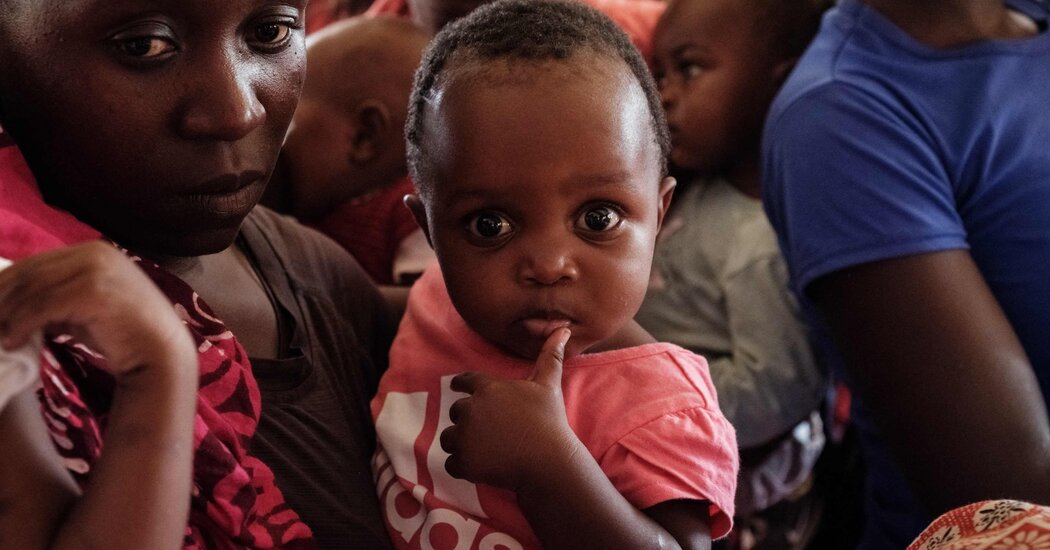
Nurses in countries from Sierra Leone to Cameroon are packing a new vaccine into the coolers they tote to villages for immunization clinics: a shot to protect against malaria, one of the deadliest diseases for children.
Babies and toddlers in eight countries in the region recently started to get the vaccine as part of their routine childhood shots. Seven other African countries are eagerly awaiting its arrival.
This is a milestone in global health.
But it’s also a cautionary tale about a system that is ill equipped to deliver critical tools to the people who need them most.
It took decades and at least a billion dollars to reach this point. Even now, only a fraction of the children whose lives are at risk will get the vaccine this year, or next year, or the year after.
It’s been clear for some time what went wrong, but almost none of those issues have been fixed. That means that the next desperately needed vaccine stands every chance of running into those same problems.
Take, for example, a new vaccine for tuberculosis that started clinical trials a few months ago. If it works as well as hoped, it could save at least a million lives a year. We’ll know by 2028 if it stops tuberculosis infections. But if it follows the same trajectory, it will be at least 2038 before it’s shipped to clinics.
“Children are receiving the vaccine, and for that, I am the happiest man in the world. But on the other hand, I cannot avoid being dismayed at this inexcusably long delay.”
— Dr. Joe Cohen, co-inventor of the first malaria vaccine
The U.S. Army started work on a malaria vaccine back in the 1980s, hoping to protect soldiers deployed to the tropics. It teamed up with the drug company GlaxoSmithKline, and together they produced promising prototypes. But the military lost interest after a few years, and that left GSK with a problem.
The people who desperately needed a malaria vaccine were in villages in sub-Saharan Africa. They would not be able to pay for a product that would cost millions of dollars to develop.
GSK needed an altruistically minded partner. It found one in the nonprofit global health agency PATH, and by the late 1990s they had a vaccine to test. The Bill & Melinda Gates Foundation put up more than $200 million to test it.
The clinical trials were complex, because this was a whole new type of vaccine — the first ever against a parasite — delivered to children in places with limited health systems. The process took more than a decade.
Finally, in 2014, results showed this vaccine cut severe malaria cases by about a third.
This was a successful result, but not as much protection as scientists had hoped to see. Still, GSK and PATH planned a production facility to make millions of doses. Gavi, the organization that procures vaccines for low- and middle-income countries, with funds from donors, would buy them.
Then the Gates Foundation pulled its support.
There was a shake-up in the malaria division, and the leadership reoriented toward a new goal: eliminating the disease.
The new malaria team said the vaccine didn’t work well enough to justify pouring millions more dollars into it. It would be better, they said, to wait for a more effective shot in the future, and in the meantime to fund other strategies, such as genetically modifying mosquitoes.
“If you go from very enthusiastic to very unenthusiastic and you’re the Gates Foundation, people pay attention.”
— Dr. Robert Newman, former director, Global Malaria Program, W.H.O.
The decision was driven by researchers who were looking at data. They didn’t factor in that the idea of a vaccine, even one with limited efficacy, would be so important to African parents — and African governments, which would come to see this as a classic example of a paternalistic donor ignoring their priorities. More than 300,000 children died of malaria that year.
The foundation’s announcement shoved the vaccine into limbo — in ways the foundation today says it did not anticipate.
“In hindsight, we could have communicated more often and more clearly about our decisions and listened more clearly to what the impact of those might have been on other institutions and their decisions.”
— Dr. Chris Elias, president of global development at the Bill & Melinda Gates Foundation
GSK and PATH tried to push the vaccine forward. The company submitted a 250,000-page dossier to the European Medicines Agency, which can approve products not relevant in Europe but of humanitarian benefit. In 2015, the agency said the vaccine was safe (with some issues it wanted GSK to continue to study), and PATH began hunting for new financial partners to replace Gates.
Then came a second shock.
The World Health Organization evaluates new vaccines to decide what’s safe and well made, so that countries and Gavi know what to order.
The malaria vaccine needed this sign-off, and since the European agency, a stringent regulator, had approved it, GSK and PATH assumed the W.H.O. would do so swiftly, too.
Two groups met to consider the vaccine for the W.H.O.: an external advisory committee that evaluates vaccines, and a panel of malaria experts.
The malaria specialists, who had seen African hospital wards full of children dying of the disease, said, “Yes, let’s go.”
But the vaccine experts said: No.
They argued that a small increase in cases of meningitis in children who got the shot hadn’t been sufficiently explained. If this small-chance issue turned out to be an actual problem, it could undermine African parents’ confidence in all childhood vaccines, with catastrophic consequences.
Second, they feared that countries might struggle to deliver the vaccine. It came in four doses, none delivered on the usual childhood immunization schedules; the last dose came a year after the third, and without it, the vaccine offered little protection.
In the end, there was a compromise: The W.H.O. announced what it called a pilot implementation, in Kenya, Malawi and Ghana, that would cost close to $100 million.
“I think that was the right thing. It meant a delay, which was unfortunate. But everyone, including GSK, knew a larger rollout was coming, and they should be ready. Did they act accordingly? I’m afraid not.”
— Dr. Pedro Alonso, former director, Global Malaria Program, W.H.O.
When GSK heard that instead of triumphantly shipping malaria shots to Africa, it would have to put the vaccine through another evaluation, executives ordered that the production facility and the vaccine ingredients be directed to more lucrative products.
“All the manufacturing plans that GSK had put in place were derailed. They stopped manufacturing because they did not want to continue to assume the risk of keeping a facility going for several years at huge expense for a vaccine that they weren’t sure was ever going to see the light of day.”
— Dr. Ashley Birkett, former director of the PATH Malaria Vaccine Initiative
Two years later, the W.H.O. had scraped together funding. GSK restarted a small production line to make enough of the vaccine for the study.
At Gavi, however, board members representing Africa were demanding answers.
When was Africa going to get a vaccine for malaria?
Gavi turned to MedAccess, an organization that provides funding to reduce the financial risk for private companies working on medical products for low-income nations. With MedAccess’ support, Gavi offered a deal to protect GSK from financial risk, saying, in essence, we’ll fund you to start producing, and if the vaccine isn’t approved, we’ll cover the loss.
GSK agreed and kept the production line open.
In the end, the news was good. Data from the pilot showed no safety risk, and the W.H.O. approved the vaccine for Gavi to buy in bulk and ship to Africa. It was December 2021.
But then GSK told Gavi that after all the agony of winning approval, it could produce only 12 million doses of its vaccine each year, tens of millions fewer than anxious countries were hoping for.
Many people in the vaccine world believe that the issue was the chemical used to boost the strength of the immune response from vaccines, something called an adjuvant. It was made from the bark of a Chilean tree, and it has proved to be one of the more valuable substances the company ever produced.
When GSK said it would be limited in how much of its malaria vaccine it would make, angry collaborators at the W.H.O. and other agencies suggested it was because the company was keeping most of the adjuvant for more lucrative products such as its shingles vaccine, Shingrix, which sells for $350 per dose (compared with $10 for the malaria shot).
GSK says that the adjuvant is not the constraint but that the factory that produces the vaccine is 50 years old and simply can’t make any more than those 12 million doses at present. The company says it will expand to an additional three million per year starting in 2026.
“The adjuvant is not the issue.”
— Dr. Thomas Breuer, chief of global health, GSK
The company has licensed the vaccine to Bharat Biotech, a drug maker in India, and is sharing the technology to produce it, but that process is complex; it will be at least five years until Bharat is making the vaccine on its own. In the meantime, GSK will upgrade its facility in Belgium later this year, and then make about 15 million doses a year until Bharat takes over.
But until the end of 2025, there will be enough doses for only 4.5 million children, which could mean many more may fall ill and die.
Except: there is a second vaccine.
While this protracted process was playing out, a second malaria vaccine was moving through clinical trials. It was developed by researchers at the University of Oxford, who faced the familiar financial challenge.
In 2021, the Serum Institute of India, the world’s biggest vaccine maker, put up the money to move the vaccine through a costly Phase 3 clinical trial. But there was still the question of production: it would cost millions of dollars to start mass-producing the vaccine, and the company had no guarantee of when, or even if, it would be able to sell it. The GSK experience had cast a chill over the whole field.
The Oxford team submitted its clinical trial data for approval to the W.H.O. right around the time the GSK shot finally cleared the last hurdle. Because the two vaccines are based on essentially the same science, this one moved much more quickly through the process.
And the Serum Institute bet big.
“We decided just to go ahead and make 25 million.”
— Adar Poonawalla, chief executive, Serum Institute of India
Those doses were made in time to be shipped in 2024, and the Serum Institute says it has the capacity to make 100 million doses per year.
Even so, more than a decade after it was proved that a vaccine could protect children from malaria, only a fraction of the children at risk will get the shot this year or next. Gavi will ship about 11 million doses this year. The organization says that’s as much as countries rolling it out can handle right now.
Policy Cures Research, a nonprofit that studies global health research investment, calculated that if the GSK vaccine had moved through the system as quickly as the Oxford-Serum shot did, the deaths of 590,000 children could already have been prevented.
It’s an unsettled debate among experts, whether the W.H.O. pilot study was worth the years it added — was it better to err on the side of caution, because the stakes were so high for children’s health, or to gamble, given the scale of malaria’s devastation?
When the W.H.O. decided on this delay, it seemed like the world might be winning the fight against malaria. The sense of urgency in the hunt for new tools was lower than it is today, when malaria deaths are climbing. And, in the Covid-19 era, regulators are more comfortable with emergency approval for vaccines than they were a decade ago.
The malaria vaccines we have now won’t be the last. There are 65 new candidate vaccines in the development pipeline. They will all face this question of how to raise funds for production before we know they work.
Some of the lessons from the malaria experience have been applied to the tuberculosis vaccine, but it is made with the same GSK adjuvant and key questions about supply remain unresolved.
If the new tuberculosis vaccine proves effective, will it get to the people who need it any faster?
There is still no system that solves the fundamental problem of how to pay for at-risk production of a tool that is vitally important for the health of millions of people who can’t afford to pay for it. All the work on the tuberculosis vaccine is being bankrolled by philanthropies, which set their own agendas — not by the countries that need the vaccine.
“We will have scientific questions which may hold us up: You have to know that we may need to ride this out for longer than our wishful thinking would like. Who is going to pay for that and for how long?”
— Aurélia Nguyen, chief program officer, Gavi
Produced by Antonio de Luca