


A surgeon has developed a way to remove brain tumours the size of apples through the eyebrows, in what is described as a world-first.
The technique spares patients from major ‘open skull’ surgery, instead making a keyhole incision in the front of the head.
The op takes half the time of previous versions and patients recover faster with patients left with little more than a small scar and ‘a black eye’ afterwards.
Consultant neurosurgeon Anastasios Giamouriadis of NHS Grampian has performed the procedure on 48 patients so far and many have left hospital a day later.
One, 75-year-old Doreen Adams, from Aberdeen, said she felt ‘great’ after the operation to remove her ‘tennis ball’ sized brain tumour.

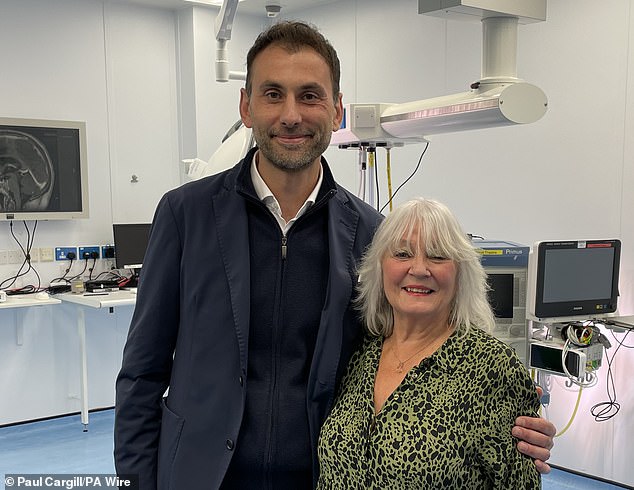
Consultant neurosurgeon Anastasios Giamouriadis of NHS Grampian, Scotland, pictured with 75-year-old patient Doreen Adams, has adapted an existing technique of keyhole surgery that takes half the time to complete
Mr Giamouradis explained the new technique allows them to operate on very large brain tumours in the front of the brain and also the middle.
Usually patients with these tumours require an operation called a craniotomy which involves removing a large part of the skull — sometimes called ‘open skull’ surgery.
This can take up to 10 hours and expose healthy parts of the brain during the operation, increasing the risks.
But this new keyhole surgery known as the Modified Eyebrow Keyhole SupraOrbital Approach for Brain Tumours, may offer a safer alternative for some patients.
Mr Giamouradis said: ‘By doing this through the keyhole approach through the eyebrow, it is more challenging technically, but it takes half the time — if not less.
‘The patient will go home the second day and be back to normal life in most occasions within a week or two.’

Mr Giamouradis explained he has modified the new technique with his team, which allows them to operate on very large brain tumours in the front of the brain and also the middle
Patient Doreen Adams had previously experienced headaches before falling ill and undergoing a craniotomy while abroad which was unsuccessful in removing her tumour.
She saw Mr Giamouradis while she was still recovering from her first operation and recalls being put at ease.
‘He is the most wonderful young man,’ she said. ‘He told me he could sort me right away. He would put anybody at ease.’
Ms Adams said she felt hardly any of the usual after-effects of surgery when she came around in recovery.
‘I felt great after the operation,’ she said. ‘I was left with a black eye and it took a while for it to open, but that was all.’
Mr Giamouriadis said the most rewarding part of his work in coming up with the new technique is experiencing the gratitude of patients once they awake from surgery.
‘Doreen hugged me when she woke up,’ he said. ‘They are fully awake straight away, they are completely compos mentis and they are already improved in recovery.
‘We joke in the team that patients are more awake than anyone else by the end of the day.’
Mr Giamouriadis is hopeful he can one day use virtual reality to teach other surgeons how to perform the new improved procedure.
He revealed he is working with a team at the University of Aberdeen on the project and that they are ‘very close’ to having it ready.
‘It’s very challenging to train someone in real life with this operation,’ he explained.
‘We’re developing a simulation so I can train people before we do the operation in real life. That’s the safest way to do it.
‘We’re very close to rolling it out so we can train other people.’