


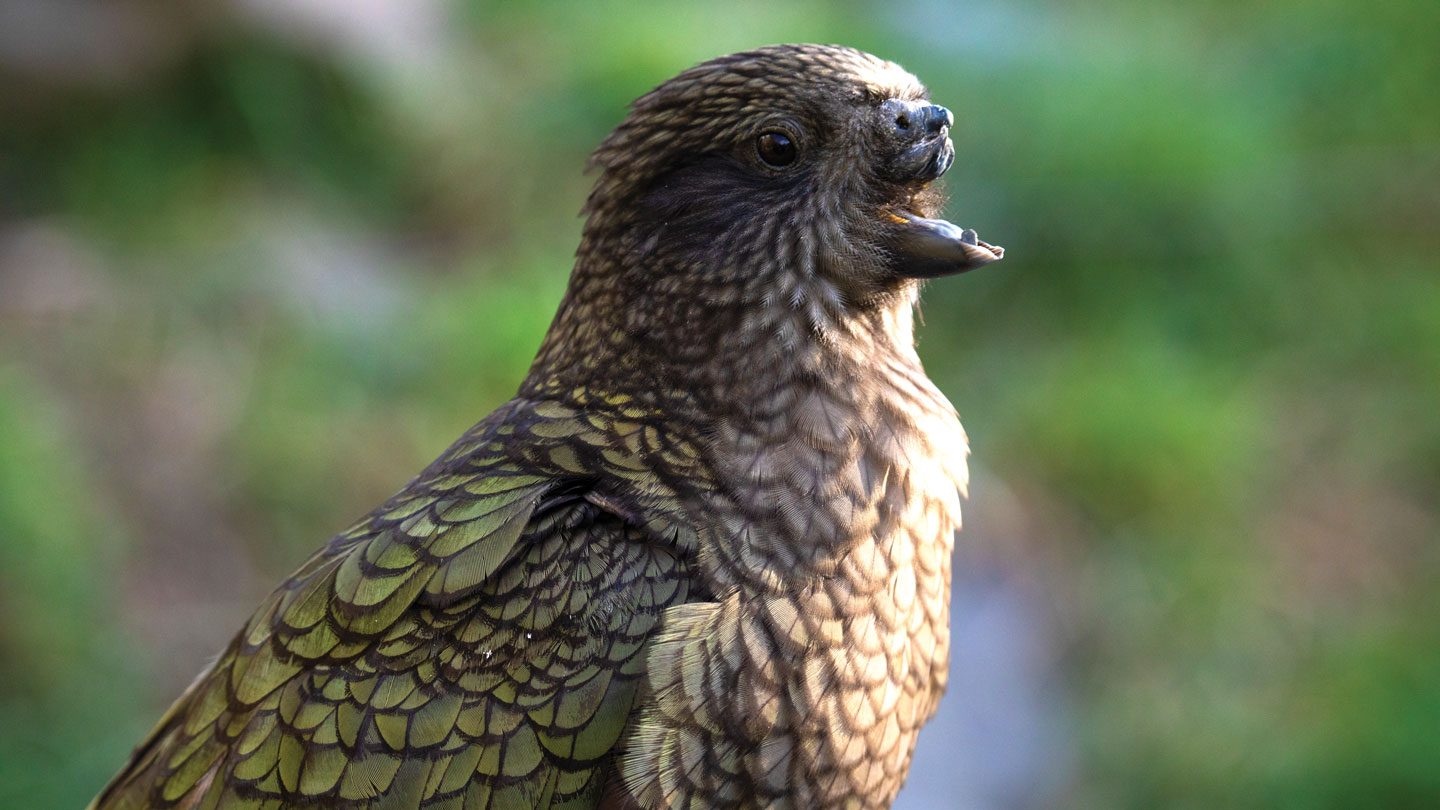
Bruce the kea is missing his upper beak, giving the olive green parrot a look of perpetual surprise. But scientists are the astonished ones.
The typical kea (Nestor notabilis) sports a long, sharp beak, perfect for digging insects out of rotten logs or ripping roots from the ground in New Zealand’s alpine forests. Bruce has been missing the upper part of his beak since at least 2012, when he was rescued as a fledgling and sent to live at the Willowbank Wildlife Reserve in Christchurch.
The defect prevents Bruce from foraging on his own. Keeping his feathers clean should also be an impossible task. In 2021, when comparative psychologist Amalia Bastos arrived at the reserve with colleagues to study keas, the zookeepers reported something odd: Bruce had seemingly figured out how to use small stones to preen.
“We were like, ‘Well that’s weird,’ ” says Bastos, of Johns Hopkins University.
Over nine days, the team kept a close eye on Bruce, quickly taking videos if he started cleaning his feathers. Bruce, it turned out, had indeed invented his own work-around to preen, the researchers reported in 2021 in Scientific Reports.
First, Bruce selects the proper tool, rolling pebbles around in his mouth with his tongue and spitting out candidates until he finds one that he likes, usually something pointy. Next, he holds the pebble between his tongue and lower beak. Then, he picks through his feathers.
“It’s crazy because the behavior was not there from the wild,” Bastos says. When Bruce arrived at Willowbank, he was too young to have learned how to preen. And no other bird in the aviary uses pebbles in this way. “It seems like he just innovated this tool use for himself,” she says.
Tool use is just one of parrots’ many talents. The birds are famous for emulating, and perhaps sometimes even understanding, human speech. Some species can also solve complex puzzles, like how to invade a secured trash bin, or practice self-control. Such abilities, on par with some primates, have earned parrots a place alongside members of the crow family as the “feathered apes.”
For a concept as abstract as intelligence, it’s challenging to develop a concrete definition that applies across animals. But researchers often point to features once thought to make humans special — enhanced learning, memory, attention and motor control — as signs of advanced cognition. Many of these capabilities are definitely seen in parrots, as well as in the crow family, and other animals like chimpanzees, dolphins and elephants.
“The question is, why is this kind of intelligence evolving multiple times?” says Theresa Rössler, a cognitive biologist at the University of Veterinary Medicine Vienna.
Exploring the parallels between parrots and people could provide clues. “Parrots are our evolutionary mirror image,” behavioral ecologist Antone Martinho-Truswell wrote in his 2022 book, The Parrot in the Mirror. With powerful brains and a proclivity for words, these birds are “the very best example,” he writes, of “nature’s ‘other try’ at a humanlike intelligence.”
It’s taken decades for cognitive scientists to realize this, says Irene Pepperberg, a parrot researcher and comparative psychologist at Boston University. At first glance, parrot brains look quite simple. And given the obvious physical differences and the fact that birds and humans last shared a common ancestor more than 300 million years ago, parrots are not an obvious candidate to help researchers understand human intelligence.
“When I started this work in the ’70s, my first grant proposal came back literally asking me what I was smoking,” Pepperberg says. That’s when she started working with Alex, an African gray parrot who, by the time of his death in 2007, had become renowned for his extensive vocabulary and knowledge of shapes, colors and even math.
Further supporting Pepperberg’s pioneering work, a slew of studies over the last decade highlight parrot smarts — and what these brilliant birds may teach us about how humanlike intelligence can emerge.
A vast skill set
Parrots’ most well-known talent is their affinity for spoken words. Proficiency varies among species, but African grays (Psittacus erithacus) are particularly good at picking up words and speaking clearly, Pepperberg says.
These parrots can repeat up to 600 different words, researchers reported in 2022 in Scientific Reports. While some parrots simply mimic words, it is possible to train birds such as Alex, who had a vocabulary of more than 100 words, to communicate with people.
“It’s not like you can actually sit there and ask them, ‘Why did you do that? What were you thinking?’ ” Pepperberg says. “But because you can [train them to communicate], you can ask them the same types of questions that you ask young children.” Another one of her African grays, for example, can request time alone by saying “Wanna go back.”
Many of parrots’ other cognitive triumphs have come to light only more recently.
Like Bruce the kea, a variety of other parrots are also capable of incredible feats with a tool in claw or beak. Hyacinth macaws (Anodorhynchus hyacinthinus) crack open nuts by holding pieces of wood in their beak or foot to keep the food in just the right position. Palm cockatoos (Probosciger aterrimus) craft drumsticks and rock out to attract mates. Goffin’s cockatoos (Cacatua goffiniana) can recognize individual tools as being part of a set, the only animals other than chimpanzees and humans known to do so (SN: 3/11/23, p. 12).
Overall, 11 of the nearly 400 parrot species, or about 3 percent, have been documented in scientific studies using tools. Crowdsourcing from YouTube videos, Bastos and colleagues uncovered 17 more tool-using species, bringing the total to 28. After plotting the known tool users onto an evolutionary tree, the team estimates that 11 to 17 percent of parrot species may use tools.
Because the ability is more widespread across species than previously thought and found in all but one of the parrot families, it’s possible that tool use originated with the very first parrot, which lived more than 50 million years ago, Bastos argues. Why all the parrots in one major group, the family that includes common pet species like lovebirds and lorikeets, might have lost this proficiency is unclear.
“I’m hoping that future research can reveal why on Earth this one family of parrots doesn’t do it, whereas [every other family] seems to,” Bastos says.
Meanwhile, other researchers are investigating more subtle skills. Some parrots, for example, can practice restraint.
Griffin, one of Pepperberg’s current African grays, can pass a version of the marshmallow test. In the human version, children are offered a marshmallow as an immediate treat but are promised more if they can wait until later to devour it. Offered nuts instead of a marshmallow, Griffin can wait up to 15 minutes for better or more rewards, just like many preschoolers. Exactly what such self-discipline reveals about intelligence is debated, but self-control in humans may be a factor in decision making and planning for the future.
Among humans, how much trust people have in others and other factors such as socioeconomic status can influence responses to the marshmallow test. Different African grays also respond differently, Pepperberg and colleagues reported in August in the Journal of Comparative Psychology.
A parrot named Pepper started out waiting for a larger treat, Pepperberg says. “Then she realized, ‘Wait a minute, if I take the smaller treats [really quickly], I get to go back to playing with my human, and I prefer that to the [big] treat.’ ”
Unlike Griffin, who receives near-constant interaction with people, Pepper is often left to her own devices. Because Pepper spends more time alone, perhaps she considers it unacceptable or unpleasant to wait to take a treat when people in the room are ignoring her.
The beauty of a bird brain
A bird’s brain looks nothing like a primate’s. Most primate brains have curves and crinkles that twist into the elaborate patterns of the cerebral cortex. The nerve cells packed within these wrinkles help people think, remember and learn. A bird brain, on the other hand, “looks like a blob of protoplasm,” the jellylike substance that fills cells, Pepperberg says. Because of this simple-looking brain, it was long thought that to have a bird brain was to be stupid.
But Pepperberg knew that was wrong. When she gave scientific talks in the 1980s about parrot accomplishments, people would say, “But it can’t be happening, there’s no cerebral cortex,” she recalls. “I was like, you’re the neurobiologists. Go find it.”
By the early 2000s, scientists had discovered that, in fact, parts of the avian brain are akin to the mammalian neocortex, the largest part of the cerebral cortex. Subsequent work has found that, compared with mammals, avian brains have “a higher total number of neurons for the same amount of skull space,” says neurobiologist and geneticist Erich Jarvis of Rockefeller University in New York City.
Parrot brains are especially densely packed. Some species even have more neurons than some large-brained primates. This density may facilitate the formation of brain circuits not found in other animals, Jarvis says.
One of those circuits seems to be a major information highway comparable to one in human brains, says comparative neurobiologist Cristián Gutiérrez-Ibáñez of the University of Alberta in Edmonton, Canada.
Human brains transfer information from the cerebral cortex to the cerebellum — a “little brain” at the back of the skull that in part coordinates movement — through clusters of neurons known as the pontine nuclei. This connection is crucial for cognitive functions like learning how to talk or making tools.
In birds, the similar pathway connects the avian equivalent of the neocortex to the cerebellum, Gutiérrez-Ibáñez and colleagues reported in 2018 in Scientific Reports. In addition to the pontine nuclei, birds shunt information through a second conduit, the SpM. It’s unclear what info gets transmitted via the SpM, Gutiérrez-Ibáñez says. But among birds, the parrot SpM is particularly large in size — a tantalizing hint that it may contribute to parrot intelligence.
Parrot and human brains may also share genetic underpinnings, a team of researchers including Jarvis and behavioral neurobiologist Claudio Mello reported in 2018 in Current Biology.
Parrots have acquired duplicate copies of various genes, some of which are known to be important for brain development and speech in people, says Mello, of Oregon Health & Science University in Portland. More copies could mean more ability. But parrot smarts may come down to how genes in the brain are regulated in addition to gaining more or new genes. Unlike other studied birds, parrots have genetic mutations in regions of DNA that provide instructions to switch genes on or off, perhaps to activate certain genes crucial for brain function and cognition.
This is reminiscent of humans, Mello says. We have mutations in these same gene regulators while other apes don’t. In us, the changes allow the regulators to kick-start genes related to growing big forebrains, a region important for complex cognition. If the same is true in parrots, it could point to a shared evolutionary process for humanlike intelligence.
The evolution of intelligence
To figure out the evolutionary origins of parrots’ brainpower, scientists have to go way back — all the way to the mass extinction that ended the Age of Dinosaurs. In the aftermath, as modern avian groups emerged, some birds rapidly evolved big brains.
That’s what paleontologist Daniel Ksepka and colleagues found by analyzing the skull casts of more than 2,000 living bird species, 22 extinct bird species and 12 nonavian dinosaurs. A large brain relative to body size is one indication, albeit imperfect, that an animal might be intelligent. Parrots, as well as members of the crow family, ended up with some of the largest brains of any birds.
Dinosaurs and early birds had similar sized brains relative to their bodies, the researchers reported in 2020 in Current Biology. By the time of the mass extinction 66 million years ago, both groups were already beginning to form forebrains. Rapid environmental change in the wake of the asteroid impact that may have sparked the mass extinction could have pushed some avian brains further on the fast track to growth, says Ksepka, of the Bruce Museum in Greenwich, Conn.
“The day after [impact] is going to be really hard,” he says. And then came forest fires and changes in the atmosphere and temperature as dust blocked out the sun.
Adaptable animals with relatively large brains — a group that probably included parrot ancestors — may have had a leg up over those without. Animals that figure out how to open pinecones with their beaks, say, will do better than the ones waiting for the next crop of berries that might never come, Ksepka says.
Today, having a big brain is just one thing humans and parrots have in common. In general, they also share long lives, monogamy and learning to sing or talk from others, a trait known as vocal learning. Researchers are investigating how these traits might relate to the evolution of intelligence. Right now, there are more hypotheses than answers.
For example, one line of thinking suggests vocal learning and a need for complex forms of communication may have paved the way to greater intelligence. Parrots “have very large, flexible vocal repertoires,” says behavioral ecologist Lucy Aplin of the University of Zurich and Australian National University in Canberra. “They can learn new vocalizations throughout their lives.”
It’s unclear what most parrot calls mean. But some parrots make signature sounds that declare who they are or what groups they belong to, Aplin says. If parrot talkativeness is indeed a driver of cognition, “that then begs the question, why do they need such complex communication, which then ties it back to their social systems,” she says.
Parrots live in large, cohesive groups. So having a good memory and enhanced intelligence may help the birds maintain relationships and strategically climb up the social ladder. Sulphur-crested cockatoos (Cacatua galerita), for instance, live in groups of hundreds of individuals yet maintain hierarchies that don’t seem to be based on physical characteristics. “The assumption is that they must be doing it based on memory, which is a big cognitive load,” Aplin says.
The possible connection between big brains and parrots’ social natures is a question that Aplin’s team is beginning to explore using MRIs of parrot brains. The goal, she says, is to identify how brain size as a whole — as well as regions particularly important in cognition — vary among species that differ in level of sociality.
In the case of songbirds, species with more complex vocal skills are better at solving cognitive puzzles in the lab, Jarvis and colleagues reported in September in Science. Jarvis, who is also a Howard Hughes Medical Institute Investigator, speculates that the same is probably true among parrots.
Parrots and songbirds, as well as humans, have neural circuits involved in song and speech that evolved from nearby pathways that control body movements. Instead of controlling muscles that move wings or arms, the circuits are connected to sound-producing organs. Parrots have more sophisticated vocal communication skills than songbirds, thanks to an additional copy of this same circuit, Jarvis and colleagues reported in 2015. The extra dedicated brain space hints that vocally adept parrots may therefore be better problem solvers than songbirds. So far, Jarvis has only tested songbirds’ problem-solving skills.
Parrots’ dexterity in maneuvering objects with their feet may also relate to the evolution of intelligence, Gutiérrez-Ibáñez and colleagues reported in August in Communications Biology. “[Hand-eye coordination] is like a stepping stone into intelligence and higher cognitive ability,” he says.
Take primates. Monkeys and apes with better motor skills tend to have bigger brains, researchers reported in 2016. Finesse with handling objects as tools is key for accessing challenging food sources, like using sticks to crack open nuts or to pull ants out of anthills. Good motor skills, Gutiérrez-Ibáñez says, are also probably key for understanding an item’s physical properties, and big brains can mentally manipulate those objects.
Parrot intelligence in the wild
How parrot intelligence plays out in the wild is mostly unknown. What scientists know about parrot smarts largely comes from captivity, where the absence of predators and the abundance of food might free up mental space, Pepperberg says.
Captive parrots are probably best viewed as what can be, not necessarily what always is. “We say humans are brilliant, and we point to Einstein, we point to Beethoven, we point to Picasso,” Pepperberg says. While the average human might struggle with calculus, musical theory or painting masterpieces, we still say Homo sapiens does great things.
It’s also possible that scientists are just missing the cognitive feats of wild parrots. It’s difficult to get wild parrot studies off the ground because the birds can fly away, and researchers can’t easily follow. (New Zealand’s kākāpō, the only flightless parrot, is the exception.) “Researching these highly mobile animals is a challenge in the wild,” says Rachael Shaw, a behavioral ecologist at Te Herenga Waka – Victoria University of Wellington in New Zealand.
Cognitive biologist Alice Auersperg of the University of Veterinary Medicine Vienna and colleagues solved that problem by capturing wild Goffin’s cockatoos in Indonesia, placing them in a field-based aviary and then releasing them after studying how the cockatoos make and use sets of wooden tools to get seeds out of sea mangos.
Shaw and colleagues are working to improve another challenge of field studies — recognizing individual birds — by developing facial recognition software, which could also be useful in conservation. More than 100 parrot species are endangered or threatened because of habitat loss and the pet trade.
Studying parrot intelligence could help conservation efforts, Bastos says. A study from 2018 found that wild keas in New Zealand learned to use sticks to tamper with egg-baited traps intended for stoats — a relative of weasels that preys on keas. Some birds got stuck inside the boxes and died. Understanding the bird’s cognitive limits could lead to new, kea-proof trap designs.
Sometimes wild parrots aren’t in forests but in people’s yards. Across the Tasman Sea from New Zealand, in Sydney, sulphur-crested cockatoos can learn from one another how to break into trash bins for food (SN: 10/8/22, p. 10). People retaliate with tricks of escalating difficulty to keep the birds out.
These urban bird populations highlight the adaptability of parrots, Aplin says. Sydney has sprung up around cockatoos’ native habitat. “We can’t assume that cities are empty spaces where we only have to account for human wants and needs. We also have to be thinking about the animals that we’re supporting specifically in those cities.”
Some Goffin’s cockatoos escaped from the pet trade into urban settings in Singapore, where there is now a stable population. Seeing how the birds adapt in real time is “super exciting,” Rössler says. Scientists could learn how the new surroundings might spark new innovative behaviors. “That’s the evolution in the making.”
Source link