



Nearly a decade ago, Neil Zeller spied a mysterious purple glow in the night sky.
Zeller was on a family vacation in British Columbia, Canada. One August 2014 night, he glimpsed something strange while photographing the northern lights. A band of purple light ran east to west across the sky. This was south of the auroras that made up the northern lights.
The purplish-white streak looked almost like the vapor trail of an airplane — yet not quite. Intrigued, Zeller swiveled his camera toward the mystery light.
Later, he found that other aurora chasers online had seen similar purple streaks. They called them proton arcs. The term referred to known features of the northern and southern lights. But a couple of years later, Zeller and his fellow photographers would learn that they actually had been documenting a natural light show that was yet unknown to science.
The revelation took place in a pub in Calgary, Canada. A group of aurora-chasers were hanging out with researchers from the University of Calgary. “I ended up sitting with Dr. Eric Donovan,” Zeller says. “And just in casual conversation, we started a tiny bit of an argument.”
Zeller said he’d seen a proton arc. Donovan replied that this was impossible. That type of northern light can’t be seen with the unaided eye, he explained. So to prove what he’d seen, Zeller pulled out a photo of the purple streak.
Zeller recalls Donovan saying: “Yeah, I don’t know what that is, but it’s not a proton arc.” In fact, it didn’t look like any aurora Donovan or his colleagues had ever seen.
Since no one had a clue what this ribbon of purple could be, aurora chasers started calling it Steve. Scientists later turned that name into an acronym. It’s now short for “Strong Thermal Emission Velocity Enhancement.” But to this day, researchers are still struggling to understand STEVE.
One mystery is what makes STEVE’s purple light. Sky detectives also are puzzling over what causes the “picket fence” of green stripes that can sometimes glimmer in the sky below STEVE. And recently, citizen-science photos have raised questions about how STEVE might be related to another non-aurora light show known as a stable auroral red arc.
“STEVE and the picket fence are arguably the biggest mystery in space physics right now,” says Claire Gasque. She’s a space physicist at the University of California, Berkeley.
Conditions in Earth’s atmosphere where STEVE appears can affect satellite signals, she notes. So explaining what causes STEVE could have uses beyond understanding a pretty sky light.
STEVE’s perplexing purple
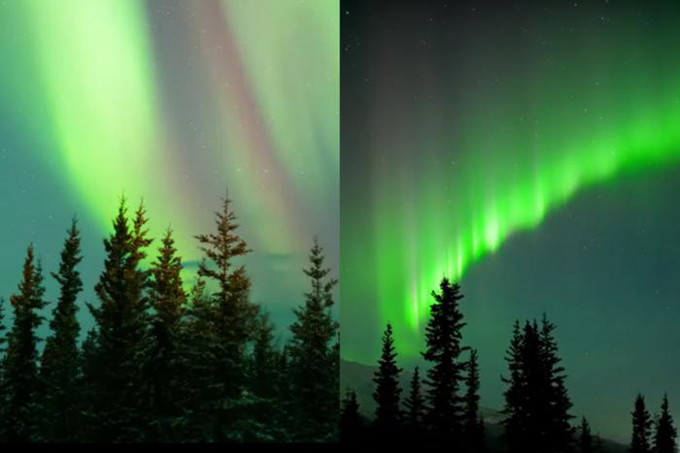
The auroras that make up the northern and southern lights drape the sky with green, blue and red hues. They form when charged particles rain down into the atmosphere from the magnetic bubble around Earth — our magnetosphere.
Those particles crash into airborne oxygen and nitrogen atoms near Earth’s North and South Poles. This causes those oxygen and nitrogen atoms to glow green, red and blue.
STEVE, on the other hand, paints the sky with a brush of purple. And it shows up closer to the equator.
Satellite data have shown that STEVE is likely powered by a river of charged particles rushing through the atmosphere. That stream of plasma surges across the sky at several kilometers (miles) per second. It’s thought to energize the air about 200 kilometers (125 miles) off the ground so that it glows.
But what molecules give STEVE its signature purple hue remain unclear. Scientists thought nitric oxide might be responsible. But a new video of STEVE has thrown a wrench into that idea.
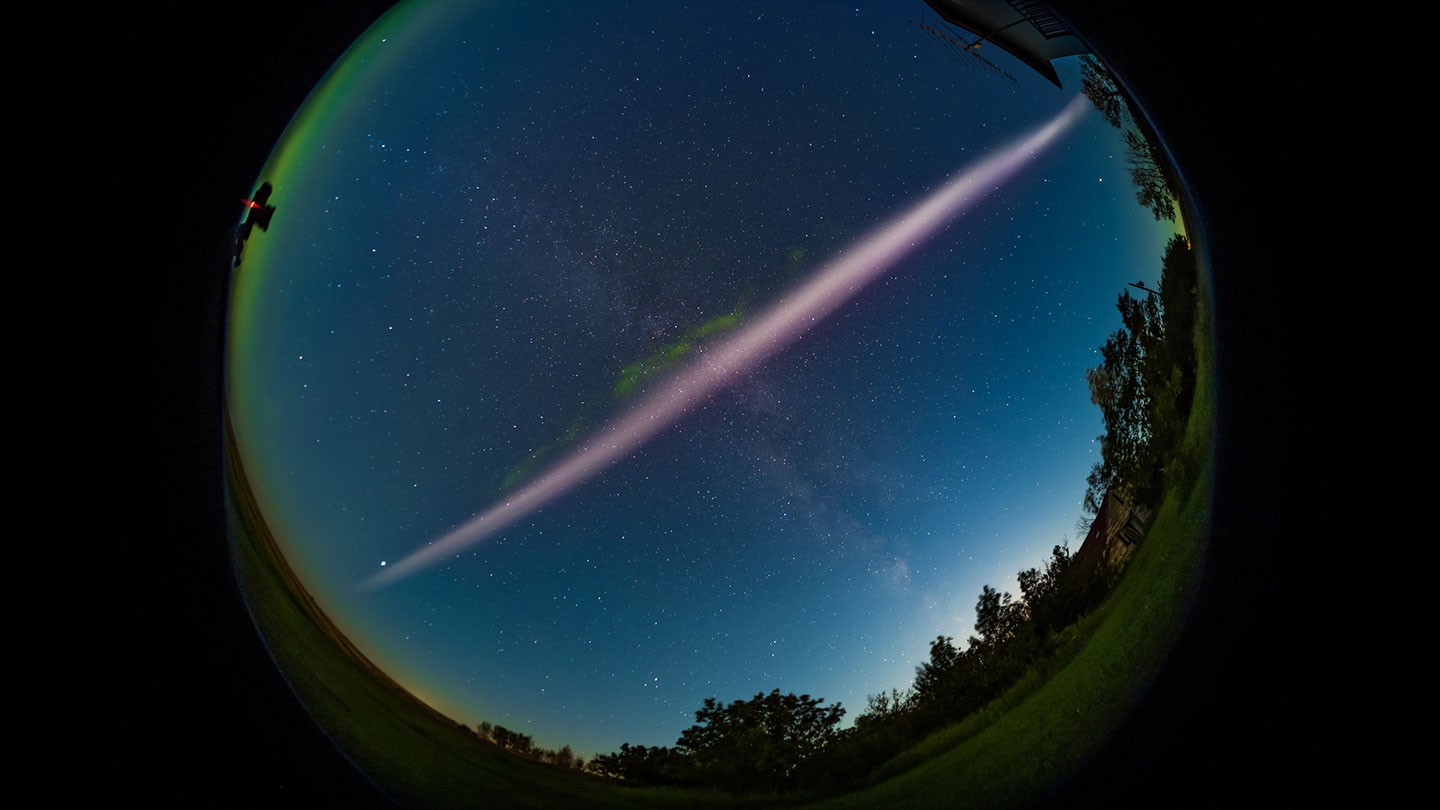
Citizen scientist Alan Dyer took the video in his backyard in Alberta, Canada. He and other photographers normally try to take photos of STEVE that are as bright and colorful as possible. To achieve that, they often let their cameras collect light for seconds at a time.
Such long-exposure shots smear STEVE’s finer details. So Dyer tried a different approach when a STEVE stretched over his house one night in August 2022. He zoomed in on the sky glow and took a high-speed video of STEVE’s nitty-gritty details.
This video captured structures in STEVE’s light as small as 90 meters (some 300 feet) across. That’s pretty small for an airglow that can span thousands of kilometers. The footage was made up of 24 snapshots per second.
This high-resolution, high-speed video offered quite a different view of STEVE. Instead of a largely smooth drift of purple, Dyer’s video exposed STEVE as a quickly flickering torrent of purplish white fuzz.
“It didn’t look that beautiful,” Dyer says. Still, he thought the video might be scientifically useful. He sent it to Toshi Nishimura. This space physicist studies STEVE at Boston University in Massachusetts.
Dyer’s video stunned Nishimura. “I said, ‘Oh my God, no one has ever seen this before,’” the scientist recalls. He also was eager to analyze such a high-res view of STEVE.
Not what the experts had expected
On close inspection, STEVE’s fine details didn’t seem to match what scientists understood about how the airglow forms. “This fine-scale structure gave us a huge headache,” Nishimura says.
Dyer’s video showed a speckled stream of light with variations in brightness as small as a few kilometers across. Some of those features popped in and out of view within seconds.
“The leading theory of the STEVE emission is that there’s nitric oxide that is excited by the fast plasma stream,” Nishimura says. Excited nitric oxide can glow for an hour. And that’s about how long STEVE lasts. But nitric oxide can’t explain bursts of brightness that last mere seconds.
Nishimura’s team shared its assessment in the December JGR Space Physics.
Launching a rocket loaded with scientific sensors through STEVE could help identify the molecules behind the airglow. “But the challenge is that we need to know when and where STEVE is going to happen,” Nishimura says. “That’s extremely difficult.”
STEVE can appear just after the peaks of substorms. Those are disturbances in the magnetosphere. And they can stir up spectacular auroras. “STEVE generally appears after the main aurora show has kind of faded,” Dyer says. But not every substorm comes with a STEVE encore. What’s more, recent research suggests not all STEVE events need a substorm to appear.
There is one thing that might help researchers refine their STEVE predictions, Nishimura says. That’s a better understanding of STEVE’s relationship to another type of non-auroral airglow: a stable auroral red arc (SAR arc, for short). Citizen-scientist photos have recently shown SAR arcs morphing into STEVEs.
STEVE and SAR arcs
In March 2015, Ian Griffin set out to photograph a particularly dazzling auroral display near Dunedin, New Zealand. But just north of these southern lights, the citizen scientist spotted something even more spectacular. A wide, red sky glow morphed into the purple strand of STEVE. Griffin caught this whole transformation on camera.
Griffin’s footage offered researchers their first glimpse of a STEVE blooming out of a SAR arc. Carlos Martinis and his colleagues described it in June 2022 in Geophysical Research Letters. Martinis is a space physicist at Boston University in Massachusetts.
Scientists have studied SAR arcs for decades, Martinis says. Like STEVE, these airglows stretch east-to-west across the sky. And they grace the sky closer to the equator than do the northern and southern lights. But while STEVE lasts roughly an hour, SAR arcs can stain the sky for hours to days at a time. While visible to cameras, these red glows are usually too dim to see with the unaided eye.
SAR arcs appear due to disturbances in Earth’s magnetosphere. Those disturbances can cause collisions between charged particles thousands of kilometers out in space. Such collisions create heat that seeps down into the ionosphere. (This is the layer of the atmosphere that’s home to STEVE.) Here, the heat energizes electrons. The electrons can then excite oxygen atoms to shed the red light that makes up SAR arcs.
These red arcs normally are about a tenth as bright as auroras. But the SAR arc that Griffin saw was bright enough to rival red southern lights.
“It was just stunning,” says Megan Gillies, who studies auroras at the University of Calgary. “It’s a beautiful deep, deep red.” Over time, she says, “you can see the SAR arc sort of fades, and then STEVE rolls across the field of view.”
Griffin’s footage inspired Gillies to hunt for other cases of STEVE emerging from SAR arcs. Her team found one that had been recorded in Canada in April 2022. It appeared over Lucky Lake, Saskatchewan. The group reported it in Geophysical Research Letters in March 2023.
In this event, STEVE’s bright purple streak emerged from a SAR arc’s red glow. It hung around for about half an hour, then gave way to more red. “It’s like watching a fire smoldering. And then you throw more wood on it, and then it blazes up,” Gillies says. Later, it dies down again.
“There’s something that happens that triggers a STEVE,” Gillies says. But not all SAR arcs mutate into STEVE. So it’s not clear what might cause this transition in some cases.

It might have something to do with the plasma torrent that powers STEVE. SAR arcs have also been linked to plasma flowing westward in the atmosphere. The plasma linked to SAR arcs just flows more slowly than the plasma that powers STEVE. Maybe as the slower, wider plasma flow linked to a SAR arc quickens and narrows, it becomes strong enough to power a STEVE.
Satellite data collected during the 2015 event that Griffin saw suggest that might be the case. But what would trigger that switch from a wide, slow plasma flow to a narrow, fast one is still an open question, Martinis adds.
“This is where modeling comes in,” Gillies says. Scientists can use computers to test whether the physics they think is happening produces light patterns that look like STEVE. Computer models are already helping piece together another STEVE-related puzzle: What causes STEVE’s occasional sidekick, the picket fence?
Building the picket fence
The picket fence is a row of green stripes that may light up the sky below STEVE’s purple arc. At first, researchers thought this green light might be a plain old aurora. After all, the picket fence’s hue is similar to some normal green northern lights. But the specific wavelengths of light emitted by the picket fence hint that it might be something else.
True auroras get their energy from charged particles way out in the magnetosphere. “When [those particles] collide with the atmosphere, they’re going to create a pretty wide spectrum of colors,” Gasque says. These include the green light emitted by oxygen, plus red and blue light from nitrogen.
“That blue is kind of the smoking gun that we didn’t see with the picket fence,” Gasque says. Its absence hints that the picket fence’s green spires don’t come from the same process as auroras.
Gasque and her colleagues are looking into another explanation for the picket fence. They think it might come from electric fields in Earth’s atmosphere.
Those electric fields could energize electrons in Earth’s atmosphere — rather than relying on particles raining down from the magnetosphere above it. Electrons energized by electric fields could tickle oxygen into glowing green. And they could coax nitrogen into giving off a bit of red.
They wouldn’t cause nitrogen to emit any blue light.
Gasque and her team tested this idea with a computer model of Earth’s atmosphere. This model energized the electrons with electric fields. The team then compared the light produced inside their model atmosphere to the light of a picket fence seen at Lucky Lake in April 2018.
The model did indeed produce the green light and the smidge of red seen in the real-life picket fence. But there was no tinge of blue. This supports the idea that atmospheric electric fields could construct the picket fence.
The researchers shared their findings last November in Geophysical Research Letters. But scientists now need to confirm that such electric fields actually exist in the atmosphere. A rocket mission could help.
Observations to come
Gasque and her colleagues have just proposed such a mission to NASA. Their rocket wouldn’t fly through the picket fence. Like STEVE, the picket fence is too unpredictable to plan a rocket launch around it. Instead, the rocket would target a feature of the northern lights that looks similar to the picket fence but is much more common: an enhanced aurora.
“With enhanced aurorae, you have kind of these sharp, bright layers within the aurora,” Gasque says. The sharpness of those slices of light and their picket fence–like color hints that they, too, might be powered by electric fields.
If a future rocket detected electric fields threaded through enhanced auroras, that would help confirm that similar fields build green picket fences.
NASA’s Geospace Dynamics Constellation mission may also yield data that help explain aspects of STEVE. This mission aims to launch a fleet of spacecraft as soon as 2027. Their mission: in-depth exploration of Earth’s ionosphere and magnetosphere. Those are the layer of Earth’s atmosphere home to STEVE and the region of near-Earth space that impacts it.
Until then, STEVE’s paparazzi of citizen scientists will continue snapping photos of the sky glow from the ground.
“We’re out specifically looking for STEVE,” Dyer says, because there’s scientific interest in it. “Prior to the era of STEVE … you might have thought, well, there’s nothing amateurs can contribute now to aurora research. It’s all done with rockets and satellites and the like. But nope! There’s a lot we can contribute.”
Those contributions will surely turn up plenty of new puzzles for scientists to solve.