


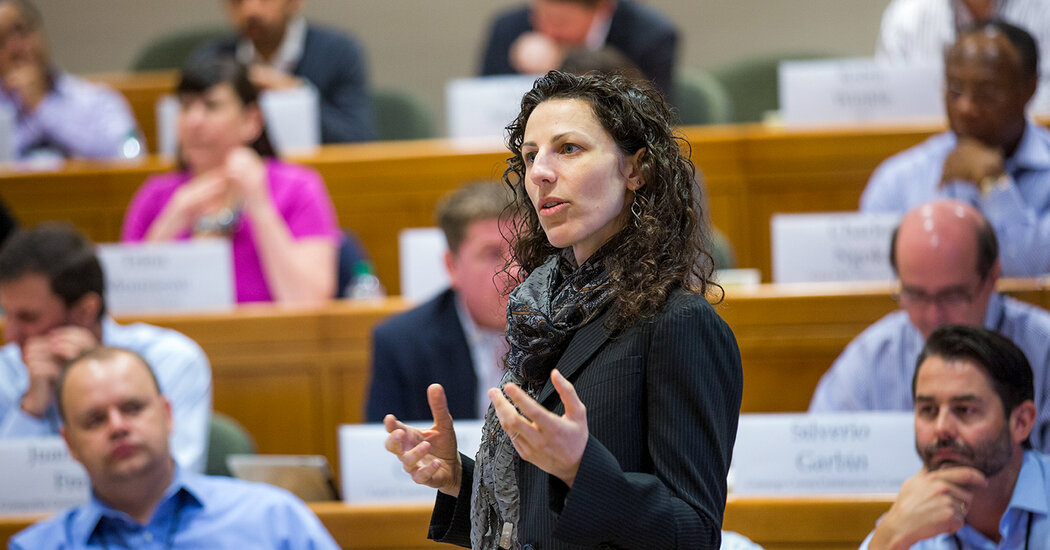
The day almost two years ago when Harvard Business School informed Francesca Gino, a prominent professor, that she was being investigated for data fraud also happened to be her husband’s 50th birthday. An administrator instructed her to turn in any Harvard-issued computer equipment that she had by 5 p.m. She canceled the birthday celebration she had planned and walked the machines to campus, where a University Police officer oversaw the transfer.
“We ended up both going,” Dr. Gino recalled. “I couldn’t go on my own because I felt like, I don’t know, the earth was opening up under my feet for reasons that I couldn’t understand.”
The school told Dr. Gino it had received allegations that she manipulated data in four papers on topics in behavioral science, which straddles fields like psychology, marketing and economics.
Dr. Gino published the four papers under scrutiny from 2012 to 2020, and fellow academics had cited one of them more than 500 times. The paper found that asking people to attest to their truthfulness at the top of a tax or insurance form, rather than at the bottom, made their responses more accurate because it supposedly activated their ethical instincts before they provided information.
Though she did not know it at the time, Harvard had been alerted to the evidence of fraud a few months earlier by three other behavioral scientists who publish a blog called Data Colada, which focuses on the validity of social science research. The bloggers said it appeared that Dr. Gino had tampered with data to make her studies appear more impressive than they were. In some cases, they said, someone had moved numbers around in a spreadsheet so that they better aligned with her hypothesis. In another paper, data points appeared to have been altered to exaggerate the finding.
Their tip set in motion an investigation that, roughly two years later, would lead Harvard to place Dr. Gino on unpaid leave and seek to revoke her tenure — a rare step akin to career death for an academic. It has prompted her to file a defamation lawsuit against the school and the bloggers, in which she is seeking at least $25 million, and has stirred up a debate among her Harvard colleagues over whether she has received due process.
Harvard said it “vehemently denies” Dr. Gino’s allegations, and a lawyer for the bloggers called the lawsuit “a direct attack on academic inquiry.”
Perhaps most significant, the accusations against Dr. Gino inflamed a long-simmering crisis within the field.
Many behavioral scientists believe that, once we better understand how humans make decisions, we can find relatively simple techniques to, say, help them lose weight (by moving healthy foods closer to the front of a buffet) or become more generous (automatically enrolling people in organ donor programs).
The field enjoyed a heyday in the first decade of the 2000s, when it spawned a ream of airport best-sellers and viral blog posts, and a leading figure bagged a Nobel Prize. But it has been fending off credibility questions for almost as long as it has been spinning off TED Talks. In recent years, scholars have struggled to reproduce a number of these findings, or discovered that the impact of these techniques was smaller than advertised.
Fraud, though, is something else entirely. Dozens of Dr. Gino’s co-authors are now scrambling to re-examine papers they wrote with her. Dan Ariely, one of the best-known figures in behavioral science and a frequent co-author of Dr. Gino’s, also stands accused of fabrication in at least one paper.
Though the evidence against Dr. Gino, 45, appears compelling, it remains circumstantial, and she denies having committed fraud, as does Dr. Ariely. Even the bloggers, who published a four-part series laying out their case in June and a follow-up this month, have acknowledged that there is no smoking gun proving it was Dr. Gino herself who falsified data.
That has left colleagues, friends, former students and, well, armchair behavioral scientists to sift through her life in search of evidence that might explain what happened. Was it all a misunderstanding? A case of sloppy research assistants or rogue survey respondents?
Or had we seen the darker side of human nature — a subject Dr. Gino has studied at length — poking through a meticulously fashioned facade?
During more than five hours of conversation with Dr. Gino, she was proud of her accomplishments, at times defiant toward her accusers and occasionally empathetic to those who, she said, mistakenly believed the evidence of fraud.
“I don’t blame readers of the blog for coming to that conclusion,” she said, adding, “But it’s important to know there are other explanations.”
I would ask a question; she would provide a plausible answer. Often the replies were detailed and specific: She recalled dates and dialogue and the names of obscure colleagues. She did not present as a fraud.
But, then, what would a fraud sound like anyway?
The Dishonesty Researchers
Dr. Gino was something of an academic late bloomer. After growing up in Tione di Trento, a small town in Italy, she earned a Ph.D. in economics and management from an Italian university in 2004, then did a postdoctoral fellowship at Harvard Business School. But she did not receive a single tenure-track offer in the United States after completing her fellowship.
She seemed to romanticize American academic life and worried that she would have to settle for a consulting job or university post in Italy, where she had a lead.
“I have a vivid memory of being in an airport somewhere in Europe — I think in Frankfurt — in tears,” she recalled.
The job she eventually landed, a two-year position as a visiting professor at Carnegie Mellon University, arose when a Harvard mentor lobbied a former student on the faculty there to give her a chance.
In conversation, Dr. Gino can come across as formal. The slight stiltedness of her nonnative English merges with the circumlocution of business-school lingo to produce phrases like “the most important aspect is to embrace a learning mind-set” and “I believe we’re going to move forward in a positive way.”
But she also exhibits a certain steeliness. “I am a well-organized person — I get things done,” she told me at one point. She added: “It can take forever to publish papers. What’s in my control, I execute at my pace, my rigor.”
Dr. Gino distinguished herself at Carnegie Mellon with a ferocious appetite for work. “She thrived on and put more pressure on herself than anyone would have,” said Sam Swift, a graduate student in the same group. Shortly after starting, Dr. Gino dusted off a project that had stalled out and, within weeks, had whipped up an entire draft of a paper that was later accepted for publication.
After Carnegie Mellon, she took a position in 2008 as an assistant professor at the University of North Carolina — a respectable landing spot, to be sure, but not one regarded as a major hub for behavioral research. Soon, however, a series of projects she had started years earlier began appearing in journals, often with high-profile co-authors. The volume of publications she notched in a short period was turning her into an academic star.
Among those co-authors was Dr. Ariely, who moved from the Massachusetts Institute of Technology to Duke around the same time Dr. Gino arrived at North Carolina. Dr. Ariely entered the public consciousness early the same year with the publication of his best-selling book, “Predictably Irrational: The Hidden Forces That Shape Our Decisions.”
The book helped introduce mainstream audiences to the quirks of human reasoning that economists traditionally ignored because they assumed people act in their self-interest. Behavioral science seemed to offer easy fixes for nonrational acts, such as our tendency to save too little or put off medical visits. It rode a wave of popular interest in social science, which had made hits of recent books like “The Tipping Point,” by the journalist Malcolm Gladwell, and “Freakonomics,” by the economist Steven Levitt and the journalist Stephen Dubner.
Dr. Gino and Dr. Ariely became frequent co-authors, writing more than 10 papers together over the next six years. The particular academic interest they shared was a relatively new one for Dr. Gino: dishonesty.
While the papers she wrote with Dr. Ariely were only a portion of her prodigious output, many made a splash. One found that people tend to emulate cheating by other members of their social group — that cheating can, in effect, be contagious — and another posited that creative people tend to be more dishonest. In all, four of her six most cited papers were written with Dr. Ariely, out of more than 100.
Dr. Gino seemed to value the relationship. “She talked about him a lot,” said Tina Juillerat, a graduate student who worked with Dr. Gino at the university. “She really seemed to admire Ariely.”
In our conversations, Dr. Gino seemed eager to minimize the relationship. She said she did not consider Dr. Ariely a mentor and had frequently worked with his students and postdocs rather than with him directly. (Dr. Ariely said that “for many years, Dr. Gino was a friend and collaborator.”)
Dr. Ariely is famous among colleagues and students for his impatience with what he regards as pointless rules, which they say he grudgingly abides by; Dr. Gino comes off as something of a stickler. But they seemed to share an ambition: to show the power of small interventions to elicit surprising changes in behavior: Counting to 10 before choosing what to eat can help people select healthier options (Dr. Gino); asking people to recall the Ten Commandments before a test encourages them to report their results more honestly (Dr. Ariely).
By 2009, Dr. Gino had begun to feel isolated in North Carolina and let it be known that she wanted to relocate. This time, it was the schools that seemed desperate to land her, rather than vice versa. A number of competitors recruited her, but she eventually accepted an offer from Harvard.
Within a few years, Dr. Gino had tenure and a team of students and researchers who could run experiments, analyze the data and write the papers, which she helped conceive and edit. The arrangement, which is common among tenured faculty members, allowed her to leverage herself more effectively. She was pulled into the jet stream of talks and NPR cameos and consulting projects.
In 2018, she published her own mass-market book, “Rebel Talent: Why It Pays to Break the Rules at Work and in Life.” “Rebels are people who break rules that should be broken,” Dr. Gino told NPR, summarizing her thesis. “It creates positive change,” she added.
The Decline of a Discipline?
It’s often difficult to identify the moment when an intellectual movement jumps the shark and becomes an intellectual fad — or, worse, self-parody.
But in behavioral science, many scholars point to an article published in a mainstream psychology journal in 2011 claiming evidence of precognition — that is, the ability to sense the future. In one experiment, the paper’s author, an emeritus professor at Cornell, found that more than half the time participants correctly guessed where an erotic picture would show up on a computer screen before it appeared. He referred to the approach as “time-reversing” certain psychological effects.
The paper used methods that were common in the field at the time, like relying on relatively small samples. Increasingly, those methods looked like they were capturing statistical flukes, not reality.
“If some people have ESP, why don’t they go to Las Vegas and become rich?” Colin Camerer, a behavioral economist at the California Institute of Technology, told me. (Behavioral economists root their work in economic concepts like incentives as well as insights from psychology; the line between them and behavioral scientists can be blurry.)
Few scholars were more affronted by the turn their discipline was taking than Uri Simonsohn and Joseph Simmons, who were then at the University of Pennsylvania, and Leif Nelson of the University of California, Berkeley.
The three behavioral scientists soon wrote an influential 2011 paper showing how certain long-tolerated practices in their field, like cutting off a five-day study after three days if the data looked promising, could lead to a rash of false results. (As a matter of probability, the first three days could have lucky draws.) The paper shed light on why many scholars were having so much trouble replicating their colleagues’ findings, including some of their own.
Two years later, the three men launched their blog, Data Colada, with this tagline below a logo of an umbrella-topped cocktail glass: “Thinking about evidence, and vice versa.” The site became a hub for nerdy discussions of statistical methods — and, before long, various research crimes and misdemeanors.
Dr. Gino and Dr. Ariely have always kept their focus firmly within the space-time continuum. Still, they sometimes produced work that raised eyebrows, if not fraud accusations, among other scholars. In 2010, they and a third colleague published a paper that found that people cheated more when they wore counterfeit designer sunglasses.
“We suggest that a product’s lack of authenticity may cause its owners to feel less authentic themselves,” they concluded, “and that these feelings then cause them to behave dishonestly.”
This genre of study, loosely known as “priming,” goes back decades. The original, modest version is ironclad: A researcher shows a subject a picture of a cat, and the subject becomes much more likely to fill in the missing letter in D_G with an “O” to spell “DOG,” rather than, say, DIG or DUG.
But in recent decades, the priming approach has migrated from word associations to changes in more complex behaviors, like telling the truth — and many scientists have grown skeptical of it. That includes the Nobel laureate Daniel Kahneman, one of the pioneers of behavioral economics, who has said the effects of so-called social priming “cannot be as large and as robust” as he once assumed.
Dr. Gino said her work in this vein had followed accepted practices at the time; Dr. Ariely said findings could be sensitive to experimental conditions, such as how closely participants read instructions.
Other subtle cues purporting to pack a big punch have come in for similar scrutiny in recent years. Another Harvard Business professor, Amy Cuddy, who had become a get-ahead guru beloved by Sheryl Sandberg and Cosmopolitan magazine, resigned her tenure-track position in 2017 after criticism by Data Colada and other sites of a widely discussed paper on how so-called power poses — like standing with your legs spread out — could boost testosterone and lower stress. (Dr. Cuddy did not face accusations of fraud or misconduct. She continued to teach at Harvard Business School in various capacities after 2017.)
In 2021, the Data Colada bloggers, citing the help of a team of researchers who chose to remain anonymous, posted evidence that a field experiment overseen by Dr. Ariely relied on fabricated data, which he denied. The experiment, which appeared in a paper co-written by Dr. Gino and three other colleagues, found that asking people to sign at the top of an insurance form, before they filled it out, improved the accuracy of the information they provided.
Dr. Gino posted a statement thanking the bloggers for unearthing “serious anomalies,” which she said “takes talent and courage and vastly improves our research field.”
Around the same time, the bloggers alerted Harvard to the suspicious data points in four of her own papers, including her portion of the same sign-at-the-top paper that led to questions about Dr. Ariely’s work.
The allegations prompted the investigation that culminated with her suspension from Harvard this June. Not long after, the bloggers publicly revealed their evidence: In the sign-at-the-top paper, a digital record in an Excel file posted by Dr. Gino indicated that data points were moved from one row to another in a way that reinforced the study’s result.
Dr. Gino now saw the blog in more sinister terms. She has cited examples of how Excel’s digital record is not a reliable guide to how data may have been moved.
“What I’ve learned is that it’s super risky to jump to conclusions without the complete evidence,” she told me.
A Controversial Investigation
Dr. Gino’s life these days is isolated. She lost access to her work email. A second mass-market book, which was to be published in February, has been pushed back. One of her children attends a day care on the campus of Harvard Business School, from which she has been barred.
“I used to do the pickups and drop-offs, and now I don’t,” she told me. “And the few times where I’m the one going, I feel this sense of great sadness,” she said. “What if I run into a colleague and now they report me to the dean’s office that somehow I’m on campus?”
In a paper concluding that people have a greater desire for cleansing products when they feel inauthentic, the bloggers flagged 20 strange responses to a survey that Dr. Gino had conducted. In each case, the respondents listed their class year as “Harvard” rather than something more intuitive, like “sophomore.”
Though the “Harvard” respondents were only a small fraction of the nearly 500 responses in the survey, they suspiciously reinforced the study’s hypothesis.
Dr. Gino has argued that most of the suspicious responses were the work of a scammer who filled out her survey for the $10 gift cards she offered participants — the responses came in rapid succession, and from suspicious I.P. addresses.
But it’s strange that the scammer’s responses would line up so neatly with the findings of her paper. When I pointed out that she or someone else in her lab could be the scammer, she was unbowed.
“I appreciate that you’re being a skeptic,” she told me, “since I think I’m going to be more successful in proving my innocence if I hear all the possible questions that show up in the mind of a skeptic.”
More damningly, the bloggers recently posted evidence, culled from retraction notices that Harvard sent to journals where Dr. Gino’s disputed articles appeared, indicating that much more of the data collected for these studies was tampered with than they initially documented.
In one study, forensic consultants hired by Harvard wrote, more than half the responses “contained entries that were modified without apparent cause,” not just the handful that the bloggers initially flagged.
Dr. Gino said it wasn’t possible for Harvard’s forensics consultants to conclude that she had committed fraud in that instance because the consultants couldn’t examine the original data, which was collected on paper and no longer exists.
Notwithstanding the evidence, the manner in which Harvard investigated her could ensure that the case remains officially unresolved for years. Dr. Gino’s lawsuit, which she filed in August, claims that the Data Colada bloggers offered to delay posting the evidence of fraud until Harvard investigated.
Harvard reacted, she claims, by creating a more aggressive policy for investigating misconduct and applied it to her case. Unlike the older version, the new policy contained rigid timetables for each phase of the investigation, like giving her 30 days to respond to an investigative report, and instructed an administrator to take custody of her research records.
The suit argues that applying the new policy breached Dr. Gino’s employment contract and constituted gender discrimination because the business school did not subject men in similar situations to the same treatment. Dr. Gino further argued that the school had disciplined her without meeting the new policy’s burden of proof, and that both Harvard and Data Colada had defamed her by indicating to others that she had committed fraud.
Brian Kenny, a spokesman for the business school, said the lawsuit did not present a complete picture of “the facts that led to the findings and recommended institutional actions.” He added: “We believe that Harvard ultimately will be vindicated.” Harvard will file a legal response in the coming weeks.
In an email to faculty in mid-August, the dean of Harvard Business School, Srikant Datar, implied that the accusations against Dr. Gino had prompted a change in policy because they were “the first formal allegations of data falsification or fabrication the school had received in many years.” He wrote that the new policy closely resembled policies at other schools at Harvard.
Even in the midst of her professional disgrace, Dr. Gino finds herself with some sympathetic colleagues, who are outraged at their employer’s treatment of a tenured professor. Five of Dr. Gino’s tenured colleagues at the business school told me that they had concerns about the process used to investigate Dr. Gino. Some found it disturbing that the school appeared to have created a policy prompted specifically by her case, and some worried that the case set a precedent allowing other freelance critics to effectively initiate investigations. (A sixth colleague told me that he was not troubled by the process and was confident in Dr. Gino’s guilt.)
Most of the faculty members requested anonymity because of the legal complications — the university’s general counsel distributed a note instructing faculty members not to discuss the case shortly after Dr. Gino filed her complaint.
Researchers accused of fraud rarely win lawsuits against their institutions or their accusers. But some experts have argued that Dr. Gino could stand better odds than most, partly because of the business school’s apparent adoption of a new policy to investigate misconduct in her case.
In October, dozens of Dr. Gino’s co-authors will disclose their early efforts to review their work with her, part of what has become known as the Many Co-Authors project. Their hope is to try to replicate many of the papers eventually.
But the credibility questions extend beyond her, and there is no similar project focusing on the work of other behavioral scientists whose results have drawn skepticism — including Dr. Ariely, who stands accused of similar misconduct, albeit in only one instance.
(Dr. Ariely indicated to The Financial Times in August that Duke was investigating him, though he remains a faculty member there and the school said it couldn’t comment. The publisher of his Ten Commandments paper said it was reviewing the article, which other scholars have struggled to replicate. Dr. Ariely said that he was unaware of the review and that he and his colleagues had recently replicated the result in a new study that was not yet public.)
In an interview, Dr. Kahneman, the Nobel Prize winner, suggested that while the efforts of scholars like the Data Colada bloggers had helped restore credibility to behavioral science, the field may be hard-pressed to recover entirely.
“When I see a surprising finding, my default is not to believe it,” he said of published papers. “Twelve years ago, my default was to believe anything that was surprising.”
J. Edward Moreno contributed reporting. Sheelagh McNeill contributed research.