


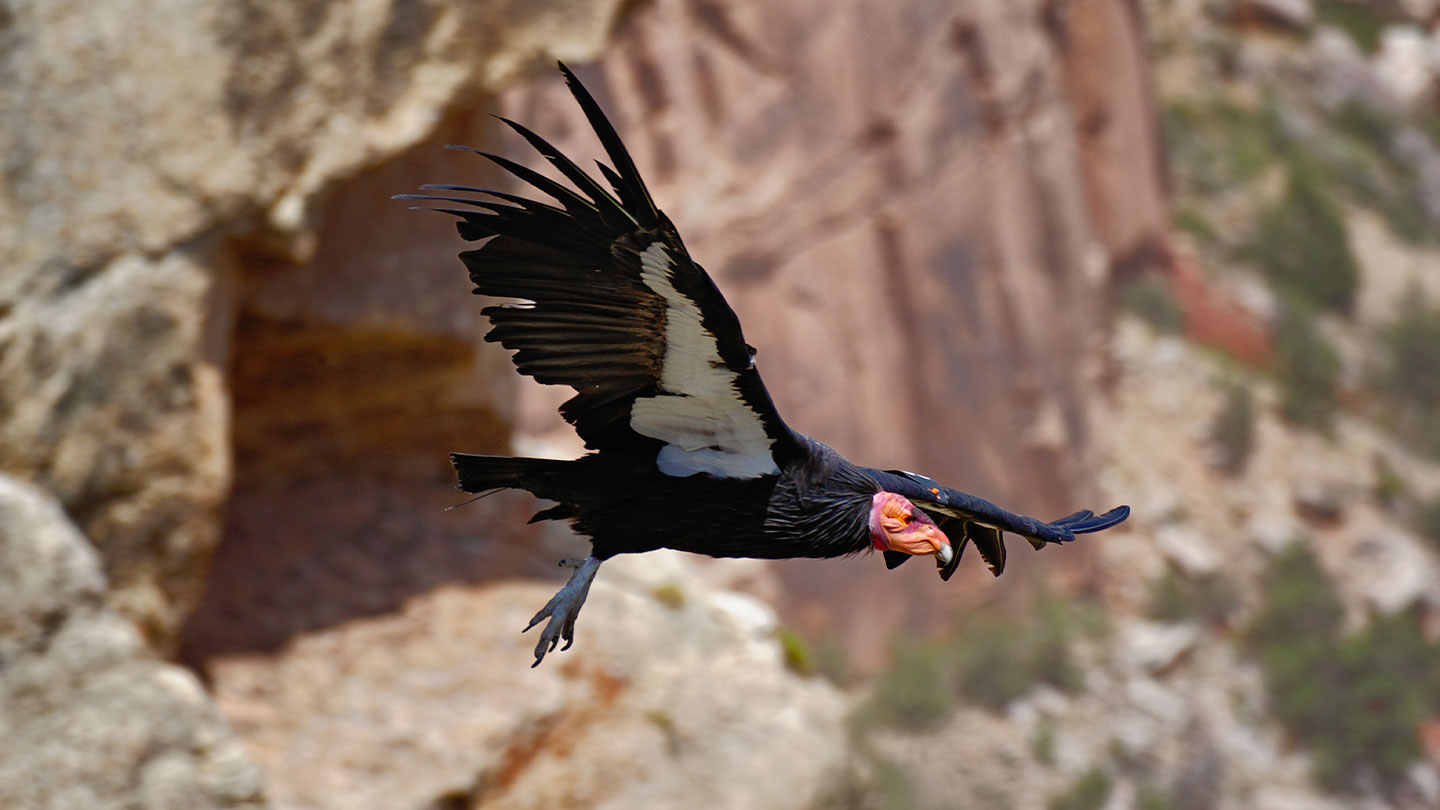
While growing up in California in the 1980s, Winifred Frick never saw a condor in the wild. The population of North America’s largest bird, Gymnogyps californianus, had dwindled to nearly zero by 1987 because so many were shot, poisoned or captured.
The few remaining wild condors were brought into zoos in the early 1980s as part of a captive breeding program aimed at restoring the condor population (SN: 4/25/87). A small group of the birds reproduced, and eventually many of the condors were released back into the wild (SN: 1/25/92).
Today, Frick — now a conservation biologist at the University of California, Santa Cruz — and her 14-year-old son can admire soaring condors while hiking along the Pacific coast. Nearly 350 of these majestic scavengers, whose wings can span nearly 3 meters, once again fly over parts of California and Arizona.
The condors’ happy ending is thanks in large part to the U.S. Endangered Species Act, or ESA, enacted on December 28, 1973. The act currently protects more than 2,300 species. This includes more than 900 plants and upwards of 160 marine species.
When it comes to preventing plants and animals from going extinct, the ESA is “one of the most powerful laws we have,” says Frick, who is also the chief scientist at Bat Conservation International, a nonprofit group based in Austin, Texas. She should know: 12 bat species fall under ESA’s protection, and more than half of North America’s 154 bat species are at risk of declining over the next 15 years, according to the group’s 2023 report. The ESA is “about protecting wildlife for our future generations,” Frick says.
If a species is deemed threatened or endangered with going extinct, it goes through a rigorous vetting process to determine whether it should be added to the endangered species list. Once a species makes the list, government agencies create a plan to help it recover. This might mean describing ways to restore its habitat or identifying ways to halt threats to a species. For instance, being listed under the act makes it illegal to harass, kill or catch any of these organisms. It also bans the import of any endangered foreign animals, as well as any meat or products made from them.
The ESA has catalyzed plenty of success stories over the past half-century. It has helped large predators recover, including grizzly bears (Ursus arctos horribilis), gray wolves (Canis lupus) and American alligators (Alligator mississippiensis).
It has also benefited tiny creatures, such as a brown snail called the Magazine Mountain shagreen (Inflectarius magazinensis). In 2013, this snail became the first endangered invertebrate to graduate off the federal endangered species list. Its numbers recovered after the Arkansas forest where it lives was protected from logging and construction.
Thanks to the ESA, Southern California’s island night lizard (Xantusia riversiana) — which has no eyelids — also has recovered. And on islands near Toledo, Ohio, the act has helped Lake Erie water snakes (Nerodia sipedon insularum) slither back from the brink.
Some endangered plants have bounced back, too. In 1997, only 20,000 golden paintbrush plants (Castilleja levisecta) remained in the wilds of Washington and Oregon. Now more than 325,000 of the bright wildflowers grow there — enough that the species no longer needs ESA protection.
So far, the act has helped keep 99 percent of species under its protection from extinction, researchers concluded in a 2019 study in Peer J.
But it’s not all good news.
Across the globe, some one million species of plants and animals are at risk of going extinct, warned a 2019 United Nations report. These species range from parrots and oak trees to giraffes and seaweed. As a U.S. law, the ESA can attempt to help only a small fraction of these.
For many of the species it can protect, the ESA tends to come into play too late in the game. If not given this protection soon enough, species that are now threatened could soon become endangered. And once they reach that critical state, they become far harder to save.
Species success stories
Even amid its shortcomings, the ESA has racked up plenty of important wins for wildlife.
In 2014, the pinky-sized Oregon chub (Oregonichthys crameri) was the first fish to graduate off the endangered species list (SNE: 2/13/14). Only 1,000 of these silver minnows were left when the chub was put on ESA’s list in 1993. Landowners and government agencies restored bogs and ponds where these fish live. Then scientists reintroduced the chub to these places. Today, more than 160,000 of the tiny fish swim wild in Oregon’s Willamette River Valley.

The status of 60 other species has improved enough that the ESA no longer lists them as endangered with extinction, though they remain listed as threatened with extinction. This is the case for the American burying beetle (Nicrophorus americanus), a carrion beetle native to many states.
A great example of the act in action is how it has protected some of the world’s largest animals: whales. Eight whale species, including the humpback (Megaptera novaeangliae), were among the first animals added to the U.S. endangered species list. In the North Pacific, whaling had reduced the number of humpbacks to an estimated 8 percent of their historic levels, from around 15,000 whales to just 1,200.
In 1985, with U.S. support, the International Whaling Commission banned the commercial harvest of whales. Since then, nine out of 14 populations of humpbacks are no longer considered threatened.
One of the biggest humpback success stories is the Hawaiian-born population, which migrates each summer to dine in Alaska. Now numbering about 11,000 animals, they have “likely met or exceeded their historic abundance,” says Suzie Teerlink, a humpback whale biologist based in Juneau, Alaska, who works for the National Oceanic and Atmospheric Administration.
The Endangered Species Act gives whales and their habitats additional protections from other human-related threats, Teerlink points out. These include laws aimed at reducing injuries to whales from being struck by ships or tangled in fishing lines, such as enforcing speed limits for vessels in certain waters.
Criticism of ESA
One important way that ESA protects at-risk plants and wildlife is by requiring the U.S. government to consider how development might affect threatened or endangered species (SN: 11/27/01). Such projects could include new roads, bridges or pipelines, as well as logging, mining or building wind turbines.
This law “makes people stop and look first,” before they tear up or through the environment, says Derek Goldman, national field director out of Missoula, Mont., for the Endangered Species Coalition, a mix of 400 groups that works to protect imperiled species.
But this stop-and-look requirement has critics. “They believe it slows down development,” Goldman says. He stresses, however, that the ESA isn’t intended to prevent projects from happening. It just asks developers to find ways to limit harm to the local plants and animals that might be affected. For instance, the company developing America’s largest offshore wind project 24 kilometers off the coast of Massachusetts is undertaking a host of actions to minimize its impacts on endangered marine species. This includes using bubble curtains to dampen construction noise, employing an observer to keep an eye out for endangered species during turbine installation, and driving their vessels slowly to prevent whale strikes.
Another criticism of the ESA is that, for many species, its protections come too late. As a case in point, the U.S. Fish and Wildlife Service took 21 species off the list in October because they are now extinct. This includes eight species of birds endemic to Hawaii as well as eight species of freshwater mussels.
A 2022 study published in PLOS ONE found that most plants or animals on the endangered species list only received protection after their numbers reached “dangerously low” levels.
Under the law, species recommended for ESA listing should wait no more than two years before the U.S. government decides whether to list a species. However, for most species, that wait is longer — sometimes much longer, the study found. From 2010 to 2020, the median wait time was three years. In the 10 years before that, it was 9.1 years.
Overwhelmed government agencies are one reason for the delay in listing species, the study suggests. The more species recommended for listing, the longer the wait. It appears that in recent decades, agencies lacked enough people and money to move faster.

And, the study points out, for species “with very small or rapidly declining populations, a multi-year delay in receiving protection increases the risk of extinction.”
“The Endangered Species Act has two parallel goals,” says ecologist Erich Eberhard of Columbia University and coauthor of the PLOS ONE study. “One is to prevent the extinction of species. The other is to recover listed species.”
When it comes to that second goal, he says, the act “isn’t succeeding.” Just 3 percent of listed species have recovered enough to come off the list, Eberhard and his colleagues found.
Helping troubled species recover
One way to help species rebound is to direct more money toward protecting them and their ecosystems. That’s why many biologists are championing the Recovering America’s Wildlife Act as a companion law that could bolster species before they require listing under ESA.
This proposed law was introduced in the U.S. Senate in March. It would invest $1.4 billion each year to help states and tribal nations keep wildlife populations healthy. It would help pay for habitat conservation and state research programs. And that money would benefit more than just species on ESA’s list; it would also help out 12,000 species of concern on the lists of individual states. Such species include the monarch butterfly (Danaus plexippus), western bumble bee (Bombus occidentalis) and dwarf shrew (Sorex nanus).
If the Endangered Species Act is an emergency room for species whose numbers have gotten critically low, then the proposed law would provide preventive care, working to keep wildlife populations and their habitats healthy.
Frick of Bat Conservation International believes that passing the Recovering America’s Wildlife Act could be “a game changer” for conserving wildlife.
As ESA celebrates its 50th anniversary in December 2023, Frick hopes a lot more healthy species will “graduate” from an endangered status.
Teerlink, who focuses on ocean critters, agrees. “Extinction is forever. The future depends on us being considerate and intentional in what we leave behind.”