


advocate: (n.) Someone who performs work to support some cause, idea or program. For instance, they might campaign for some change, speak up on behalf of someone or something in court (or other public forum), or write commentaries (opinion pieces) on a topic for some news outlet. (v.) The term for the act of doing such work. For instance, Sarah advocated for turning over the group’s bake sale proceeds to buy a new park bench.
aggregate: The term scientists use to describe the clumps of organic and inorganic matter that make up soil
algae: Single-celled organisms, once considered plants (they aren’t). As aquatic organisms, they grow in water. Like green plants, they depend on sunlight to make their food.
angler: A term for someone who fishes for food, usually for personal consumption, not on an industrial scale.
array: A broad and organized group of objects. Sometimes they are instruments placed in a systematic fashion to collect information in a coordinated way. Other times, an array can refer to things that are laid out or displayed in a way that can make a broad range of related things, such as colors, visible at once. The term can even apply to a range of options or choices.
average: (in science) A term for the arithmetic mean, which is the sum of a group of numbers that is then divided by the size of the group.
behavior: The way something, often a person or other organism, acts towards others, or conducts itself.
biology: The study of living things. The scientists who study them are known as biologists.
breed: (noun) Animals within the same species that are so genetically similar that they produce reliable and characteristic traits. German shepherds and dachshunds, for instance, are examples of dog breeds. (verb) To produce offspring through reproduction.
bycatch: Organisms caught by accident while intentionally fishing for something else.
cartilage: (adj. cartilaginous) A type of strong connective tissue often found in joints, the nose and ear. In certain primitive fishes, such as sharks and rays, cartilage provides an internal structure — or skeleton — for their bodies.
charismatic: (n. charisma) An adjective for someone or something that has the ability to charm, fascinate or inspire great devotion.
chemistry: The field of science that deals with the composition, structure and properties of substances and how they interact. Scientists use this knowledge to study unfamiliar substances, to reproduce large quantities of useful substances or to design and create new and useful substances. (about compounds) Chemistry also is used as a term to refer to the recipe of a compound, the way it’s produced or some of its properties. People who work in this field are known as chemists. (in social science) A term for the ability of people to cooperate, get along and enjoy each other’s company.
class: (in taxonomy) A ranking used to group similar organisms. It comes below phylum and just above order in the hierarchy (which ranges in descending order from domain to kingdom, phylum, class, order, family, genus and finally species. Members within a class share more traits with each other than with species in other classes within their phylum.
climate change: Long-term, significant change in the climate of Earth. It can happen naturally or in response to human activities, including the burning of fossil fuels and clearing of forests.
colleague: Someone who works with another; a co-worker or team member.
commercial: An adjective for something that is ready for sale or already being sold. Commercial goods are those caught or produced for others, and not solely for personal consumption.
conservation: (v. conserve) The act of preserving or protecting something. The focus of this work can range from art objects to endangered species and other aspects of the natural environment.
coral: Marine animals that often produce a hard and stony exoskeleton and tend to live on reefs (the exoskeletons of dead ancestor corals).
culture: (n. in social science) The sum total of typical behaviors and social practices of a related group of people (such as a tribe or nation). Their culture includes their beliefs, values and the symbols that they accept and/or use. Culture is passed on from generation to generation through learning. Scientists once thought culture to be exclusive to humans. Now they recognize some other animals show signs of culture as well, including dolphins and primates.
diversity: A broad spectrum of similar items, ideas or people. In a social context, it may refer to a diversity of experiences and cultural backgrounds. (in biology) A range of different life forms or a range of traits within the population of some species.
ecologist: A scientist who works in a branch of biology that deals with the relations of organisms to one another and to their physical surroundings.
ecotourism: A mode of travel that seeks not only to protect or conserve the environment, but also to support the health and welfare of local people.
empathy: (adj. empathetic) The ability to recognize and share what someone else is feeling or experiencing.
endangered: An adjective used to describe species at risk of going extinct.
environment: The sum of all of the things that exist around some organism or the process and the condition those things create. Environment may refer to the weather and ecosystem in which some animal lives, or, perhaps, the temperature and humidity (or even the placement of things in the vicinity of an item of interest).
European Union: The confederation of 27 European countries that have agreed to work peacefully together. Residents of EU can move freely between its member countries and sell goods to them. Most members have also adopted the same currency, known as the Euro.
expedition: A journey (usually relatively long or over a great distance) that a group of people take for some defined purpose, such as to map a region’s plant life or to study the local microclimate.
expertise: The knowledge in some field that experts develop through their experience, research and education.
exploitation: (verb: to exploit) Taking advantage of one or more people for personal gain. Examples can include making people work for little or no pay, making people do things under threat of harm, or tricking people into giving up something of value.
extinction: (adj. extinct) The permanent loss of a species, family or larger group of organisms.
field: An area of study, as in: Her field of research is biology. Also a term to describe a real-world environment in which some research is conducted, such as at sea, in a forest, on a mountaintop or on a city street. It is the opposite of an artificial setting, such as a research laboratory.
food web: (also known as a food chain) The network of relationships among organisms sharing an ecosystem. Member organisms depend on others within this network as a source of food.
force: Some outside influence that can change the motion of an object, hold objects close to one another, or produce motion or stress in a stationary object.
generation: A group of individuals (in any species) born at about the same time or that are regarded as a single group. Your parents belong to one generation of your family, for example, and your grandparents to another. Similarly, you and everyone within a few years of your age across the planet are referred to as belonging to a particular generation of humans. The term also is sometimes extended to year classes of other animals or to types of inanimate objects (such as electronics or automobiles).
genetic: Having to do with chromosomes, DNA and the genes contained within DNA. The field of science dealing with these biological instructions is known as genetics. People who work in this field are geneticists.
habitat: The area or natural environment in which an animal or plant normally lives, such as a desert, coral reef or freshwater lake. A habitat can be home to thousands of different species.
juvenile: Young, sub-adult animals. These are older than “babies” or larvae, but not yet mature enough to be considered an adult.
laser: A device that generates an intense beam of coherent light of a single color. Lasers are used in drilling and cutting, alignment and guidance, in data storage and in surgery.
life cycle: The succession of stages that occur as an organism grows, develops, reproduces — and then eventually ages and dies. Or the sum of all processes involved in creating a product, starting with the extraction of raw materials and ending with the disposal of the product when it’s no longer useful. Indeed, engineers describe this as the cradle-to-grave life of a product.
lightning: A flash of light triggered by the discharge of electricity that occurs between clouds or between a cloud and something on Earth’s surface. The electrical current can cause a flash heating of the air, which can create a sharp crack of thunder.
liver: An organ of the body of animals with backbones that performs a number of important functions. It can store fat and sugar as energy, break down harmful substances for excretion by the body, and secrete bile, a greenish fluid released into the gut, where it helps digest fats and neutralize acids.
marine biologist: A scientist who studies creatures that live in ocean water, from bacteria and shellfish to kelp and whales.
marine mammal: Any of many types of mammals that spend most of its life in the ocean environment. These include whales and dolphins, walruses and sea lions, seals and sea otters, manatees and dugongs — even polar bears.
marine protected area: Some region in the ocean that is marked off and managed by a government for the long-term protection of ecosystems there and local sea life or perhaps noteworthy cultural features.
media: A term for the ways information is delivered and shared within a society. It encompasses not only the traditional media — newspapers, magazines, radio and television — but also digital outlets, such as Twitter, Facebook, Instagram, TikTok and WhatsApp. The newer, digital media are sometimes referred to as social media. The singular form of this term is medium.
migrate: To move long distances (often across many countries) in search of a new home. (in biology) To travel from one place to another at regular times of the year to find food or more hospitable conditions (such as better weather). Species that migrate each year are referred to as being migratory.
organ: (in biology) Various parts of an organism that perform one or more particular functions. For instance, an ovary is an organ that makes eggs, the brain is an organ that makes sense of nerve signals and a plant’s roots are organs that take in nutrients and moisture.
oxygen: A gas that makes up about 21 percent of Earth’s atmosphere. All animals and many microorganisms need oxygen to fuel their growth (and metabolism).
policy: A plan, stated guidelines or agreed-upon rules of action to apply in certain specific circumstances. For instance, a school could have a policy on when to permit snow days or how many excused absences it would allow a student in a given year.
population: (in biology) A group of individuals (belonging to the same species) that lives in a given area.
predator: (adjective: predatory) A creature that preys on other animals for most or all of its food.
premature: Too early; before something should occur. Premature births, for instance, are when babies are born weeks or months early — potentially before they are ready for life on their own, outside their mom’s protective womb.
pressure: Force applied uniformly over a surface, measured as force per unit of area.
prey: (n.) Animal species eaten by others. (v.) To attack and eat another species.
primary: An adjective meaning major, first or most important. (In reference to colors). The basic hues that can combine to make all other colors. For mixing light, the primary colors are red, green, and blue.
protein: A compound made from one or more long chains of amino acids. Proteins are an essential part of all living organisms. They form the basis of living cells, muscle and tissues; they also do the work inside of cells. Antibodies, hemoglobin and enzymes are all examples of proteins. Medicines frequently work by latching onto proteins.
pup: A term given to the young of many animals, from dogs and mice to seals.
quota: A limit set by some authority (such as a regulatory agency) in hopes of equitably sharing some limited resource or preventing its depletion.
ray: (in biology) A term for members of kite-shaped fish in the shark family. They actually resemble flattened sharks with wide fins that resemble wings.
reef: A ridge of rock, coral or sand. It rises up from the seafloor and may come to just above or just under the water’s surface.
resilience: The ability to recover quickly from a setback.
scuba diving: A form of underwater diving in which the person carries special equipment in order to breathe, including a tank of air and a breathing mask. The word scuba is short for self-contained underwater breathing apparatus.
sea: An ocean (or region that is part of an ocean). Unlike lakes and streams, seawater — or ocean water — is salty.
sensor: A device that picks up information on physical or chemical conditions — such as temperature, barometric pressure, salinity, humidity, pH, light intensity or radiation — and stores or broadcasts that information. Scientists and engineers often rely on sensors to inform them of conditions that may change over time or that exist far from where a researcher can measure them directly. (in biology) The structure that an organism uses to sense attributes of its environment, such as heat, winds, chemicals, moisture, trauma or an attack by predators.
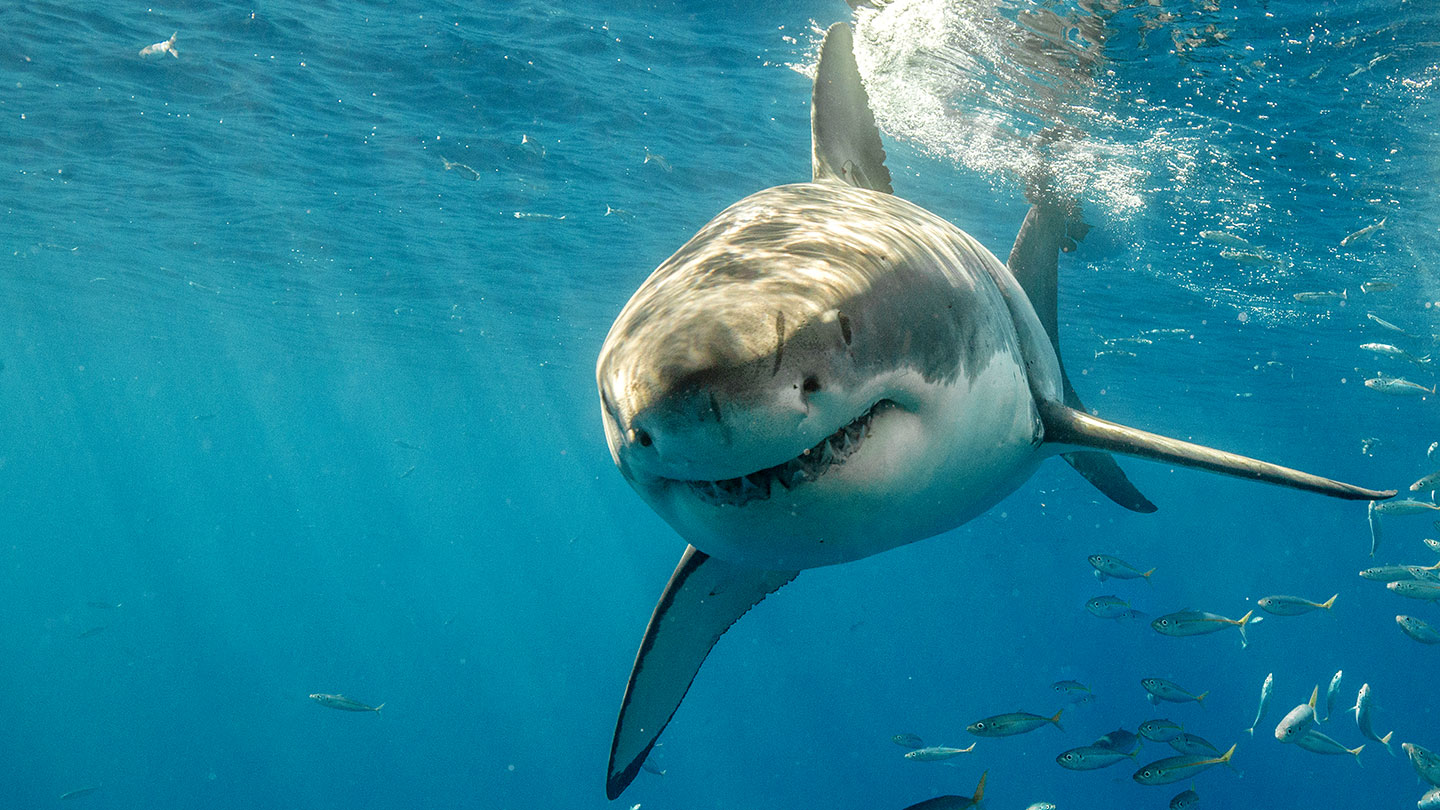
shark: A type of predatory fish that has survived in one form or another for hundreds of millions of years. Cartilage, not bone, gives its body structure. Like skates and rays, sharks belong to a group known as elasmobranchs. They tend to grow and mature slowly and have few young. Some lay eggs, others give birth to live young.
skates: (in biology) A type of diamond-shaped fish with a flat underside and long, skinny tail. Wing-like pectoral (side) fins sweep down from nearly their snouts to the beginning of their tails. They wave these fins to navigate, almost as though flying through the sea. Skates lay eggs in leathery sacks commonly known as “mermaid’s purses.” Like sharks and rays, skates belong to a group of fishes known as elasmobranchs.
skeptical: Not easily convinced; having doubts or reservations.
species: A group of similar organisms capable of producing offspring that can survive and reproduce.
stewardship: Taking care of something, such as the environment.
strait: (in geography) A narrow passage between two big bodies of water (often used in the plural form). Or the term for some difficult situation that leaves someone temporarily confused and/or stressed (again, often used in the plural form, as in: that put her in dire straits).
stress: (in biology) A factor — such as unusual temperatures, movements, moisture or pollution — that affects the health of a species or ecosystem.
suffocate: To be unable to breathe, or to cause a person or other organism to be unable to breathe.
survey: To view, examine, measure or evaluate something, often land or broad aspects of a landscape.
sustainable: (n. sustainability) An adjective to describe the use of resources in a such a way that they will continue to be available long into the future.
tag: (in conservation science) To attach some rugged band or package of instruments onto an animal. Sometimes the tag is used to give each individual a unique identification number. Once attached to the leg, ear or other part of the body of a critter, it can effectively become the animal’s “name.” In some instances, a tag can collect information from the environment around the animal as well. This helps scientists understand both the environment and the animal’s role within it.
threatened: (in conservation biology) A designation given to species that are at high risk of going extinct. These species are not as imperiled however, as those considered “endangered.”
tissue: Made of cells, it is any of the distinct types of materials that make up animals, plants or fungi. Cells within a tissue work as a unit to perform a particular function in living organisms. Different organs of the human body, for instance, often are made from many different types of tissues.
totem: Something that serves as an emblem to represent a family or group and that may harken to some element of its ancestry. It might be a shape, but is often some carved, molded or painted emblem of the natural world (such as an animal or plant).
trade: The buying, selling or swapping of goods or services — indeed, of anything that has value. Trade groups represent the makers or sellers of these goods and services. When nations talk about trade, they usually refer to the sale or purchasing of goods with one or more countries.
United Arab Emirates: A nation made of seven states, called emirates, that lies along the southern coast of the Persian Gulf. This oil-rich country, sometimes called the Emirates, shares a border with Saudi Arabia and Oman. Getting only 100 to 150 millimeters (4 to 6 inches) of rain each year, it hosts a large rocky desert, coastal wetlands and arid mountains.
vertebrae: (sing. vertebra) The bones that make up the neck, spine and tail of vertebrates. Bones in the neck are called cervical vertebrae. Bones in the tail, for animals that have them, are called caudal vertebrae.
vertebrate: The group of animals with a brain, two eyes, and a stiff nerve cord or backbone running down the back. This group includes amphibians, reptiles, birds, mammals and most fish.
whale: A common, but fairly imprecise, term for a class of large mammals that lives in the ocean. This group includes dolphins and porpoises.