


Like underwater cities on the floor of tropical oceans, reefs are bustling hubs of activity. Corals — relatives of sea anemones and jellyfish — are the main builders of these cities. Over time, the limestone skeletons of corals grow into structures that can tower above the seafloor. A quarter of all marine life also calls these reefs home.
Reef dwellers include a colorful mix of sharks and other fish, sea turtles, sponges, starfish, shrimp and more. Many types of algae also live on reefs. Some algae make their own limestone that adds to the reef. Many other algal species don’t. Left unchecked, those algae can overgrow a reef, taking space from corals. If algae overgrow the corals, a reef may stop growing.
But just as deer and other grazers on land keep plants trimmed, many animals graze and trim back a coral reef’s algae.
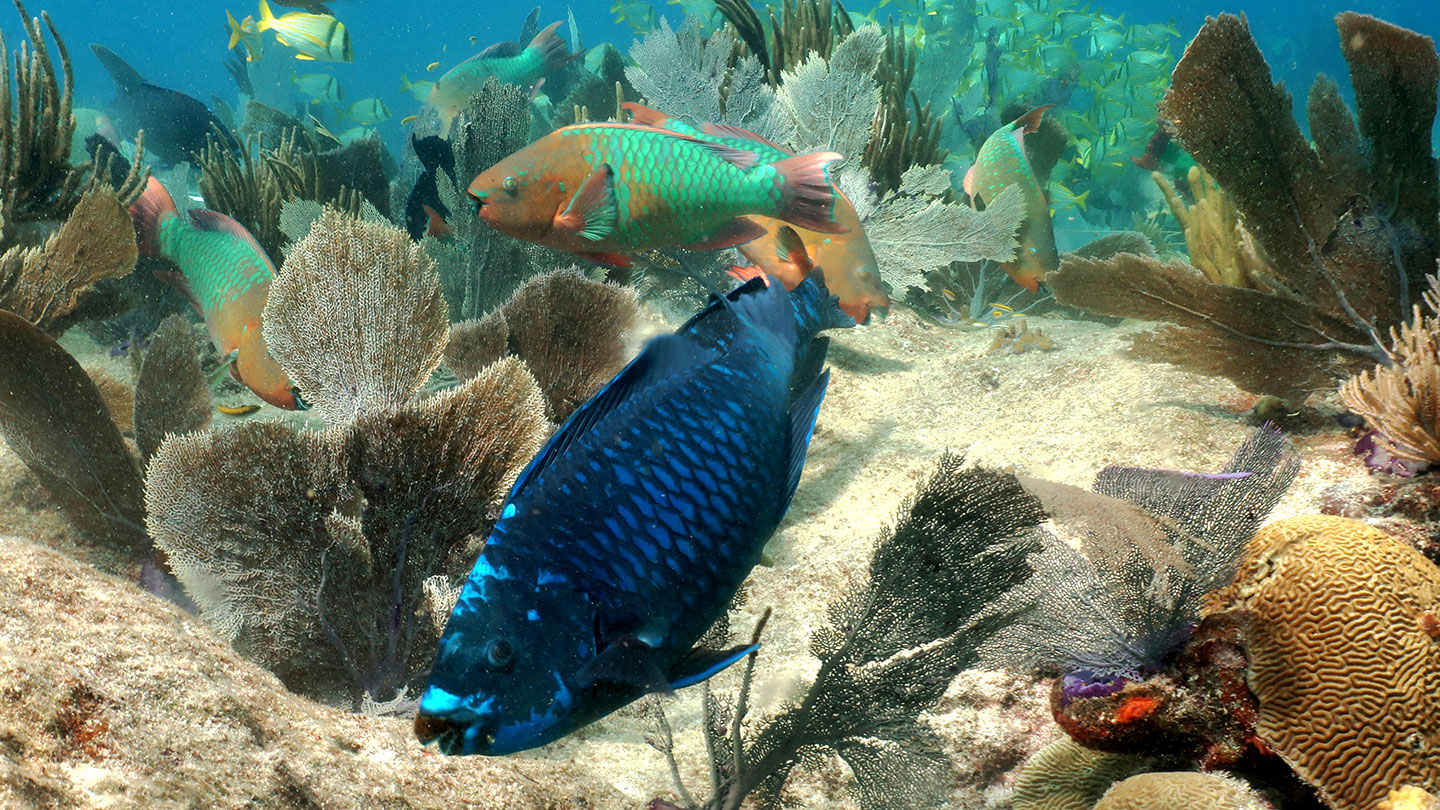
Parrotfish are especially avid algae eaters. These large fish can be as brightly colored as parrots. They also have somewhat beak-shaped mouths.
“They’re beautiful and colorful and the most prominent fish on most reefs,” says Katie Cramer. She’s a marine ecologist at Arizona State University in Tempe. By eating so much algae, parrotfish directly affect the amount of coral, she says. The fish clear space where new coral can come in and grow.
But the limestone structure of reefs in many areas is in trouble. This is especially true in the Caribbean Sea. Reefs there have less coral and more algae than a few decades ago.
One reason: fewer grazers. Many algae-eating urchins died from disease in the 1980s. And overfishing has caused parrotfish numbers to fall.
Boosting parrotfish populations has seemed like a promising solution. Today, parrotfish are now protected in many reefs.
But algae aren’t the only threat to reefs. And hungry parrotfish won’t eat just the algae. They’ll also chomp on chunks of the reef itself.
Scientists are now working to understand when nibbling parrotfish help reefs grow and when they reduce its limestone to sand. Indeed, parrotfish play a more complex role on reefs than once thought, emerging data show. And knowing more of that story may help guide projects that aim to restore and protect reefs as they face threats — from pollution and poisons to diseases and a warming climate.
Clues from ancient parrotfish
To understand parrotfish in today’s reefs, Cramer is exploring their history. “I’ve always been interested in what things used to look like,” she says.
In the Caribbean, many people fish parrotfish as food — and they do it heavily. As a result, many reefs have fewer parrotfish than they used to. Cramer wanted to learn whether overfishing is a recent problem. She also wanted to know what reefs were like before fishing took its toll.
Cramer is part of a team that has studied layers of sediments below living reefs near Belize. Off the coast of this Central American country are some of the most expansive reefs in the Caribbean. They are a part of the second largest barrier reef in the world. (Called the Mesoamerican Barrier Reef, it’s smaller than only Australia’s Great Barrier Reef.)
Over time, sediments accumulate under living reefs. Their layers hold the remains of animals that used to live there. These include coral skeletons, shells — and fish teeth.

Parrotfish have “a lot of teeth,” notes Cramer — more than other fish. Those teeth fall out and get replaced as a parrotfish grows. The number of teeth in sediment are one clue to how many parrotfish have lived on a reef. But because the fish keep making new teeth, there are far more teeth than parrotfish.
Researchers use a gravity corer to collect sediment. It looks like a giant metal drinking straw. It gets hammered into the seabed. When pulled up, it brings a cylinder — or core — of sediments. Layers at the core’s bottom are oldest. And the oldest layer of Belize cores formed 1,300 years ago. Layers at the cores’ top formed very recently.

By comparing samples from different layers, scientists see how the reef has changed over time.
Before searching each core for fish teeth, researchers must first pick out larger items, such as corals and shells. They put what remains into a weak acid. It’s about as acidic as vinegar. This dissolves everything except fish teeth. (Tooth minerals are so tough that they don’t dissolve easily.)
A parrotfish tooth is tiny — some are just a quarter of a millimeter (one-hundredth of an inch) across. That’s smaller than a grain of salt! Scientists must use microscopes to identify these teeth. “We had tons of students helping out with that,” Cramer recalls.
They found thousands of fish teeth in the cores. In layers from the 1700s, nearly half of all fish teeth present — 45 percent, on average — came from parrotfish. By the 1900s, that number dropped to just 24 percent. That suggests that far fewer parrotfish dwell in reefs today than back then.

It also suggests overfishing has been going on for a long time, Cramer says. Human populations in the Caribbean have grown over the past several centuries. High demand for seafood has upped the harvesting of many sea species, including parrotfish.
More parrotfish can help coral reefs grow
The sediment cores also told Cramer that reefs with more parrotfish had grown faster in the past. She was part of a team that dated the ages of coral skeletons in each core. Based on the core lengths, they could calculate how much the reefs had grown each year. With more corals, a reef grows faster.
More parrotfish eating more algae seem to have allowed corals to dominate these reefs, she says.
Parrotfish are now protected in many reefs. Fishing them is limited in some places and banned in others. Although these fish can swim in and out of protected reefs, their numbers tend to be higher where rules are in place.
Coral in the Bahamas grew more in reefs with protected parrotfish. These reefs had less algae, too. In Belize, too, scientists found more parrotfish and less algae in reefs where these fish were protected. But there, the amount of coral did not increase.
After corals die, parrotfish can help reefs rebound. Near the Caribbean island of Bonaire, a hurricane killed corals in 2008. Heat in 2010 killed even more. This left reefs with less coral and more algae. But between 2010 and 2017, young corals again started to grow in these reefs.
Scientists now believe that hungry parrotfish, which are protected in Bonaire, helped those corals out.
Corals start their lives as larvae that float in the ocean. When they find an open space on a reef, they attach to it. Now they can start to grow their limestone skeletons. By clearing away algae, parrotfish may have made more space in which new corals could settle.
Parrotfish can munch reefs into sand
But parrotfish cannot fix all reefs. In some cases, their chomping may actually damage the reef’s limestone structure.
Some species of parrotfish nibble, trimming just the tops of algae. Some scrape algae off a reef. But many parrotfish swim towards the reef with their mouth wide open and — crunch! — bite at both the algae and the limestone.
“Unlike most fish, you can hear them,” says Anthony Martin. Crackling sounds of parrotfish munching rock can resonate through reefs.
Martin is a geologist and paleontologist at Emory University in Atlanta, Ga. He studies trace fossils — signs of what animals did in the past. And parrotfish bite marks on reefs can become trace fossils.
But the main thing these fish leave behind is sand.
After eating limestone, these fish poop it out as sand. And parrotfish poop has a lot of sand, Martin says. For some species, a single parrotfish can make about 1,000 kilograms (2,200 pounds) of sand each year as it bites at reefs.
The sand these fish produce can be helpful, says Martin. Some becomes home to algae and sand-dwelling animals on the seafloor, he notes. Other sand adds to the beaches on nearby islands. All that sand is made as parts of reefs are destroyed.

Ana Molina Hernández studies how parrotfish eat reef limestone. A marine ecologist, she works at the National Autonomous University of Mexico in Puerto Morales. There, she studies bioerosion — how living things eat away at rock.
Parrotfish aren’t the only animals that chip away at reef limestone. But they’re the main culprit at reefs she studies in the Mexican Caribbean. Like the Belize reefs, these are also part of the Mesoamerican Barrier Reef.
Not all types of parrotfish affect reefs the same way. Some species eat more reef limestone. Others eat more algae, clearing space for new corals on reefs. Molina Hernández and her coworkers shared details of this in the November/December 2024 Conservation Letters.
A notable reef sculptor
The Caribbean is home to 16 species of parrotfish. Molina Hernández compared 10 of them. The stoplight parrotfish — the largest there — “is the most amazing,” she says. “He’s a great herbivore. But he also is a good eroder.”
This species grinds the most limestone into sand of all the fish she studied. Some smaller parrotfish species eat more algae and less reef limestone. These are better at clearing algae off the reefs, she says.
How much algae and limestone parrotfish eat also changes as a fish grows, she discovered. In general, older ones eat more rock and algae than younger ones.
On a healthy reef, corals grow at least as much limestone as parrotfish and other creatures eat away. “Coral reefs that are in good shape — that have a lot of living corals — can endure really, really high bioerosion rates,” says Molina Hernández. But on a reef where corals have died, little limestone gets added. So over time, these reefs will shrink.
“This is a really tough problem,” she says. Molina Hernández is seeing this unfold now on reefs in the Mexican Caribbean. These reefs protect the Mexican coast from incoming waves, she explains. Without that protection, “we are going to start to see more [loss] of the beach.”
Do you have a science question? We can help!
Submit your question here, and we might answer it an upcoming issue of Science News Explores
Reefs need more than parrotfish
Parrotfish can’t help corals that are struggling to survive due to other threats.
“We can fill our reefs with parrotfish, but this will not save corals,” says Lorenzo Alvarez-Filip. He’s a marine ecologist who works with Molina Hernández at the National Autonomous University of Mexico.
“It somehow seemed that this beautiful [fish] — because they are beautiful — could be the perfect superhero that will save reefs,” he says. But, he adds, “they will not save all the reefs from all the threats.”
Alvarez-Filip points to one big problem: too many nutrients.

Corals adapted to live in low-nutrient water. But nutrients like nitrogen from fertilizers and sewage wash into the sea from towns and farms. Just as fertilizer helps plants grow, nutrients carried into reefs spur the growth of algae. With too much algae, reef corals will struggle.
Warming oceans due to climate change also harm corals. In 2023 and 2024, extreme heat killed millions of corals in the Caribbean, Great Barrier Reef and other parts of the world. And then there’s disease. A killer — stony coral tissue loss disease — has been spreading through the Caribbean since 2014.
Parrotfish alone may not save reefs. That’s why it’s important that people help where they can. Spewing fewer greenhouse gases could slow climate change. Cutting nutrient runoff would help corals.
Even if you live a long way from a coral reef, you can help by protecting nature, says Alvarez-Filip. “Put your energy into solving the issues where you are,” he says. “If enough people do this, it will be helping coral reefs.”
Not long ago, Alvarez-Filip was diving in a reef in the Mexican Caribbean. He saw several young corals he had not seen before. In the same reef, older corals of the same species had died. He had feared the species might never return. But it did.
The young corals were small, just two or three centimeters (about an inch) across. But they gave him hope. If there’s enough space on the reef, young corals may make a home there. “We need to trust in corals that they are capable of coming back.”