



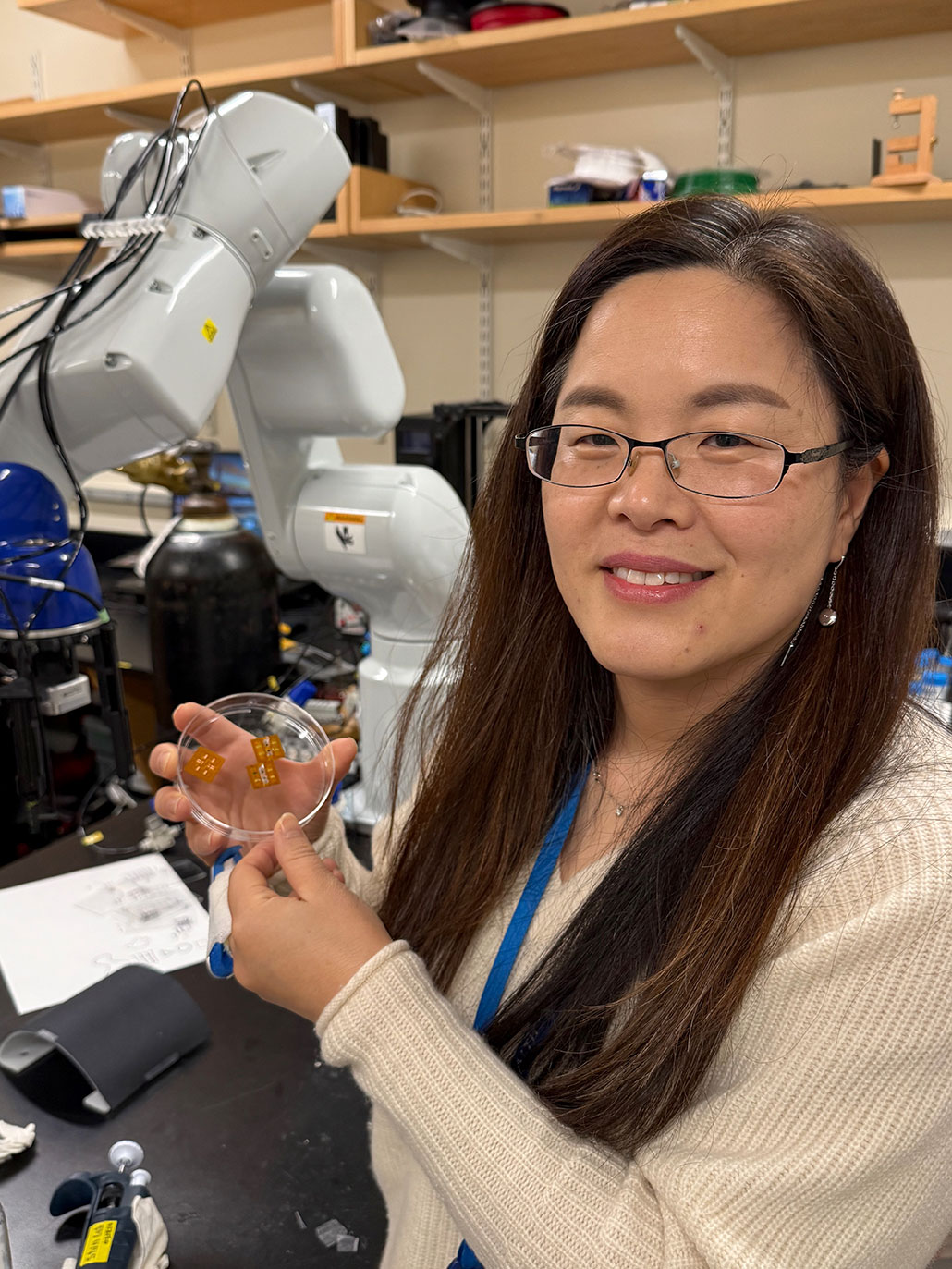
Nicole Xu reached into a Styrofoam tank to grasp a live moon jellyfish. Quickly and carefully, she inserted a tiny electronic device into the animal.
“It takes a little bit of practice,” she says. “But once you know how to do it, it’s very simple and very quick.” Xu is an engineer at the University of Colorado Boulder.
She handed the jellyfish to a pair of divers waiting in the shallow water off of an ocean pier in Woods Hole, Mass. The divers took the animal down to the bottom of the ocean, then released it. Speedily, it swam up to the surface.
Jellies swim by pumping water through their bodies. The device that Xu inserted used electricity to jolt the jellyfish’s muscles so they pumped faster. It reached the surface more than twice as fast as usual. In lab tests, the device tripled the animals’ speed.
With its speed-boosting implant, this jellyfish is a biohybrid robot. That means it contains electronics that interact with a living system. Researchers are building biohybrid robots with all sorts of living parts. They’ve experimented with insect antennae, human skin and muscle tissue, pill bugs, fungus and more.
It may seem creepy or weird to mash-up technology and living parts. But organisms have evolved to perform certain tasks over millions of years. In many cases, that allows their bodies to do things that remain difficult or even impossible for machines.
By combining biology and engineering, you can “create robots with capabilities beyond traditional machines,” says Shoji Takeuchi. He develops biohybrid robots at the University of Tokyo in Japan.
Cyborg jellyfish are just the beginning. Here are some of the most surprising, yet very real, examples of creature-machine combos — and the types of tasks they might be uniquely suited to accomplish.
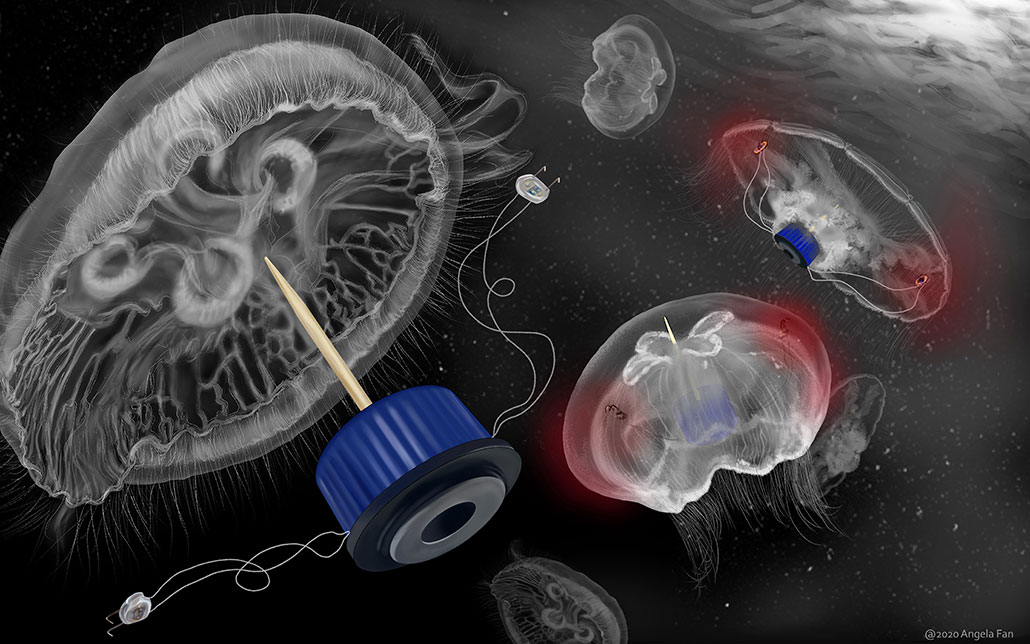
1. Cyborg jellyfish explorers
Xu is a big fan of jellyfish. Posters and artwork featuring the animals adorn her walls. She’s also in the process of building a larger jellyfish tank for her lab. It will sit in the window and be large enough to hold “dinner-plate-sized jellyfish,” she says.
Xu’s long-term goal is to turn teams of cyborg jellies into ocean explorers. “We could disperse them into a region of interest in the ocean, have them collect data for us and then go back to drop off the data,” she says. The jellies’ living bodies would power their movement. Their electronic parts would direct this motion and collect data.
There are a couple reasons cyborg jellyfish might be better for this job than typical robots.
For one thing, the moon jellyfish is “the most energy-efficient animal in the world,” says Xu. That means it powers its movements with less energy than any other creature. Mechanical robots, in contrast, are energy hogs. Typical underwater robots guzzle 10 to 1,000 times more power for their size than Xu’s biohybrid jellies.
Plus, standard robots tend to scare away sea creatures with their noise and lights. But moon jellies are common in oceans around the world. “Our robotic system isn’t freaking out different animals,” says Xu.
Experimenting with animals comes with important responsibilities. Researchers must consider the animals’ welfare. Xu points out that jellyfish are “very simple systems.” They have no brain or pain receptors. So it shouldn’t hurt them to get outfitted with robotic parts. And they probably don’t understand that their movements are being controlled. Still, her team is careful to let the animals rest and recover in between experiments.
Xu’s trip to Woods Hole took place in 2019. At the time, she was a graduate student working with John Dabiri. He is an engineer who runs a lab at Caltech in Pasadena. Now, both of their labs are spiffing out jellyfish. Dabiri’s team is putting sensors inside a stylish hat for the critters. The sensors measure things like water temperature and chemistry. A wooden pin inserted through the jellyfish connects the sensors to the plastic cap, holding everything in place. The hat’s shape also helps increase the animal’s swimming speed.
Meanwhile, Xu’s lab is looking for a way to direct jellyfish where to go. The device she tested in 2019 could only make a jellyfish go up or down. “Turning is an extremely challenging problem,” she says. That’s “because of how delicately the jellyfish buoyancy is balanced with the surrounding water.”
One option her team is considering would work sort of like a horse’s reins. Weighting the animal in one direction or another could make it turn.
2. Insect antenna sniffers
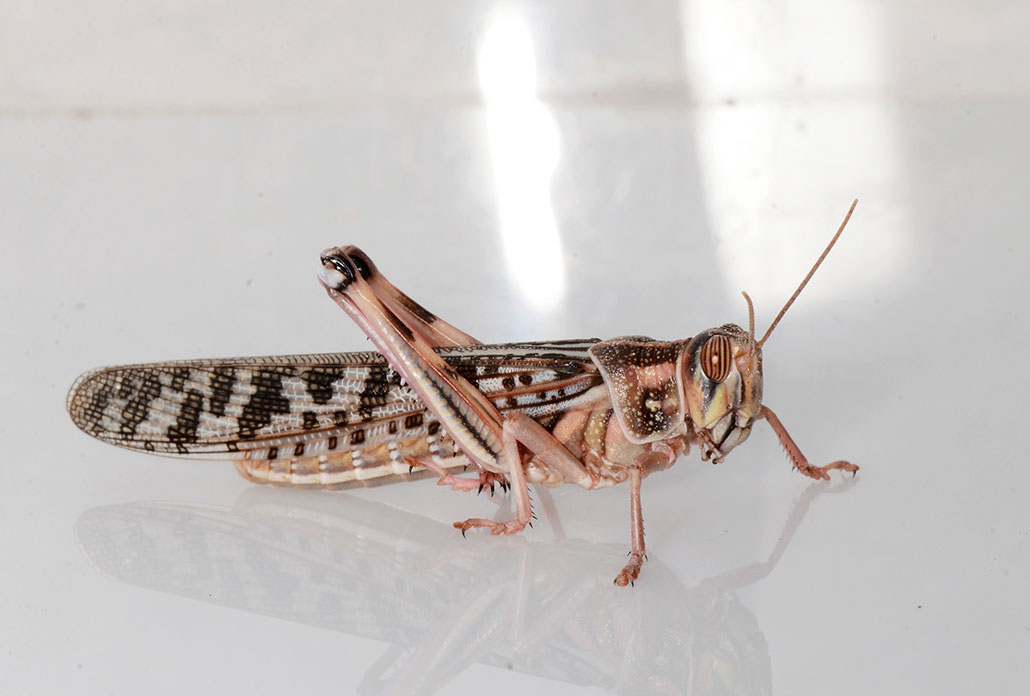
At Tel Aviv University in Israel, Amir Ayali cares for a colony of locusts. He studies insect brains and behavior. And recently, he has been developing insect-based tech.
“If you’re looking for inspiration in nature for your engineering or technological innovation, insects are a great place to look,” he says.
Locusts are very quiet animals, but “a little smelly,” he says. They also happen to be quite good at smelling. Locusts don’t have noses like ours. But the antennae that extend from their heads detect odors. In fact, locusts are “much, much better” at smelling than the best robotic noses are, says Ayali. In 2023, his team debuted a robot car that uses a locust antenna to sniff out odors.
Getting the antenna is easy. “We very delicately cut an antenna from the locust,” Ayali says. This insect “can survive happily” with just one antenna. And the severed antenna remains alive and sensing for around 12 hours — or longer if kept cold.
As different odors waft into the antenna, it responds with electrical signals. Normally, these signals would travel to the locust’s brain. Inside the robot, electrodes capture the signal. Next, machine learning software recognizes the unique patterns of different odors. “We eavesdrop on the information,” says Ayali.
An insect-based robot built at the University of Washington in Seattle uses a moth antenna to detect scents. And it flies. The creators call it a Smellicopter.
Ayali’s robot learned to identify eight pure scents, including lemon, rosemary and vanilla. It could also identify odors when they were mixed in with another scent. For these experiments, the team presented all the odors quite close to the antenna. Now, they are modifying the robot to be able to detect and follow odor trails.
Eventually, Ayali hopes, this sort of biohybrid robot might help sniff out bombs or illegal drugs. Or it might help find survivors after a natural disaster. When the antenna it’s using wears out, Ayali imagines that a robot’s handlers could just click in a new one.
3. Naturally nimble grippers
Robots have a lot of trouble picking up objects. But plenty of critters can latch easily onto a wide variety of surfaces — even delicate or slippery ones.
A team of Japanese researchers decided to put pill bugs and mollusks to work as robotic hands. Pill bugs have fourteen tiny legs that easily grab onto very light or fragile objects. And mollusks have incredible suction strength. They can grip all sorts of different materials underwater.
The researchers crafted harnesses for these small, living creatures and attached each one to the end of a robot arm. The pill bug grasped a wisp of cotton. The mollusk glommed on to pieces of plastic and wood underwater, lifting up the objects.
Though the animals did a great job grabbing things, getting them to let go wasn’t as easy. The researchers are now looking into ways to better control the animals’ natural reflexes. The team posted a paper about their research on arXiv.org in 2023.
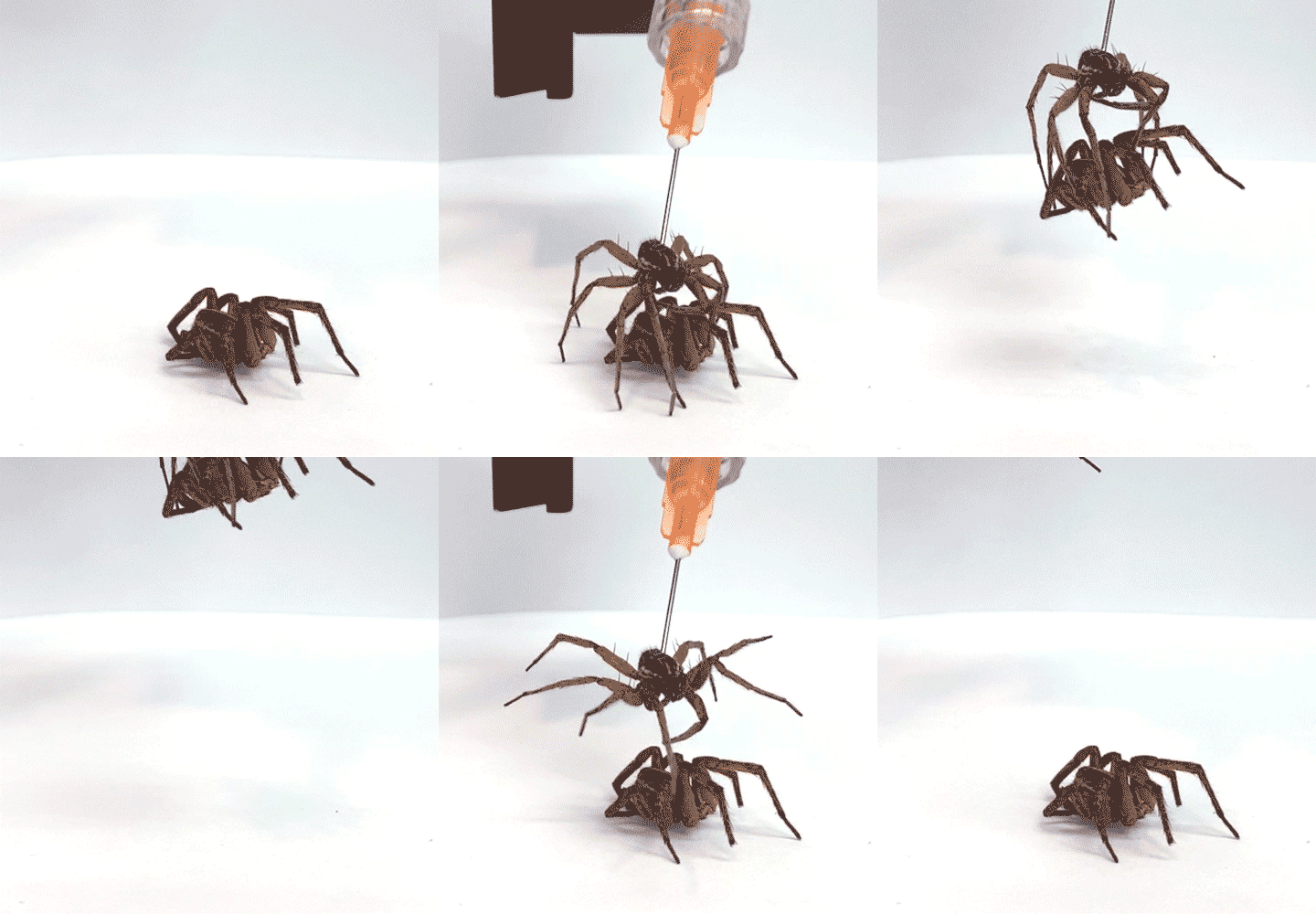
That project wasn’t the first time researchers had used whole animals to grab things. In 2022, a team at Rice University used dead spiders as robotic grippers. They coined the fittingly creepy term “necrobotics” to describe this type of dead body-based machinery. The dead spider bodies, though, were fragile. Living bodies or their parts tend to be quite strong. They can grow and repair themselves.
4. Beating heart cell swimmers
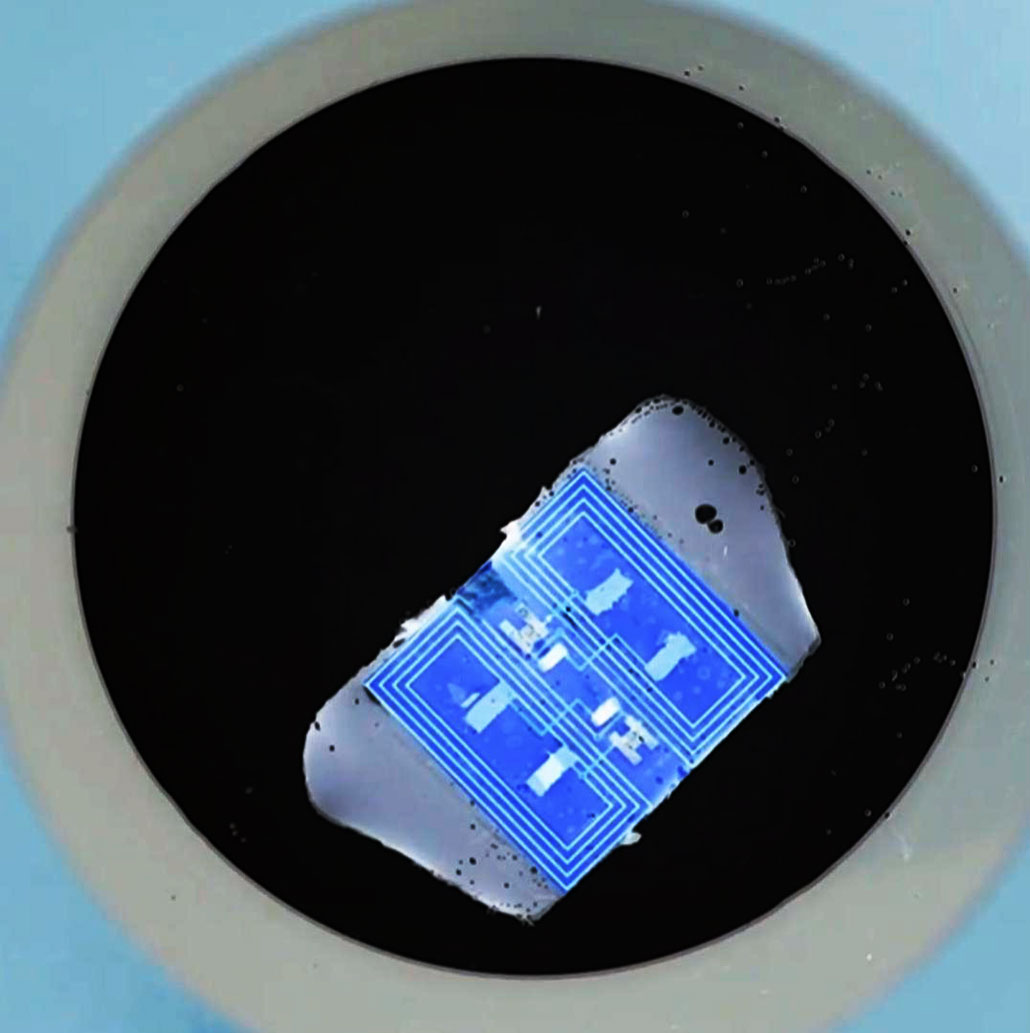
Engineer Su Ryon Shin doesn’t just make biohybrid robots. She grows them. The ones she’s working on now “look like a butterfly,” says Shin, who runs a lab at Harvard Medical School in Cambridge, Mass. Hiroyuki Tetsuka, a researcher in Shin’s lab, helped develop these swimming robots.
The robotic part of the “butterfly” is a square device about the size of a fingernail. To turn this component into a biohybrid robot, Shin 3-D prints two wings onto it. The wings are made from a gel-like material that she developed, which contains particles that boost cell growth.
Next, Shin places the winged device into a petri dish with liquid that can keep human cells alive. She dots it here and there with heart cells. She also adds neurons. Though neurons may be best known for powering thinking in the brain, these cells exist throughout the body. The neurons in Shin’s robots come from human muscles. There, they control movement.
Both types of living cells divide and grow to cover the entire butterfly shape. Now, Shin can control the robot using wireless signals from a phone. These signals prompt the device to zap cells in either the left or the right wing with electricity. When the neural cells get zapped, they trigger nearby heart cells to beat. This makes the wings flap and the robot swim.
Zapping the heart cells directly would require higher power and a pretty big wireless device, says Shin. The living brain-like network controls the robot more efficiently. This mash-up of neural cells and heart cells doesn’t exist in nature. But it works.
Shin’s inspiration to add living cells to her robots came from another researcher, Kevin Kit Parker. Parker’s lab is nearby at Harvard Stem Cell Institute in Cambridge. He has also grown small, swimming biohybrids from heart cells. One looks like a fish.
Parker and Shin both have ambitious end goals for their work. The tiny swimmers are just one stop on this path. They hope to someday grow new hearts or other cyborg body parts for people. These body parts would contain living cells and robotic parts that would trigger the tissue to grow and move naturally.
Getting there, says Shin, will “require a long time.”
5. Human skin for androids
When you imagine a robot, you probably think of shiny metal, not living skin. Someday, though, robots might wear skin just like we do.
Shoji Takeuchi and his team found a way to attach living human skin to a robot. The robotic structure can move, stretching the skin into a smile.
If you think that’s super creepy, you’re not the only one. “I understand why some people might feel uneasy,” Takeuchi says. The face-like robot falls into something roboticists call the uncanny valley. (Uncanny is another word for creepy or weird.) When a robot, doll or other character looks not-quite human, that can make people uncomfortable.
TAKEUCHI ET AL. CC-BY-ND
“I don’t find it creepy because I see it as a scientific achievement,” says Takeuchi. To create this robot, his team first crafted a surface filled with V-shaped holes. Then the researchers added skin cells. These cells grew to cover the surface and filled the holes.
“This process typically takes about two weeks for the skin to fully form,” says Takeuchi. The cells that grew inside the holes acted like anchors to hold the surface skin in place.
Why build a robot with living skin? Takeuchi has many ideas. Living skin heals itself. So a robot with skin could reform itself after damage, something that metal can’t do. His long-term goal, though, is more lifelike robots. A robot with skin could make more human-like expressions. That might make people feel more comfortable around robots. Robots that are better at interacting with people “could be useful in healthcare, companionship and customer service roles,” says Takeuchi.
Right now, the skin has to be immersed in a special liquid to keep the cells alive. And it has no sense of touch. In the future, Takeuchi hopes to add blood vessels that would help keep the skin alive. Then it wouldn’t have to sit in the liquid. He also wants to give the skin the ability to sense touch and temperature.
Do you have a science question? We can help!
Submit your question here, and we might answer it an upcoming issue of Science News Explores
Is it alive?
For Shin, the most important application of biohybrid robotics is to support human health. Biohybrid robotic tissues could become part of our bodies. The reverse idea, adding human body parts to robots that act as companions or workers, seems a little scary to Shin.
Biohybrid engineers “have to think carefully about that,” she says. She wouldn’t want human bodies to be treated like a material.
Using body parts from simple animals in robotics is not as controversial. But it’s still important to consider the impact on these living creatures. It may seem that bugs and jellyfish and mollusks aren’t capable of caring about how we use their bodies. But what if we’re wrong about that? Some researchers are finding that such creatures might have more awareness and feelings than expected.
Living robots also interact with the environment. What if a jellyfish outfitted with electronics got eaten? Xu is hoping to develop biodegradable electronics that wouldn’t harm other animals or pollute the ocean.
Biohybrid robots blur the line between machine and living thing. The jellyfish cyborgs are obviously still alive. But most biohybrids don’t really fit into one category or the other. Shin says of her heart-cell-covered bot: “it’s not a creature.” But it’s not a typical robot, either.
What do you think?