


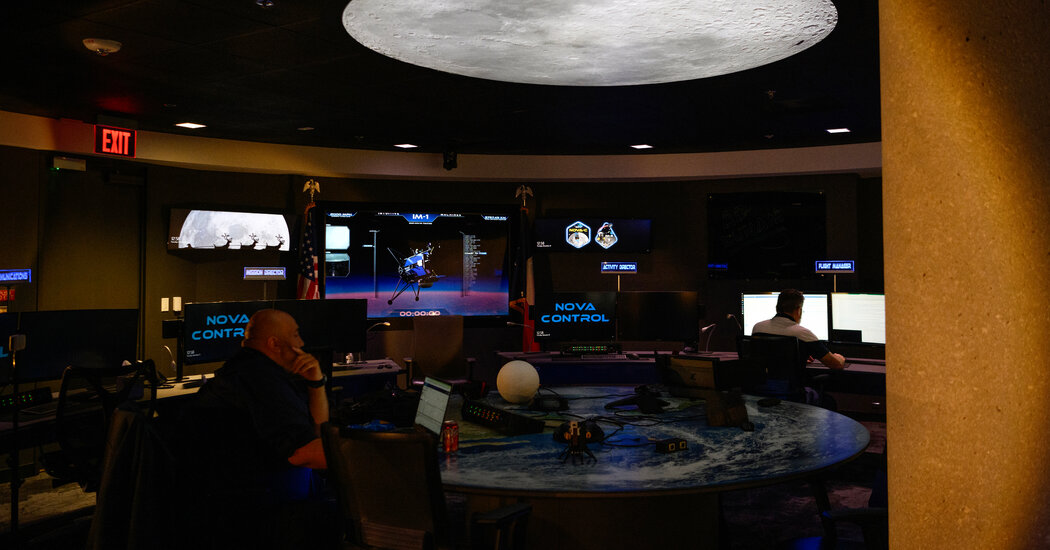
Much of the American space program is run out of nondescript offices in the Washington, D.C., suburbs. That’s where Kam Ghaffarian, the billionaire space entrepreneur, could be found on an auspicious day. Exactly 47 years before, he had immigrated to the United States from Iran. Mr. Ghaffarian, 66, sat at a table made of gently glowing white onyx, also from Iran.
Mr. Ghaffarian said he imported the stone because of its unique translucence when lit and because of the energy (spiritual, not physical) that the billion-year-old mineral emits. He is a big believer in the importance of meditating to connect with the energy in the universe, which he has done on a daily basis for decades.
“When you touch it, you feel the energy of the stone,” he said. “How many years? Go ahead, touch it.”
He was in the market for good energy. Just a few weeks later, Mr. Ghaffarian’s company tried to do something no private organization has ever done: Touch down softly on the surface of the moon.
Mr. Ghaffarian specializes in moonshots. His array of companies includes not just the one sending a lander to the moon, but also one building a space station to put in orbit around the Earth, another designing advanced nuclear reactors, a venture fund and a nonprofit studying faster-than-light travel technology. His projects are the kind that Silicon Valley frets about having given up on. They are bets on tangible technology, not software, where metrics like hits and clicks are replaced with the hard questions of physics.
And while bombastic billionaires like Elon Musk and Jeff Bezos have captured attention for their efforts to launch futuristic reusable rockets, the lower-profile Mr. Ghaffarian’s companies have helped answer the question of what to do with them, becoming crucial in the increasingly close partnership between NASA and private industry. SpaceX’s key innovation has been building rockets that have brought down the cost of going to space. Mr. Ghaffarian’s firms are using those cheap rockets to commercialize space activity in ways that Mr. Musk’s SpaceX hasn’t pursued, while Mr. Bezos’ Blue Origin has yet to reach orbit.
Mr. Ghaffarian is a believer in that public-private model. “If you look at cars or planes and all of that, there were entrepreneurs who created that and changed the game, right?” he said. “What comes to mind is Henry Ford or Howard Hughes.”
Going Private
Intuitive Machines, co-founded by Mr. Ghaffarian in 2013, is the only publicly traded American company focused on lunar exploration. The goal is to eventually build power stations, satellite networks and other infrastructure for the kind of sci-fi moon base that space dorks have lusted after for years.
On Thursday, Intuitive Machines launched a moon lander named Odysseus onboard a SpaceX rocket, the first of two it intends to dispatch to the nearby satellite this year on NASA’s behalf. When the lander reported a successful separation to its flight controllers, Mr. Ghaffarian received a text message from Intuitive’s mission director: “Congratulations Kam, you’ve got a new boy, his name is Ody, and he’s already talking.”
If all goes well, Odysseus will land on the moon on Feb. 22. The hexagonal lander is studded with the space agency’s cameras, lidar, a laser reflector and a sensor to measure the moon’s plasma environment.
But unlike the typical NASA mission, this one carries cargo paid for by private organizations. Odysseus has insulation designed by Columbia Sportswear, a stunt based on the company’s insulated jackets. It carries the first data center from a company, Lonestar Data Holdings, that wants to store information on the moon. And it contains art: 125 miniature moons created by Jeff Koons and sealed in a six-inch plastic cube, paid for by an NFT company and intended to be left on the lunar surface.
“Even five years ago, I wouldn’t talk about lunar activity,” said Chris Quilty, a space industry analyst who credits Intuitive Machines with normalizing the idea of a moon business. “People would look at me kind of funny.”
Becoming the first private company to safely reach the moon (or any other astronomical object, for that matter) would be no small feat. The lunar surface is dotted with recent failed attempts. Astrobotic, the first American company to launch, suffered a fatal propellant leak before it made it into lunar orbit; another rival went out of business before even getting off the ground.
As for the national programs, their record isn’t much better in recent years. A Russian touchdown went awry, and India failed in its first attempt in 2019 before succeeding last year. Japan’s space agency put a lander on the moon in January, just to see it tip over. Only China’s National Space Administration has touched down cleanly on the moon multiple times in the 21st century.
American space believers, and hawkish members of Congress, feel pressure to catch up. NASA’s decision to hire Intuitive Machines and others to send robots to the moon is intended to accelerate the nation’s lunar return. Intuitive Machines is one of more than a dozen firms NASA tapped to bid on lunar landing missions. This current mission is, essentially, the first wave of the Artemis program, begun by the Trump administration in 2017, which aims to have American astronauts touch down again on the moon as soon as 2026.
When the Apollo program sent astronauts on brief missions to the moon between 1969 and 1972, those voyages of discovery were intended to demonstrate U.S. technological superiority.
The goal of this generation’s moon campaign is slightly different. As the NASA administrator Bill Nelson likes to say, this time, we’re going to stay.
Artemis, if NASA gets its way, will have humans making repeated, long-term visits to Earth’s nearest astronomical neighbor, for scientific research and to enable exploration deeper into space. There’s another new goal: The agency also wants to create the conditions for an off-world economy — eventually building up infrastructure, transportation, payment systems and more. (All of that would, yes, demonstrate America’s innovative might to global rivals and friends alike.)
NASA has always needed private companies to build its vehicles and staff its facilities. (Mr. Ghaffarian even worked for Ford’s no-longer-extant space division at the beginning of his career.) But traditionally, the agency reserved control of design decisions for its elite engineers.
In the years after the loss of the space shuttle Columbia and the seven astronauts on board in 2003, NASA decided to focus its limited budget on science and deep space exploration, and to outsource the design and fabrication of vehicles to reach the space station to private companies like SpaceX. Notably, the companies would own the IP and the vehicles after the fact, and they could sell their services to private customers.
“Sometimes our ambitions extend beyond what resources are provided through the usual channels,” Alexander MacDonald, NASA’s chief economist, said of the agency’s public-private partnerships. “We can’t do everything we want by ourselves.”
The success of this model changed the business of space. NASA saved billions of dollars, while SpaceX has come to dominate the rocket industry. This seeded a new generation of space companies eager to take advantage of the falling cost of access to space—and to pitch NASA on similar team-ups, which allowed the agency to stretch its limited budget further. Venture capitalists and Wall Street investors were thrilled at forecasts of a “trillion-dollar space economy” from the likes of Morgan Stanley, and threw billions of dollars at firms that wanted to do business in orbit. Mr. Ghaffarian saw an opportunity to make up for lost time.
A Cog in the Space Program
If you talk about space with anyone of a certain age, the moon landing inevitably comes up. Mr. Ghaffarian saw one small step for man as an 11-year-old in his hometown, Isfahan, watching on his neighbor’s TV. He slept outside with his brothers on hot summer nights, mesmerized by the stars. He knew the road there went through the United States. At 18, in 1977, he abandoned a scholarship at Iran’s well-regarded Shiraz University, and caught a direct flight from Tehran to New York City with $2,000 borrowed from an uncle.
In the United States, he studied computer science. After graduating, he got a job working on mainframes at Georgetown University Hospital, in the basement next to the morgue. He became an ardent American citizen. Soon, he joined Lockheed Martin, working as a contractor to build the computer systems that pull down scientific data collected by astronauts: He was a cog in the space program.
One day, in 1994, he took out a $250,000 mortgage on his house; called a former boss, Harold Stinger; and convinced him they should start their own firm offering engineering expertise to NASA on a contractual basis. Over the next two decades, the minority-owned small business grew to become one of the space agency’s top contractors.
His firm had won a dream role in a program under the George W. Bush administration to return to the moon, but as NASA’s budget forecasts became bloated and the 2008 financial crisis shook the economy, the Obama administration canceled the program in 2010. “I hated the decision,” Mr. Ghaffarian said. “We have wasted so much money on the programs within NASA that we started that we didn’t complete.”
In 2007, he accompanied his business partner Mr. Stinger on a philanthropic trip to Kinshasa, Uganda. There, Mr. Ghaffarian had a bit of a midlife crisis. His “transformation moment” came as they visited a school they sponsored, which wasn’t connected to the electrical grid.
Mr. Ghaffarian says he realized that “if you don’t have power, you don’t have clean water, you don’t have education, you can’t really get out of poverty, and then I’m also looking at climate change.” Now financially independent from the business he’d started with Mr. Stinger, he decided to found a string of companies tackling challenging problems, starting with X-Energy in 2009, dedicated to building nuclear reactors, and soon followed by businesses in orbit and beyond.
Mr. Ghaffarian is a collector of people. He spots his targets at the awkward meetings when a losing NASA contractor hands over the keys to the winner, or at a poker game he hosted for space insiders. He stays in touch, and one day, he convinces them to take a job — or start a company.
Steve Altemus got collected when he was the top engineer at NASA’s Johnson Space Center in Houston. After 24 years at the space agency, Mr. Altemus wanted to do something different.
In 2013 he co-founded Intuitive Machines with Mr. Ghaffarian. The idea was to apply NASA know-how to solve problems in other industries — medical devices, advanced energy production — but a sustainable business plan was slow to emerge. Then, in 2018, under NASA’s new model, the agency issued a call for the private sector to carry scientific sensors to places like the craters of the lunar South Pole, where orbiting spacecraft have detected evidence of water ice.
It was a risk to pour millions into a business that did not exist beyond a gleam in NASA’s eye, but Mr. Ghaffarian, Mr. Altemus and Tim Crain, Intuitive Machines’ chief technology officer and another former NASA engineer, felt the pull of the moon. After the Obama-era program cancellations, “for years I couldn’t look at the moon without getting a queasy feeling in the pit of my stomach,” Mr. Crain wrote in an email. “I wanted to be sure that we were really going to give the effort the energy it deserved.”
In the next five years, the team designed, tested and built its moon lander; won a series of NASA contracts; and went public in 2023, raising tens of millions of dollars in capital and making Mr. Ghaffarian, on paper at least, a billionaire.
The World’s Space Airline
Mr. Ghaffarian’s other big bet on the new space economy, Axiom Space, co-founded in 2016 with Michael Suffredini, the longtime manager of the International Space Station, could be called the world’s first spaceline. It trains and flies passengers on SpaceX rockets to the International Space Station for stays of about a week, in preparation for building its own space station. Axiom faces competition from other would-be space station companies, including Mr. Bezos’ Blue Origin. And it’s grabbed headlines for a partnership with Prada to design lunar spacesuits for NASA.
When the space agency announced in 2019 that it would charge about $3.5 million per passenger for visits to the International Space Station, some fretted about the inequality of allowing the wealthy to visit a government lab in space. The full cost of a trip also includes a rocket ticket thought to cost $60 million or more.
But Axiom’s subsequent business has turned out differently: It has taken on the role of flying astronauts from friendly foreign nations seeking more experience in orbit.
In January, Axiom flew the first Turkish astronaut, Alper Gezeravci, as part of an international mission that included Swedish and Italian astronauts; it is planning an all-British mission next year. Last year, it flew a crew that included two Saudis, one of whom was the country’s first female astronaut.
“The ability of the U.S. private sector to expand such opportunities is, in my view, very complementary to U.S. diplomatic interests,” Scott Pace, the director of George Washington University’s Space Policy Institute, wrote in an email. “Flying foreign astronauts on commercial missions is just a new facet of U.S. leadership in space.”
The coalition of countries that operate the International Space Station expect to retire it before the end of the decade. But NASA and the rest of the world will still want outposts in orbit close to our planet. True to its new partnership approach, the agency has asked private companies to develop their own stations. Axiom has set out to do that, and won the right to attach its own module to the International Space Station in 2026.
There is a risk that these big swings have come too soon: SpaceX was able to sell its rockets to many customers seeking access to space, but the commercial market for visits to space stations or the moon is far less proven. It may not be as robust as hoped, or robust enough to support multiple companies.
True believers in the space economy, though, envision moving from a world of government space exploration toward a future where activity in space is much like activity on Earth — a mélange of people, companies and countries with divergent aims. Before the Odysseus launch, Mr. Ghaffarian spoke to the assembled crowd of his colleagues, NASA civil servants, SpaceX employees and investors, taking them on an imaginary journey decades into the future.
“We might have hourly visits to the space station or Space City, daily trips to the moon, and weekly trips to Mars, and maybe interstellar travel,” he told them.
“I just believe that the ultimate destiny for humanity is to go to stars,” he said.