


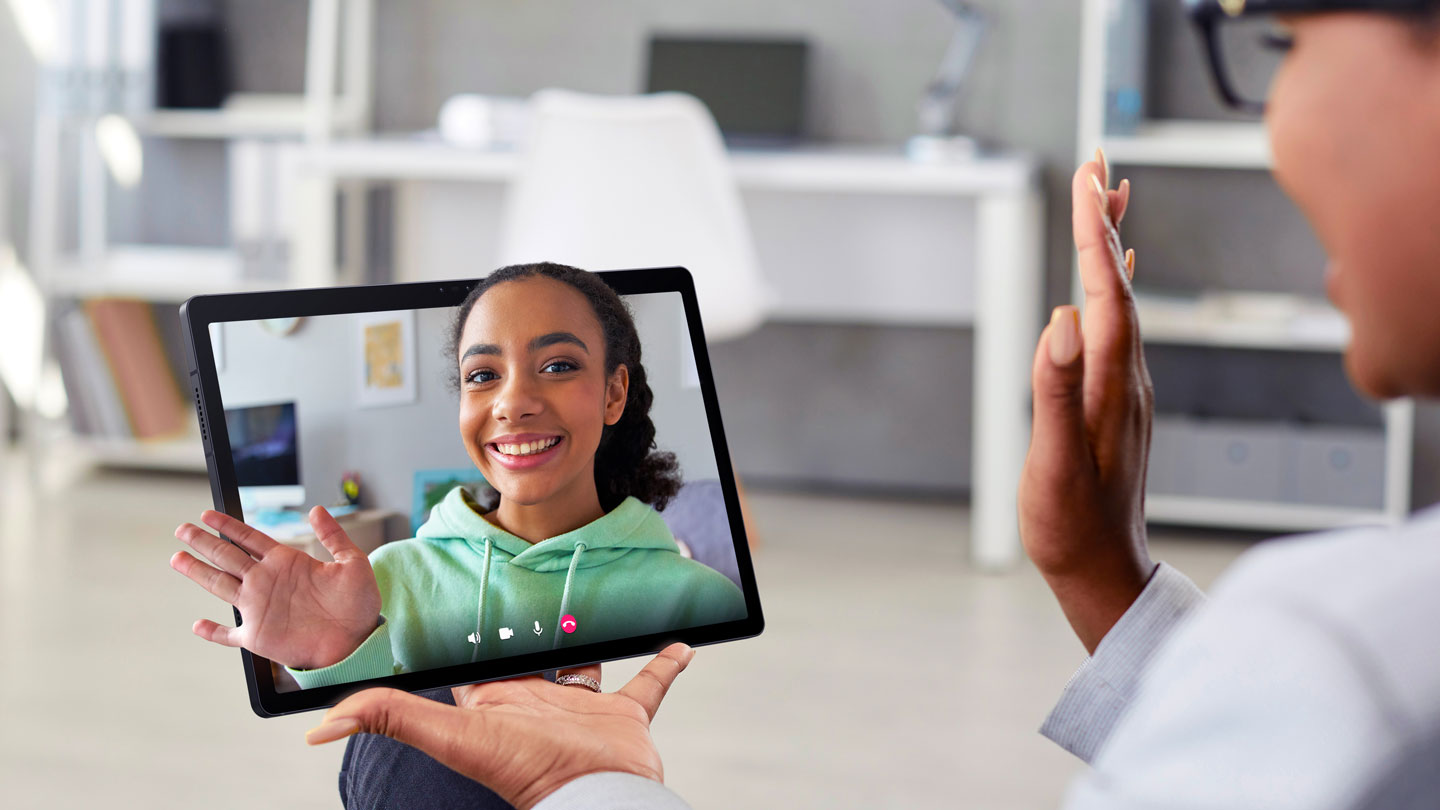
You wake up and yawn, then put on a special pair of glasses. As you’re getting ready for the day, a friend calls. The glasses project an image of your friend in front of you, like a hologram.
“I designed a new shirt,” they tell you. An image of a stylish top appears in front of your eyes. You spin it around in mid-air with a swish of your fingers. “I’ll print this out to wear today!” you say.
You send the file to a 3-D printer in the next room. As it whirs away, a helper robot makes a sandwich for you to take for lunch.
Later, as you pull on a pair of shoes — 3-D-printed to fit your feet perfectly — your glasses ding with an alert. A message appears in the air in front of you: You might be coming down with a cold or the flu, it says. A ring on your finger has an array of sensors. They had detected changes in your body that signal you might be getting sick.
You wear that ring all the time to track your health. It never needs charging because it powers itself from your body heat. You realize you don’t feel sick yet. But the alert suggests that just to be safe, you ought to wear a mask, drink extra water and go to bed early tonight. As your robot cleans up the kitchen, you head out the door.
In 2025, this morning routine is entirely science fiction. But during your lifetime, all of these moments could become normal. Engineers and entrepreneurs are working on every single one of those technologies. Here, we bring you their visions of your future.
#1 Hang out as holograms
In Star Wars, the robot R2-D2 beams out a hologram of Princess Leia asking for help. She appears in midair, visible from all sides. That’s not realistic, notes Alex Kvasov.
Glasses that produce 3-D illusions are quite real, though. He imagines that one day we might put on such glasses to have a virtual hangout with friends. Or you might experience a football game as if the stadium is “on the table in front of you.”
Kvasov is working to make this future a reality at CREAL. It’s a company he co-founded, based just outside of Lausanne, Switzerland. The glasses this company makes now are hooked up to a complex system of optics.
These optics project a series of rapid images — up to 6,000 per second — toward each of your eyes. These images show slightly different angles of one or more objects, based on how their light would reach your eyes if the objects were real. Your brain combines all the light coming through the glasses (from reality and from the illusions) into a scene that makes sense.
Most impressively, the virtual objects come into focus or blur realistically, based on where you look.
It’s one example of light field display technology.
The optics and computers — not to mention the batteries it takes to run this tech — don’t yet fit into one slim pair of glasses. You can find examples of augmented reality glasses for sale. The company Meta makes Orion glasses, for one. But these only project flat virtual images. The headgear is also pretty bulky. As of today, that’s “the best we can do,” says Kvasov.
While you’re waiting for your futuristic glasses, though, you can experience holograms in other ways. One group of engineers created a futuristic display that allows you to touch and move virtual objects.
And the company Leia Inc. has developed a new type of display for tablets or computers. A layer of tiny structures over a regular screen “basically can steer light,” says Jochem Taminiau. He heads marketing at the California-based company. A camera tracks your eyes to figure out where to direct the light, he explains. This tricks the brain into seeing a 3-D scene.
It’s like “having an open window” instead of a screen, says Taminiau.
#2 Print your own outfit
When Gihan Amarasiriwardena was a teen growing up in Massachusetts, he loved camping and wanted to make his own gear. So he glued pieces of fleece to a plastic garbage bag to make a warm vest. “Wearing a trash bag is exactly how it feels,” he recalls. It’s hot and sweaty!
Now, this engineer invents new (and more stylish) ways to make clothing at a business he co-founded. Called Ministry of Supply, it’s based in Boston, Mass. The 3-D printers he works with are called computerized knitting machines. They weave together threads or yarns. Most of these machines are as big as a refrigerator, he says. So they’re hardly something we’d want at home.

But they can already provide clothing that’s custom-made for your body. One example is a sweater that can keep you warm without making you sweat too much. To customize your sweater, you stand in front of cameras that detect body heat. That’s how “[we] figure out where the hotspots are,” says Amarasiriwardena. Then the machines weave thinner areas of material over those spots.
You can also step on a pad that figures out how your foot presses down as you walk. That info can be directed to a 3-D printer that can put cushioning into socks, just where you need it. Some parts of those socks also contain a fiber made from coffee grounds, which absorbs stinky smells. “We put it particularly in the sweaty areas,” says Amarasiriwardena.

You’ll need some shoes to go with those anti-stink socks. Our feet are “all different shapes,” observes Asher Clark. A shoemaker, he co-founded Vivobarefoot. It’s based in London, England. This company makes what it calls a scan-to-print-to-soil shoe. (The “soil” part is just to point out that the shoe’s materials are environmentally friendly.)
To get a pair, Clark explains, someone “scans their feet, picks the style, the color.” A computer program maps the style to the shape of their foot. Then the shoe forms inside a special type of 3-D printer. It contains “a big chamber of powder,” says Clark. A laser beams into the powder, “fusing it layer by layer.”
The resulting plastic can’t be composted in a backyard bin, like yard clippings and food scraps can. After all, a shoe that broke down too easily wouldn’t last long as you run around outside, says Clark. But an industrial composting facility can break down this material.
Both Amarasiriwardena and Clark note that the best way to make fashion more sustainable is to make fewer items and to use each one longer. Currently, factories churn out lots of clothing and shoes that get worn once or twice or not at all. Most items end up in landfills. So using recyclable materials to 3-D print only what we need — and would use a lot — could make fashion “greener.”
Eventually, as 3-D printing gets less costly, “a lot of things will be made at your house,” Clark predicts. He foresees a trend where people will create their own brands, developing true “ready to wear” fashion at home.
#3 Robots do your chores
“Hi, Robot,” says Chelsea Finn. “Can I have a sandwich with roast beef and cheese, please?” She’s not at home getting ready for school. She’s the co-founder of Physical Intelligence (PI for short), a company based in San Francisco, Calif. Standing in her lab, she’s watching a set of robot arms dutifully pick up bread, meat and cheese.
Floor-scooting robots that vacuum up lint and crumbs have been helping some families with their chores for more than 20 years. But until recently, robots could only perform very specific jobs. The more repetitive and predictable, the better.
What most of us really want are robots that can help with just about any chore we give them.
“Laundry is one thing that I don’t want to do,” says Lucy Shi. She’s a researcher at Stanford University in California who also works at PI. Unfortunately, laundry is one of the most robot-unfriendly tasks out there.
There are just so many ways clothes can be “crumpled and folded on top of themselves,” Finn explains.
Last year, her company announced a new artificial-intelligence model, called pi-zero. It “allows a robot to do lots of different things,” she says, “not just one very specific thing.” That AI model even directed some impressive robot laundry-folding.
Pi-zero uses a form of machine learning to predict how a robot should move to accomplish some task. The model can even control different types of robot bodies, Shi notes.
In order to interact with us at home, though, robots need to be able to communicate with us. Hi Robot, which PI debuted earlier this year, is a different AI model. It can interpret someone’s simple, spoken instructions and translate them into actions that the pi-zero model can then direct a robot to take.
In the sandwich-making example, Hi Robot turns Finn’s request into a series of tasks to do in order. Pick up one slice of bread. Put it down on the cutting board. Pick up one slice of roast beef. Put it on the bread. Plenty more steps will follow.
But that’s not all. Hi Robot can handle interruptions.
“In the real world, there are all kinds of unexpected things,” says Shi. When someone gives a robot feedback, it has to be able to “react to it on the fly,” she says. Hi Robot can. When Finn interrupts the sandwich-making process to ask for a slice of tomato, the robot stops and adds it to the sandwich.
#4 Avoid getting sick
Many people already wear a smartwatch or ring. Its sensors can track your temperature, heart rate, steps and more. If you’ve been sitting too long, it may remind you to stand up and move around. If you’re moving around a lot, it may ask if you want it to log a workout. Soon, these devices could tell you even more.
If you’re getting sick, for instance, a smart device might know even before you do.
Peter Cho and Karnika Singh are biomedical engineers at Duke University in Durham, N.C. They’re studying how smart devices might help sense illness.
During the COVID-19 pandemic, Singh recalls, they ran a study where volunteers were “donating their [smartwatch] data and letting us know when they got sick with COVID.” The results revealed that heart rates got higher five to 10 days before a positive COVID test. In addition, five days before that positive test, people were already taking fewer steps than usual.
In another test, Duke researchers worked with people who volunteered to get a cold or flu virus — all in the name of science. “They are coming into the clinic for roughly 10 days,” Cho says. Over that time, they agreed to stay quarantined as they fell ill. Throughout, researchers monitored them closely.
This monitoring included use of a smartwatch. Its data alone could reveal whether someone would have severe or mild symptoms. And those data could predict this a full 12 hours before symptoms emerged.
Sensor data alone can’t diagnose disease, be it COVID, the flu or even a cold. Other illnesses or changes to your lifestyle might be to blame, says Singh. But such warnings could certainly trigger an alert. It might encourage the wearer to put on a mask or get tested. And that might prevent them from spreading germs before they even know they are contagious.
Smartwatch alerts might even help prevent another pandemic, says Märt Vesinurm. He’s a Ph.D. student in industrial engineering at Aalto University in Espoo, Finland.
During the COVID-19 pandemic, people often spread disease before they felt ill. If devices warn someone during this time, they’d “cut that spreading by quite a lot,” he says. To gauge how much, he and some U.S. colleagues teamed up to measure how much a watch’s early warning might help.
Acting on those data had the potential to cut disease spread by some 40 to 65 percent, they found. This points to “the revolutionary potential of smartwatches to manage seasonal diseases — and alter the course of future pandemics,” the team concluded in March in PNAS Nexus.
New wearable sensors could provide even more detailed data on someone’s health. Some sensors test sweat as it oozes out of skin. These tests could detect many things, including whether we need to drink more water. Another new sensor measures gases going in and out of the skin and could help detect some types of infections.
#5 No need for batteries
Hologram glasses, sandwich-making robots, 3-D printers and health-tracking watches all need one thing: power. Today’s smart devices all contain bulky batteries for power. And when you forget to charge that battery, you end up with a dead device.
In the future, though, there could be another way.
“Wearables and small sensors could run on energy from body heat or motion,” says Mohammad Malakooti. He’s an engineer at the University of Washington in Seattle.
His team invented such a device.
He showed last year that it can harvest body heat to make enough electricity to power an LED light. It relies on thermoelectric materials. When these are exposed to heat on one side — and cold on the other side — they turn the heat into electricity.

His device is soft, stretchy and durable. “It can keep working even if it’s pierced multiple times,” Malakooti says.
He started working on it in the late 2010s when he was at Carnegie Mellon University in Pittsburgh, Pa. At the time, Mason Zadan worked with him.
Over the next few years, Zadan took the same idea in a different direction. Last year, he and another team of researchers at Carnegie Mellon made a version that powers a wearable sensor that measures heart rate and other things related to heart health.
In the lab, researchers can give such a device the perfect amount of heat and cold. But the real-world environment is always changing. People may be “playing soccer,” Zadan says, or “sitting down inside.” So as part of his research, he wore the device on a treadmill and while walking outdoors.

If it was too hot outside, the device didn’t generate power, he found. But as the temperature dropped, it began working again.
Another drawback is that such devices generate very tiny amounts of power. “Phones require a lot of power,” says Malakooti. So his new device can’t come close to charging a smartphone (or a pair of hologram glasses).
But body heat isn’t the only way a wearer might power it. Other futuristic materials make electricity when they are stretched or squished or rubbed. So these might turn different types of motion into power. “In the future, I would hope that we can use a combination of these approaches,” Zadan says. Then, maybe, we could “replace batteries altogether.”
These five technologies are just a small sample of the ideas engineers are working on to transform our world. Each might take years — even decades — to reach store shelves. So you might be one of the engineers or designers who helps turn these futuristic visions into a reality.
Check out more futuristic technologies in Kathryn Hulick’s book, Welcome to the Future: Robot Friends, Fusion Energy, Pet Dinosaurs, and More! (November 2021, Frances Lincoln Children’s Books, 128 pp).