



Have you noticed how oranges are stacked at the store? Grocers know that the most attractive and stable arrangement is a pyramid. Johannes Kepler suspected this pyramid-stacking was superior, way back in the 17th century. But the German scientist also noted that he couldn’t prove it. Sadly, like Kepler, many mathematicians may never live to see the confirmation of their discoveries. Or the full impact of their insights.
In Kepler’s case, it took nearly 400 years for mathematicians to confirm his stacking theory. And their proof now has applications that extend well beyond grocery stands. For instance, this concept has helped scientists improve radio communications.
How? Scientists use the orange-stacking concept to tightly pack various messages into radio transmissions. Think of each message as an orange. The technique suggests how they can be bundled together efficiently, without overlapping. This helps maximize information flow, which has far-reaching impacts. For instance, it ensures that long-range communications — such as those done by satellites — are less noisy and garbled.
This stacking application is one measure of the reach of geometry — the mathematics of shapes.
For centuries, mathematicians have studied geometry problems — often just for what they saw as the beauty of the math. Many people may find it hard to see the appeal or everyday uses of such math. But modern geometry is full of problems both beautiful and useful. They range from visualizing an unimaginable geometric shape (that does not yet have a real-world application) to studying the shapes of viruses — which could help scientists develop new vaccines.
Shaping the unknown
Harrison Bray runs the Mason Experimental Geometry Lab at George Mason University. That’s in Fairfax, Va. One project there challenged students to imagine what a four-dimensional, or 4-D, structure might look like.
We live in a three-dimensional, or 3-D, world. That means we can move in three dimensions: right and left, forward and backward, and up and down. Spheres (such as oranges), cubes (like dice) and cones (party hats) can all be described by measurements in three dimensions. That is, their height, width and depth. But what would the geometry of a fourth dimension be?
Bray’s students worked to imagine a special 4-D structure. It’s called a convex real projective structure. To visualize things in higher dimensions than we experience — like a fourth dimension — geometers use what’s known as a projection. They take points on an object in space and then map these points onto a different space in lower dimensions.
Think of a notebook, which exists in three dimensions. It has height, width and depth. What happens if you hold that notebook above a flat surface and shine a light down on the book? “This will cast a rectangular shadow underneath,” notes Steven Schaefer. He took part in Bray’s study. (Now, he is a PhD student in computer science at the University of Michigan in Ann Arbor.)
The notebook’s shadow is two-dimensional, or 2-D. It has only height and width. So that shadow does not provide a direct image of the 3-D notebook. But looking at the notebook’s 2-D shadow from different directions can reveal information about the book’s third dimension, Schaefer says.
Likewise, looking at 3-D “shadows” of imagined 4-D objects can offer insight into what objects in a fourth dimension might look like. The students on Bray’s team created a virtual 4-D shape on a computer using code. Then, they projected their 4-D shape into three dimensions. They printed out the resulting structure with a 3-D printer. This required writing computer code, or software, to build their projection.
That code converted thousands of points from the 4-D structure into a format that the 3-D printer could understand. The code essentially “massaged” those data in a way that allowed the printer to churn out a 3-D representation of the 4-D structure, Schaefer explains.
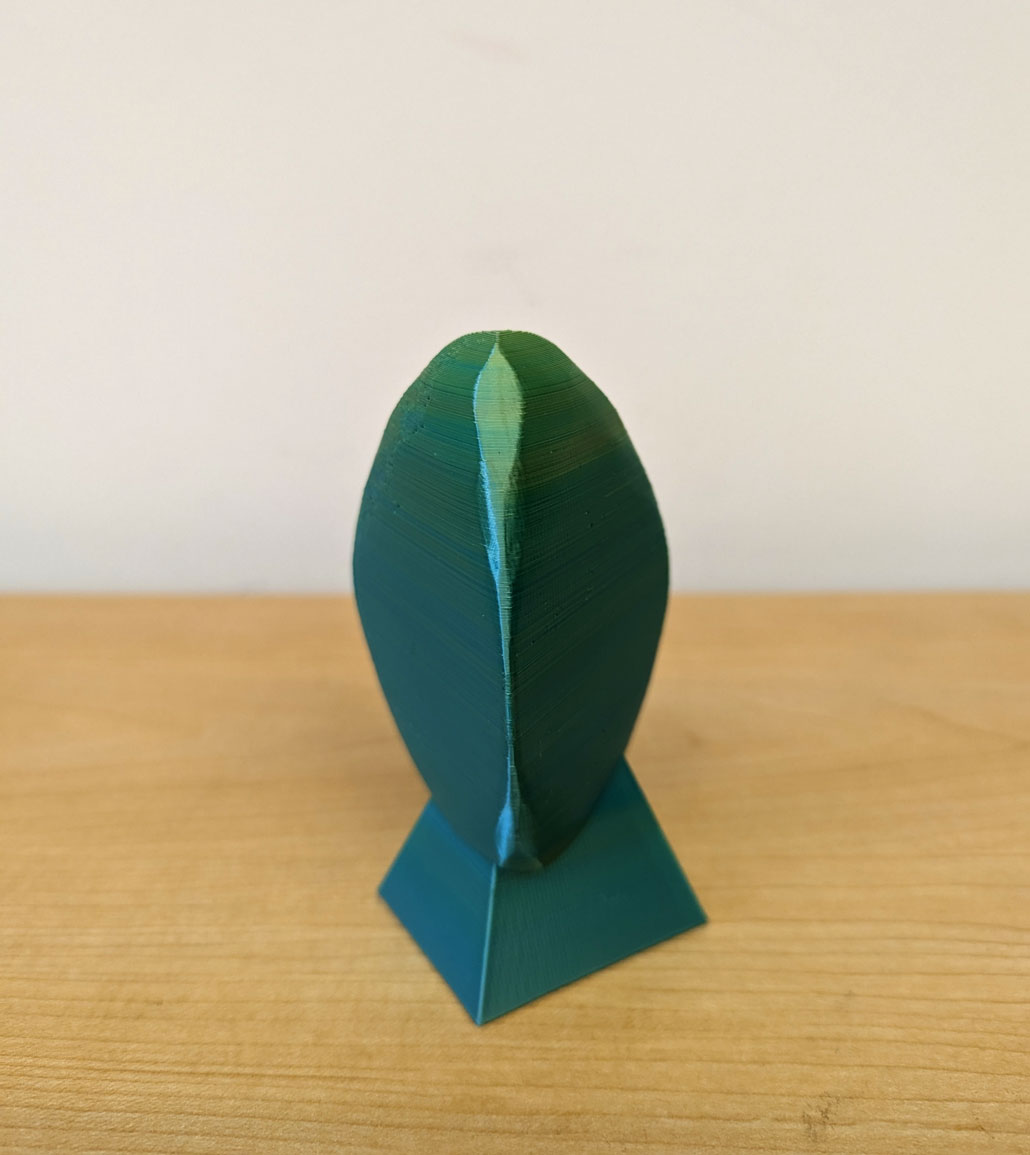
“A great thing about modern computing is that you have all these visualization tools,” says Bray. But to use them, the students had to understand the math at a really deep level. Without it, they couldn’t write the code that told the printer what to do.
“When I was 15, I thought there were no physical [math] experiments,” Schaefer says. It seemed that in math, “all one cares about is proofs.” (Proof is a method of showing that a mathematical statement is true.) Performing messier, engineering-like experiments has now helped him appreciate the many potential uses of math.
Does 3-D printing of the projection of a 4-D structure have any real-world use today? Probably not. But there may be important uses in the near future. We just can’t see them yet.
Mathematics can seem like “make-believe or just pie-in-the-sky nonsense,” says Casey Mann. He’s a geometer at the University of Washington Bothell. But eventually, math “finds its way into some application somewhere,” he says. “That’s the beauty of math.”
From bath tiles to a better robo-vacuum
Mann studies a packing problem somewhat like the orange-stacking challenge faced by grocers. In Mann’s case, he’s exploring how to tile shapes on a flat surface.
Take any triangle. Try doodling to see if you can fill a piece of paper with lots of triangles, each having that same shape. You must fill the surface completely. And there can be no overlaps or gaps between triangles. Now try doing the same thing with a four-sided shape, such as a square. Were you successful?
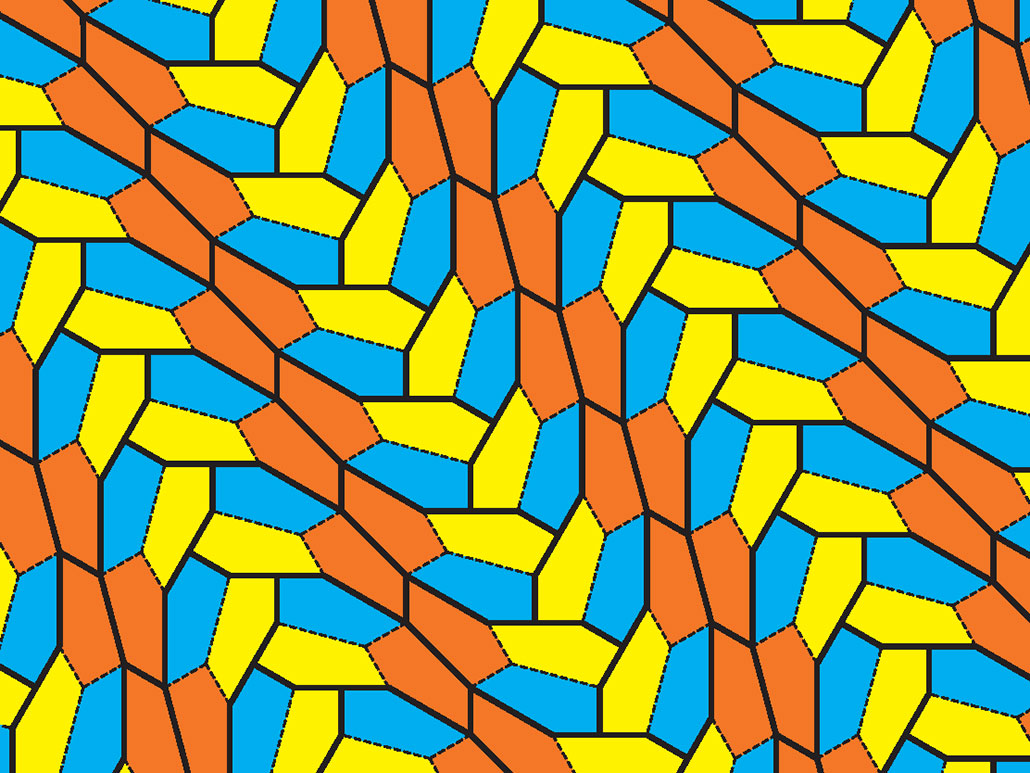
Mathematicians have proved that you can tile a surface snugly using triangles and four-sided shapes. The natural follow-up was to see if you could also do this with a pentagon (a five-sided shape). Believe it or not, this question has puzzled mathematicians for more than a century.
In a regular pentagon, all of the angles (corners) are equally wide. The length of each side is also the same. But when you try to tile a surface with a regular pentagon, there will always be gaps — uncovered spots. If you don’t require that every angle and side of each pentagon be equal, though, certain pentagons can completely cover a surface.
Based on these rules, mathematicians in the early 20th century found a few pentagons that could fully tile a surface. By the 1980s, 14 such pentagons had emerged.
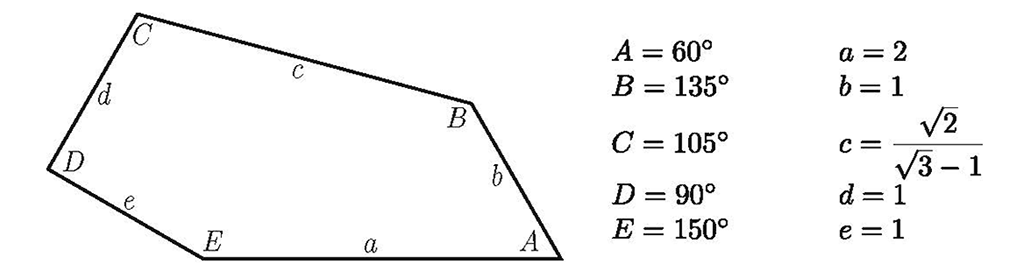
Could there be more? Mann took up this challenge. In 2015, he was part of a trio at the University of Washington that found a 15th pentagon that could completely tile a surface. Its discovery came almost 30 years after the last one.
What about a 16th or a 17th type? A couple of years later, Michaël Rao wrote a computer program to test other possible options. This mathematician works at the Ecole Normale Supérieure de Lyon, in France. He proved that no, there were only 15 types of pentagons — and no more — that could tile a surface. And all of them are now known.
So, what’s the value in finding such snug-fitting tiles?
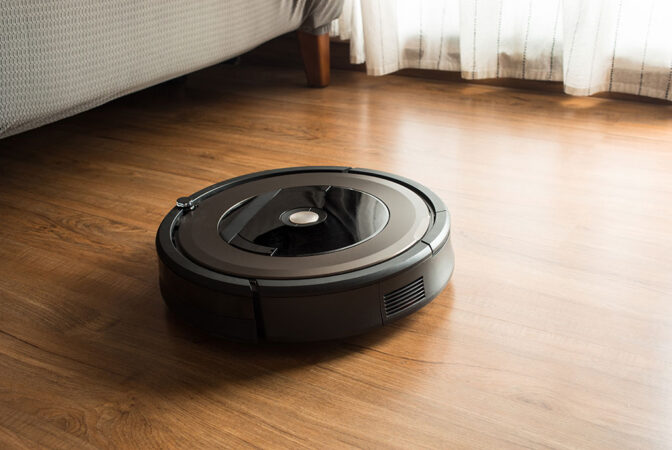
How about making better robotic vacuums? Roombas and other squat, round, self-propelled dust- and lint-busters don’t reach all of a floor’s nooks and crannies. That’s why engineers at the Singapore University of Technology and Design are looking to program a robot that can apply tiling theory to floor-cleaning. Their goal: help design cleaning paths that let those automatons clean every bit of the floor.
This so-called tiling theory also helps speed up video games that involve complex imagery. The computing power needed to calculate and then display visual complexity can slow down a game. Zoom in really close on a screen and “you’ll see little tiles,” notes Mann. “They’re all fitting together to form these surfaces [of objects].” Those tiles enable the graphics to compute more easily. This lets video games run faster and leads to a more seamless experience for players.
So next time you’re excited by a super-speedy video game, thank tiling theory. And, of course, tiling theory could come in handy if you want to literally tile a floor or counter using shapes more complex than rectangles.
How nature uses geometry
Neat, orderly shapes can be found throughout nature. They appear in honeycombs, spider webs, snowflakes, seashells — and even viruses.
Viruses come in different standard shapes, or geometries. And many viruses share certain similarities in shape. Scientists use those similarities to group viruses into families. This helps researchers relate new viruses to existing ones. It also helps scientists predict how a virus will likely behave inside the cell it infects. It can even help predict how new vaccines might target particular viruses.

One common viral structure is the icosahedron (Eye-koss-uh-HEE-drun). It’s one of the oldest known geometric shapes. Greek philosophers may have discovered it around 400 B.C. But Neolithic people in Scotland may have known about this shape at least 1,000 years earlier.
An icosahedron has 20 identical faces. Each one is a triangle whose sides are all equal in length. Joining these faces are 30 edges or lines along the sides and 12 corners. Icosahedrons show up on soccer balls, 20-sided dice and geodesic domes.
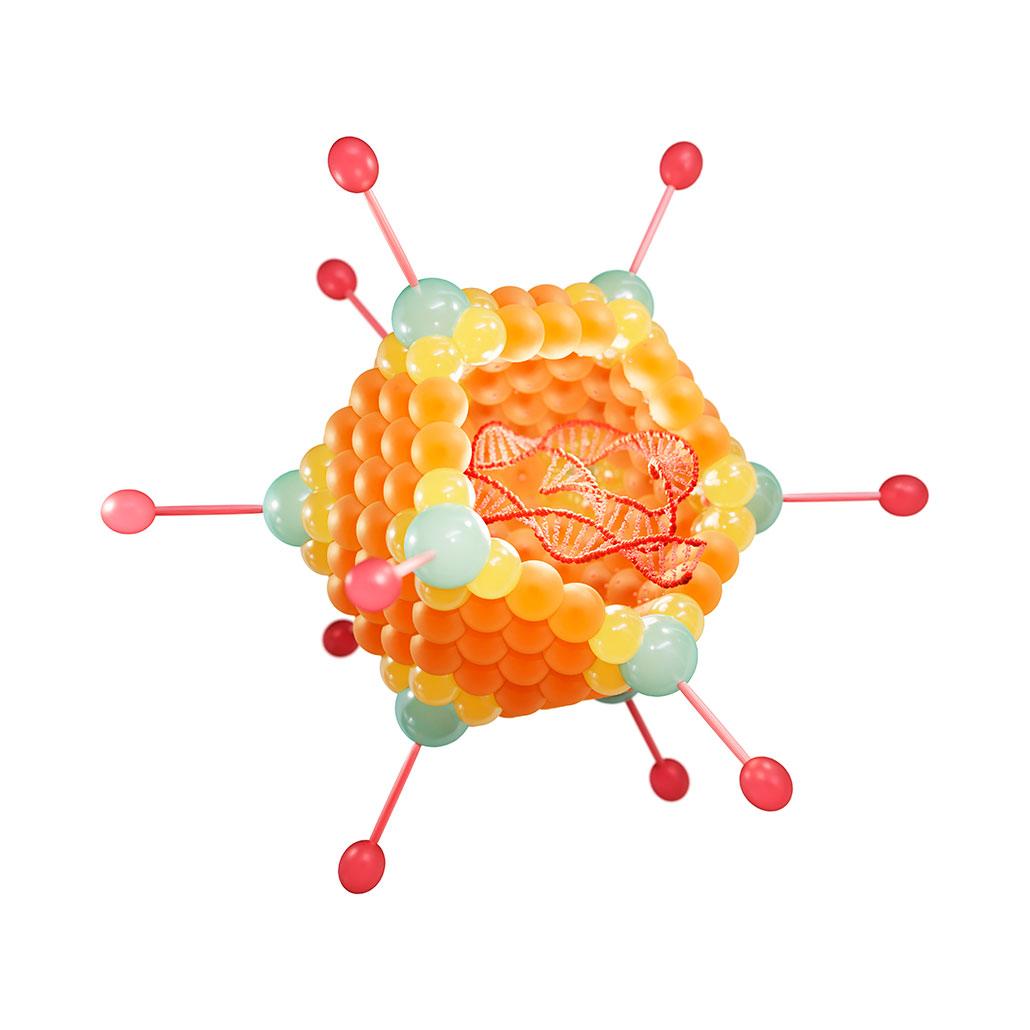
In viruses, the icosahedron is one of the most common shapes of the capsid. That’s the sort of shell that guards the genetic material in a virus. Researchers like Laura Schaposnik are working to better understand icosahedron-shaped capsids. This geometer works at the University of Illinois Chicago.
“It came to me as a surprise,” Schaposnik says, that even though icosahedrons have been “so well studied historically, certain viruses with [this] structure haven’t yet been fully understood.”

Viral geometry
Each of the 20 sides of an icosahedral capsid is made up of proteins. Those proteins are packed tightly in a symmetric way, filling up the structure’s triangular faces. These faces repeat themselves over and over across the whole outer surface of a capsid.
Mathematicians refer to the symmetry of the capsid’s icosahedral shapes as having a 2-3-5 pattern. What does this mean? Consider how you might rotate an icosahedron.
Try rotating it clockwise along an edge, half-way round. The shape on one side of that edge is a mirror image of what’s on the other side. Rotate again and you reach your starting structure. This implies that when you rotate it twice along the edge, you are back to where you started. Mathematicians call this two-fold symmetry.
What happens when you rotate the icosahedron along its face? Now it takes three rotations to get back to the starting structure. This is a three-fold symmetry. If you instead rotate the icosahedron along a corner, it takes 5 turns to get back the initial shape.
Hence, an icosahedron shows 2-3-5 symmetry. Each number identifies how many rotations you need before you reach your initial shape, depending on how the structure was rotated — along its edge, its face or its corner.
Studying the symmetry of virus capsids is crucial to understanding the stability of viruses. The more stable a virus is, the better it can defend itself from the body’s immune system. So, understanding viral symmetry helps scientists create antidotes against viruses.
Based on the 2-3-5 symmetry of viral capsids, scientists have grouped just a little more than 2,800 viruses into categories. Those categories can help pinpoint the best ways to fight different types of viruses. But studies estimate there are at least 1031 (or 10 million trillion trillion) individual viruses on Earth, many of which are as yet unidentified. While biologists work to identify these viruses, Schaposnik uses geometry to study possible viral symmetries.
She investigates which mix of symmetries along edges, triangles and vertices (and their repetitions) are possible in icosahedrons. This could help group viruses with those capsid shapes if and when they are identified. And that could help scientists more quickly identify vulnerabilities of those viruses.
But Schaposnik’s research has now raised a big question: Do viruses take advantage of all these possible icosahedron geometries? Or only some of them?
This is proving hard to answer.
Lots of work ahead
Some capsids with symmetry along certain edges are possible, Schaposnik’s work suggests. But many of these possible configurations have never been seen in nature.
“If we haven’t discovered certain types of viruses in nature,” Schaposnik says, but mathematically they should — or could — exist, “you [can] start being prepared with antivirals for those types.”
Studies like hers could help narrow down potential viral shapes, preparing scientists for new mystery germs. Such data could help many experts — from vaccine developers and scientists who study viruses to government officials — limit the risk of another pandemic.
Geometry’s tremendous reach extends far beyond finding areas of triangles in the classroom. The fruits of Kepler’s labors revealed unusual applications several centuries later. It remains to be seen whether other current research will one day find important uses in real life — much as those on viral geometry and tiling already are.