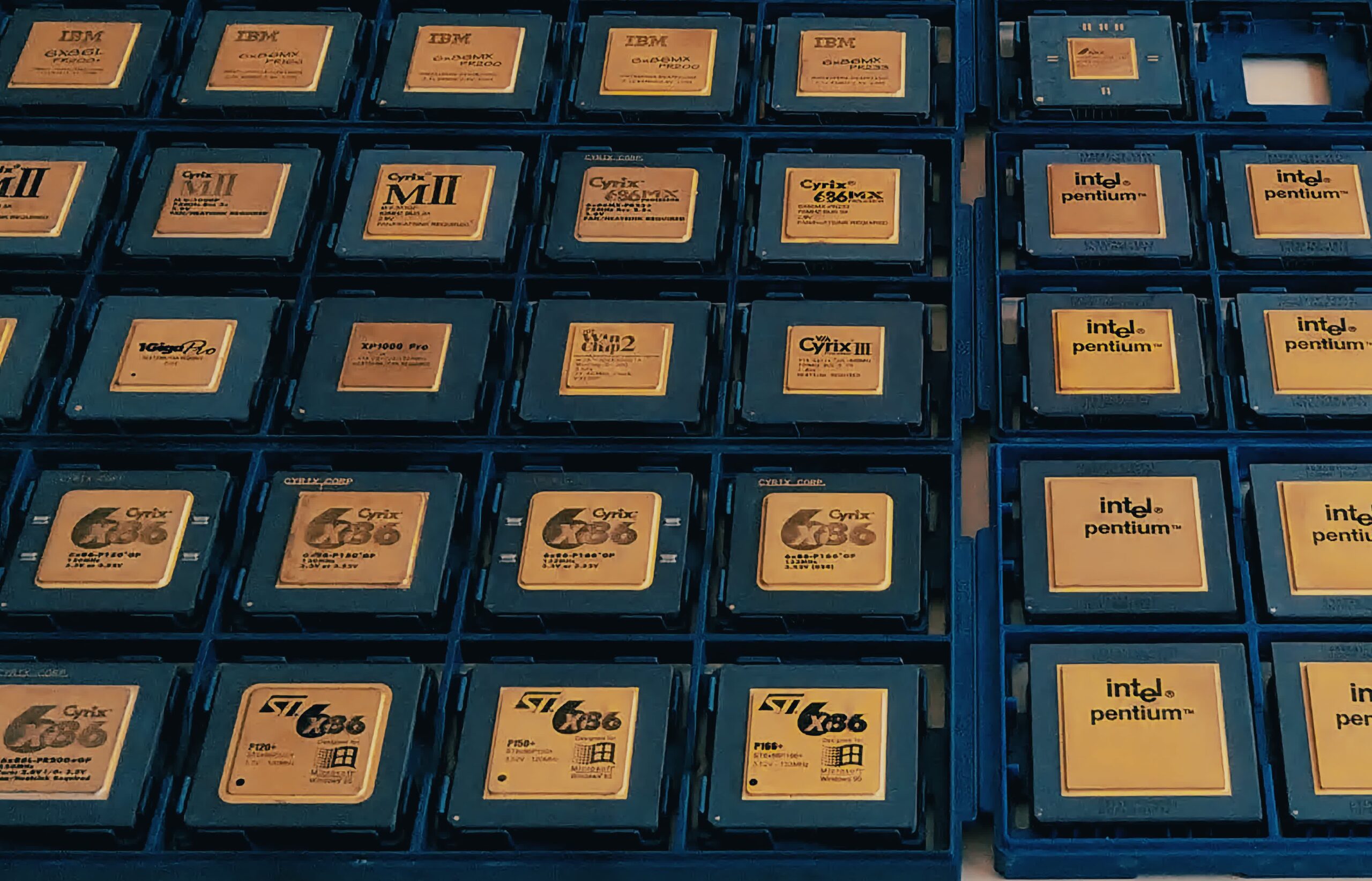
Most of you are no doubt familiar with Intel, AMD, Qualcomm, IBM, Texas Instruments, and possibly even VIA – but there’s another precursor chipmaker you should know about: Cyrix.
For the better part of a decade, Cyrix brought the world of personal computing to millions in the form of attainable budget PCs. However, the company was ultimately killed by its best product, and that chip’s inability to run a popular game, followed by a disastrous merger with a larger partner.
The early 1990s was a marvelous but strange time for the desktop computing industry.
Intel seemed to be winning the fierce competition in the microprocessor space; Apple had switched to IBM’s PowerPC architecture, while Motorola’s 68K chips were slowly dragging Commodore’s Amiga PC to the grave. Arm was only a tiny flame sparked by Apple and a few others, almost entirely focused on developing a processor for the infamous Newton.
During this period, AMD was liberating its processors from the negative aura of being second-sourced from Intel. After cloning a few more generations of Intel CPUs, AMD developed its own architecture, which by the end of the nineties was well-regarded for its price and performance.
This was around the same time that AMD was liberating its processors from the negative aura of being second-sourced from Intel. After cloning a few more generations of Intel CPUs, AMD came up with its own architecture, which by the end of the nineties was well-regarded for its price and performance.
That success can be attributed at least in part to Cyrix, who had a window of opportunity to capture the home PC market and leave both Intel and AMD in the dust, but ultimately failed to execute and quickly disappeared into the tech graveyard.
Modest Beginnings
Cyrix was founded in 1988 by Jerry Rogers and Tom Brightman, starting as a manufacturer of high-speed x87 math co-processors for 286 and 386 CPUs. These were some of the greatest minds to leave Texas Instruments, and they had high ambitions to take on Intel and beat them at their own game.
Rogers embarked on an aggressive pursuit to find the best engineers in the US and became an infamously hard-driving leader for a team of 30 people tasked with the impossible.
The company’s first math coprocessors outperformed Intel equivalents by about 50% while also being less expensive. This made it possible to pair an AMD 386 CPU with a Cyrix FastMath co-processor and get 486-like performance at a lower price. This caught the industry’s attention and encouraged Rogers to take the next step and pursue the CPU market.
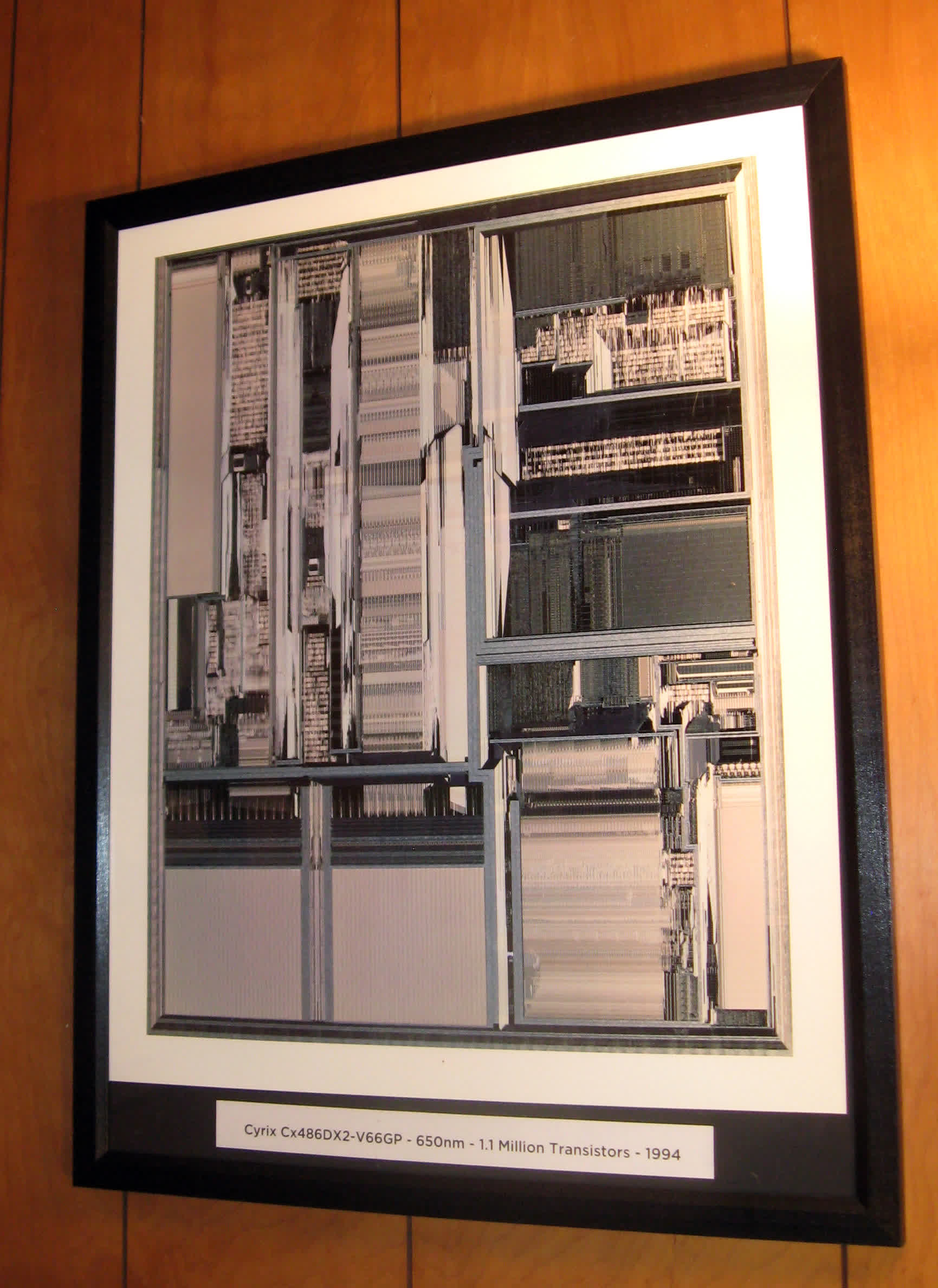
In 1992, Cyrix unveiled its first CPUs, the 486SLC and 486DLC, which were intended to compete with Intel’s 486SX and 486DX. They were also pin-compatible with the 386SX and 386DX, meaning they could be used as drop-in upgrades on aging 386 motherboards. Manufacturers also used them to sell budget laptops.
Both variants offered slightly worse performance than an Intel 486 CPU but significantly better performance than a 386 CPU.
The Cyrix 486 DLC couldn’t compete with Intel’s 486SX clock-for-clock, but it was a fully 32-bit chip with 1KB of L1 cache, and it cost significantly less.
At the time, enthusiasts loved that they could use a 486DLC running at 33 MHz to achieve comparable performance to an Intel 486SX running at 25 MHz. However, it wasn’t without problems, as it could lead to stability issues on older motherboards that didn’t have extra cache control lines or a CPU register control to enable or disable the on-board cache.
Cyrix also developed a “direct replacement” variant called the Cx486DRu2, and in 1994 released a “clock doubled” version called the Cx486DRx2, which had the cache coherency circuitry integrated into the CPU itself.
By then, however, Intel had released its first Pentium CPU, which drove 486DX2 prices down to the point where the Cyrix alternative lost its appeal. It became cheaper to upgrade to a 486 motherboard than to buy a Cyrix upgrade processor for an old 386 motherboard. When the “clock tripled” 486DX4 arrived in 1995, it was too little, too late.
Large PC manufacturers such as Acer and Compaq weren’t convinced by Cyrix’s 486 CPUs and instead opted for AMD’s 486 processors. This didn’t stop Intel from spending years in court alleging that the Cx486 violated its patents, though Intel never won a case.
Cyrix and Intel eventually settled outside of court, with Intel agreeing that Cyrix had the right to manufacture its own x86 designs in foundries that held an Intel cross-license, such as Texas Instruments, IBM, and SGS Thomson (later STMicroelectronics).
Never Repeat the Same Trick Twice… Unless You Are Cyrix
Intel launched the Pentium processor in 1993, based on a new P5 microarchitecture and finally coming up with a market-friendly name that many consumers could relate to and recommend. More importantly, it raised the bar in terms of performance, ushering in a new era of personal computing.
The novel superscalar architecture allowed it to complete two instructions per clock cycle. A 64-bit external data bus made it possible to read and write more data with each memory access. The faster floating-point unit was capable of up to 15 times the throughput of the 486 FPU, among other enhancements.
Intel launched the Pentium processor in 1993, based on a new P5 microarchitecture and finally coming up with a market-friendly name.
Cyrix took on the challenge to yet again create a middle ground for Socket 3 motherboards that were not able to handle the new Pentium CPU, even before that model was ready to ship. That middle ground was the Cyrix 5×86, which at 75 MHz offered many of the features of fifth-generation processors like the Pentium and AMD’s K5.
Cyrix even produced 100 MHz and 133 MHz versions, but they didn’t deliver all the advertised performance-enhancing features, as enabling these features caused instability. Overclocking potential was limited. These versions were short-lived, and within six months Cyrix decided to stop selling them and moved on to a different processor design.
Peak Cyrix Through the Lens of Quake
In 1996, Cyrix unveiled the 6×86 (M1) processor, which was expected to be yet another drop-in replacement for older Intel CPUs on Socket 5 and Socket 7 motherboards with decent performance. But this wasn’t just an upgrade path for budget systems, it was actually a little marvel in CPU design that was thought to do the impossible – it combined a RISC core with many of the design aspects of a CISC one.
The 6×86 also continued to use native x86 execution and ordinary microcode, while Intel’s Pentium Pro and the AMD K5 relied on dynamic translation to micro-operations.
The chip was pin-compatible with the Intel P54C and had six variants with a confusing naming scheme that was supposed to indicate the expected performance level, but wasn’t an actual indicator of clock speed.
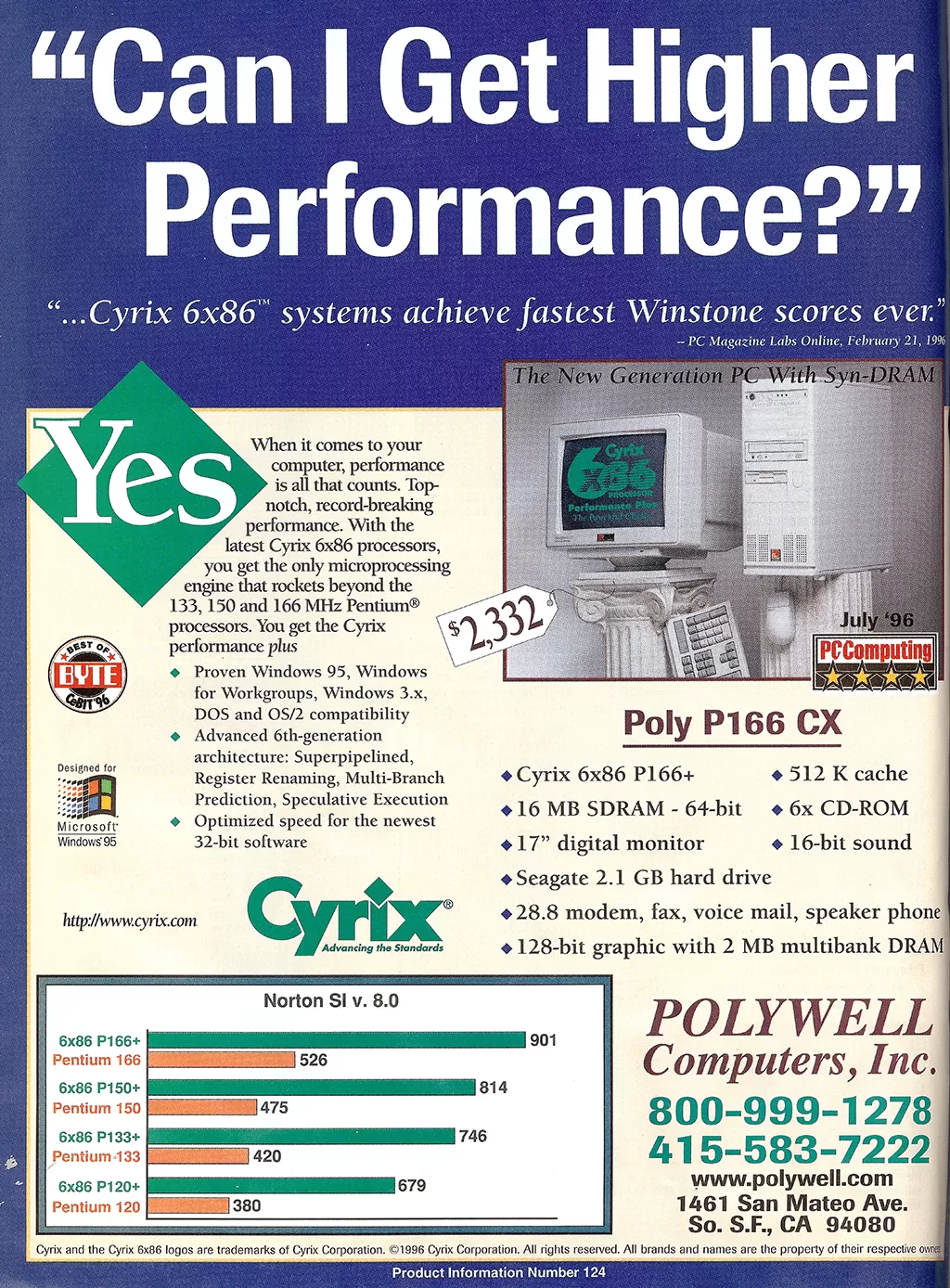
For instance, the 6×86 PR166+ only ran at 133 MHz but was marketed as being equivalent to or better than a Pentium running at 166 MHz, a strategy AMD would replicate later on.
However, the 6×86 identified itself as a 486 CPU because it didn’t support the full Intel P5 instruction set. This quickly became an issue as most application development was slowly migrating towards P5 Pentium-specific optimizations to squeeze more performance using the new instructions.
Cyrix eventually improved compatibility with the Pentium and Pentium Pro through the 6x86MX and 6x86MII variants.
A huge selling point of the 6×86 was that its integer performance was significantly better than the Pentium’s, which was a good advantage when most applications and games relied on integer operations. For a while, Cyrix even tried to charge a premium for that added performance, but eventually, that strategy fell apart.
Cyrix 6x86MX CPU die shot
As it turned out, the FPU (floating-point unit) of the 6×86 was only a slightly modified version of Cyrix’s 80387 coprocessor, and as such, it was significantly slower than the new FPU design integrated by Intel’s Pentium and Pentium Pro.
To be fair, it was still anywhere between two and four times faster than the Intel 80486 FPU, and the Cyrix 6×86 bested the Intel offerings in overall performance. But that equation broke down when software developers, particularly those making 3D games, saw the rising popularity of the Pentium and chose to optimize their code in assembly language around the advantages of the P5 FPU.
When id Software released Quake in 1996, PC gamers using 6×86 processors discovered they were getting subpar frame rates, reaching at most an unplayable 15 frames per second unless they dropped the resolution down to 320 x 200.
In that case, you’d need a top-of-the-line Cyrix 6x86MX PR2/200 CPU to get a playable 29 frames per second. Meanwhile, gamers with Intel systems had no problem running the game at playable frame rates even at 640 x 480.
Legendary game developer John Carmack figured out he could overlap integer and floating-point operations on Pentium chips, as they used different parts of the P5 core for everything except instruction loading. That technique didn’t work on the Cyrix core, which exposed the weakness of its FPU. Reviewers at the time found that in every other benchmark or performance test, the 6×86 CPU would leapfrog the Pentium by 30 to 40 percent.
Back in the mid-90s, no one knew the exact direction computing would take, and Cyrix thought it best to prioritize integer performance. This decision resulted in a processor lacking instruction pipelining, a feature that would become essential for desktop CPUs. Instruction pipelining is a technique that divides tasks into a set of smaller operations, which are then executed by different parts of the processor simultaneously in a more efficient fashion. The FPU of the Pentium processor was pipelined, leading to very low latency for floating-point calculations to handle the graphics of Quake.
The problem was easy to solve, and software developers released patches for their applications and games. However, id Software had spent too much time designing Quake around the P5 microarchitecture and never provided such a fix.
AMD’s K5 and K6 CPUs fared a little better than Cyrix’s, but they were still inferior to Intel’s offerings when it came to Quake, which was a really popular game and a flagship among a new breed of 3D titles.
This caused Cyrix CPUs to be harshly judged on that performance gap, and the company lost credibility in the eyes of many enthusiasts. Because Cyrix had been unable to score contracts with large PC OEMs, it was a particularly hard blow for Cyrix’s fierce customer base, which was made up of those same enthusiasts.
To make matters worse, Cyrix was a fabless chip maker that relied on third parties to manufacture its processors, and those companies used their most advanced lines for their own products. As a result, Cyrix processors were manufactured on a 600 nm process node, while Intel’s were 300 nm.
Efficiency suffered, and this is why Cyrix CPUs had a reputation for getting extremely hot – so much so that enthusiasts were designing hotplates using them as a heat element. They were overly sensitive to low-quality power supplies, and their overclocking potential was limited. However, that didn’t stop people (like this author, whose second PC had a Cyrix 6×86-P166+ CPU inside) from pushing them just a little bit and slowly leading them to their demise.
The Fall of the First True Rival to Intel’s CPU Hegemony
By 1997, Cyrix had tried everything in its power to forge partnerships with companies like Compaq and HP, as integrating its CPUs into their systems would have generated a steady income stream. It also tried suing Intel for infringing its patents on power management and register renaming techniques, but the matter was quickly settled with a mutual cross-license agreement, allowing the two firms to stay focused on producing better CPUs.
A famous National Semiconductor ad
The litigation took a toll on the already cash-strapped company. Faced with the prospect of bankruptcy, Cyrix agreed to merge with National Semiconductor. This was seen as a blessing. The company would finally have access to proper manufacturing plants and a strong marketing team capable of scoring large contracts. The IBM manufacturing agreements held on for a while, but Cyrix eventually moved all production to National Semiconductor.
Faced with the prospect of bankruptcy, Cyrix agreed to be merged into National Semiconductor.
Yet as it turns out, this move sealed Cyrix’s fate. National Semiconductor wasn’t interested in making high performance PC parts, and instead wanted low-power SoCs (system on a chip).
Sure enough, Cyrix came up with the universally-hated 5×86 MediaGX, a chip that integrated functions like audio, video, and memory controller with a 5×86 core running at 120 or 133 MHz.
It was a low performer, but it managed to convince Compaq to use it in their low-end Presario computers. This whetted other OEMs’ appetites for 6×86 CPUs, with Packard Bell and eMachines as notable examples.
The shift in focus didn’t stop Cyrix from trying to produce more high-performance CPUs, but it delivered promises and little else. National Semiconductor eventually sold Cyrix to Taiwan-based chipset maker VIA Technologies, but by then key people had already left, and the MII CPU was an uninteresting part that found no buyers.
The last Cyrix design was the MII-433GP, which ran at 300 MHz and, thanks to the unfortunate naming scheme, ended up in comparisons with processors that ran at 433 MHz, which were vastly superior. AMD and Intel were busy racing to 1 GHz and beyond, and it would take 20 more years for Arm to come along and challenge the two giants in the desktop and server markets – not to mention totally dominate mobile computing.
VIA put the final nail in the coffin by using the Cyrix name to replace “Centaur” branding on processors that actually used an IDT-designed WinChip3 core. National Semiconductor kept selling the MediaGX for a few more years before rebranding it as Geode and selling the design to AMD in 2003.
Three years later, AMD demonstrated the world’s lowest-power x86-compatible CPU, which took only 0.9 watts of power and was based on the Geode core, a testament to the ingenuity of the Cyrix design team.
Three years later, AMD demonstrated the world’s lowest-power x86-compatible CPU, which took only 0.9 watts of power and was based on the Geode core, a testament to the ingenuity of the Cyrix design team.
Why Cyrix’s Legacy Matters
Whether or not you ever owned a Cyrix-powered PC, the company should be remembered for its legacy and lessons learned.
Despite its relatively small influence on the industry during its decade of existence, Cyrix’s failures proved that improving IPC (instructions-per-clock) was a more productive endeavor for chipmakers compared to improving raw clock speeds.
Cyrix operated as a fabless company before that was cool.
To this day, Intel and AMD have tried to push nominal clock speeds higher with each generation, but after the 3 GHz milestone, most of the real improvements have come from rethinking core parts of their microarchitectures (and caches). A notable example is AMD’s Zen progression, which brought single-threaded performance improvements of 68% in less than four years.
Cyrix was able to survive and overcome a lot of legal (and by extension, financial) pressure from Intel, who sued almost everyone in the CPU space in the 1990s.
It showed on two occasions that litigation is detrimental to a healthy marketplace while cross-licensing deals lead to a lot of cross-pollination between engineering efforts at different companies, which proved beneficial.
Cyrix also operated as a fabless company before that was cool. These days it’s standard practice for most silicon giants, including the likes of AMD, Qualcomm, Broadcom, Nvidia, Apple, Marvell, Unigroup China, and HiSilicon, who depend on other companies like TSMC to manufacture their chips.
The company’s marketing strategy was never great before the National Semiconductor merger, and AMD would repeat the same mistakes with Athlon and Sempron processors in the 2000s.
These were labeled to indicate that they were faster than an Intel processor while operating at a lower clock speed, but that didn’t always translate well in benchmarks or real-world performance tests. AMD dropped that scheme, but suffice it to say, things remain a bit confusing to this day.
Today, it’s unlikely you’ll find a Cyrix processor outside of gold reclaiming operations and enthusiasts’ vintage computer collections. There’s some evidence online that Cyrix-based desktops were in use up until at least 2010, meaning they lingered for another decade after the company had essentially dissolved into VIA Technology’s portfolio. It’s unlikely that VIA’s Zhaoxin arm still uses anything from the original Cyrix design, but only time will tell if they learned the lessons to honor Cyrix’s legacy.
The story of key hardware and electronics companies that at one point were leaders and pioneers in the tech industry, but are now defunct. We cover the most prominent part of their history, innovations, successes and controversies.
Note: This feature was originally published on December 2021. We have revised its content several times and bumped it due to its historical significance and old school computing nature, as part of our #ThrowbackThursday initiative.