


By PAUL SHAPIRO AND WAYNE FLOWER FOR DAILY MAIL AUSTRALIA
Published: | Updated:
Follow Daily Mail Australia’s live coverage of accused mushroom chef Erin Patterson‘s murder trial at Latrobe Valley Magistrates’ Court in Morwell, Victoria.
Leading fungi expert on death cap mushrooms
Mycologist Tom May, who is an internationally recognised fungi expert, told the jury death cap mushrooms can only be found beneath or close to oak trees or trees within the oak family.
Dr May, a mushroom expert who was the principal fungi research scientist at the Royal Botanical Gardens, said death caps had a ‘symbiotic’ relationship with oak trees.
He explained this means death caps can’t live without an oak tree.
‘In Australia it has only been reported with the oak family,’ Dr May said.
The mushroom expert described death caps as mostly orangey in colour, but could be whiteish or brownish.
He said they change their appearance as they matured.
Dr May told the jury death cap mushrooms – known scientifically as amanita phalloides – were believed to have been accidentally introduced into Australia from Europe and were first detected in Victoria in the 1970s.
He said the mushrooms were ‘relatively short lived’ in the wild due to wet conditions and insects.
Dr May said death caps wouldn’t last much longer in a refrigerator due to the fungi being infested with insects that ‘keep working away’ at the mushrooms.
The jury heard button mushrooms last longer in the fridge because they weren’t infested with insects.
Dr May said there were many publicly available online databases that contained information regarding death cap mushrooms.

He said iNaturalist is Australia’s largest publicly accessible citizen scientist app for uploading information about fungi.
Dr May told the jury you need an account to post information about wild mushroom, but don’t need an account to view ‘precise location information’.
‘You can readily find the location of certain species,’ he said.
Dr May also said iNaturalist contains information on where death cap mushrooms can be found.
He said death caps appear as red dots on a map and when you click on the dot it shows information including the image, date of observation and person who made the observation.
An image shown in court included the exact location of death caps in a suburban park.
The jury heard a death cap was detected in Loch on April 18, 2023.
The doctor said death cap mushrooms have been found in the ACT, NSW and parts of Victoria, including Gippsland towns Outtrim, Loch and Morwell.
In Victoria, death caps grow throughout metro Melbourne to the east into the Dandenong Ranges and in the west to Gisborne and Bendigo, the jury was told.
Overseas, the doctor said death caps, outside of their native Europe, have been detected in the United States and New Zealand, but not in Asia or China.
Dr May said cases involving death cap mushrooms occured when people ingested the deadly fungi by mistake.
Dr May, who published a book in 2021, told the jury toxins found in death caps can be in found other mushrooms.
In 2023, one poisoning involved a Chinese tourist who ate a mushroom, became sick, went to hospital, showed early signs of organ failure, but left hospital a week later.
In 24 other cases of reported wild mushroom poisonings, patients experienced gastro symptoms, but none involved organ damage.
Fungi expert says he spotted deadly mushrooms in town near Patterson’s home
Dr Tom May (pictured below) was shown images taken from iNaturalist which he pointed to and said depicted features which were ‘highly consistent’ with being death cap mushrooms.
The jury heard Dr May was aware the images he was shown were posted on iNaturalist.
‘I would say with a high degree of confidence the images were of amanita phalloides (death cap mushrooms),’ he said.
An image was shown to Dr May which he said, ‘with confidence’, depicted 13 death cap mushrooms on a set of scales.
The doctor said the colours of the mushrooms and other characteristics led him to believe ‘with confidence’ the mushrooms were death caps, but added there were a ‘number of other’ mushrooms that could appear similar.
He also said there was ‘no evidence to rule out’ the mushrooms in the image were death caps, but there could be other (mushroom) species depicted in the image.
Dr May also identified another image which depicted a button mushroom or field mushroom.
The expert explained the characteristics were identifiably different to death caps.
Dr May revealed he posted a death cap sighting at Outtrim on May 21, 2023 to the iNaturist app under the handle ‘Funkey Tom’.
He told the court he put in a very precise pin and put in the accuracy of that pin on his post.
Dr May said his pin was within metres of where the death cap sighting was.
He said he spotted the deadly fungi after giving a talk to locals about mushrooms and then going for a walk.
Dr May had previously said the only known deaths from death cap mushroom poisoning in Australia in the last ’30 or 40′ years were five people and a Cocker Spaniel.
Dr May said only one person prior to the 2023 Leongatha lunch cooked by Patterson had died from death cap poisoning in Victoria, according to known reports.

Patterson given clean bill of health
Consultant emergency physician Dr Varuna Ruggoo (pictured below right) told the jury Patterson came into her care at the Monash Medical Centre on the morning of August 1.
The doctor said Patterson’s liver function tests were all ‘within normal limits’.
Dr Ruggoo told the jury it seemed Patterson’s health was stable enough to be discharged.
She said it was presumed any suspected food poisoning was likely caused by death cap mushrooms.
Dr Ruggoo said she asked Patterson ‘specifically’ about symptoms including vomiting and diarrhoea and all of the answers were ‘no’.
‘She seemed clinically well with good mood and affect,’ she said.
The doctor added Patterson had a normal respiratory rate, no respiratory distress, normal pulse range, normal blood pressure, that she was alert and her temperature was ‘again within normal limits’.
‘I did (deem her fit for discharge),’ Dr Ruggoo said.
Dr Ruggoo was one of several medical experts including Dr Rhonda Stuart who spoke with Patterson at the Monash Medical Centre.

Patterson’s blood test showed ‘no evidence of poisoning of any kind’
Monash Health emergency registrar Dr Laura Muldoon (pictured below) told the jury she asked Patterson about ‘her symptoms’ and ‘clinical condition’.
Dr Muldoon said she reported Patterson had nausea and diarrhoea throughout Sunday and into Monday.
‘Erin felt she had suffered food poisoning from a home cooked meal of beef Wellington,’ she said.
‘I asked her about the ingredients (and) she reported eye fillet steak, garlic, dried dehydrated mushrooms, possibly shitake or porcini.’
The doctor said Patterson didn’t have the packed, or any leftover, mushrooms and denied foraging for mushrooms.
‘I noted that she looked clinically well. She had chapped lips, but otherwise looked well,’ she said.
The doctor told the jury she provided advice to continue the liver protection drugs.
She said she saw Patterson again sometime between 9am and 10am on August 1 and reviewed her.
‘She had remained well, she reported she was feeling better,’ Dr Muldoon said.
‘All her blood tests and vitals were normal, there was no evidence of poisoning of any kind.
‘After seeing her, I was tasked with sending the leftovers to a mycologist (a mushroom specialist) at the Royal Botanical Gardens.’
The jury was then shown an image of the leftovers which had been sent for testing.
The image depicted a pastie with some of the mushroom paste removed.

Jury hears Patterson wanted to know why doctor was asking questions about mushrooms
Dr Rhonda Stuart, who is the director of infection prevention and epidemiology at Monash Health, said she was asked to quiz Patterson on where she got her mushrooms.
‘I was asked to come back and talk to her about a possible public health issue,’ Dr Stuart told the jury.
‘We were worried about the meal. I turned around and drove back to Monash Health to talk to her face-to-face. I saw her in the emergency room about 20 minutes later.’
The doctor said she asked Patterson a series of questions.
‘I asked how she prepared the meal,’ she said.
The doctor said Patterson told her she came to hospital to have her kids checked out.
She said she had given the kids some of that meal, but scraped off the mushroom paste, the jury heard.
Dr Stuart also told the jury Patterson said she’d been unwell on Sunday with ‘gastro-like symptoms’.

‘I asked about the meal,’ she said.
‘She told me she made a beef Wellington and she’d made it with a mushroom paste.
‘I quizzed her about those mushrooms.’
The doctor said Patterson said they came from the supermarket and Asian food shop ‘a number of weeks prior’.
Patterson told the doctor the Asian shop mushrooms were in a sealed packet, which she removed and put into another container, the jury heard.
Dr Stuart said she had been interested in that packet, but it was gone.
She said Patterson told her she made a paste and that she used all of the dried mushrooms to make it.
‘I was worried about those mushrooms but she couldn’t tell me where she got them, Oakleigh or Glen Waverley,’ Dr Stuart said.
The doctor said Patterson said if she ‘drove past that shop she might recognise it.’
‘She did say they had a strong smell,’ Dr Stuart said.
The doctor also denied she had foraged mushrooms.
Dr Stuart said Patterson wanted to know why she was being asked these questions.
‘I told her I was worried about a public health issue,’ Dr Stuart said.
Friend of Patterson’s son says ‘Erin just seemed like her normal self’
The jury heard a statement from a friend of Patterson’s now 16-year-old son.
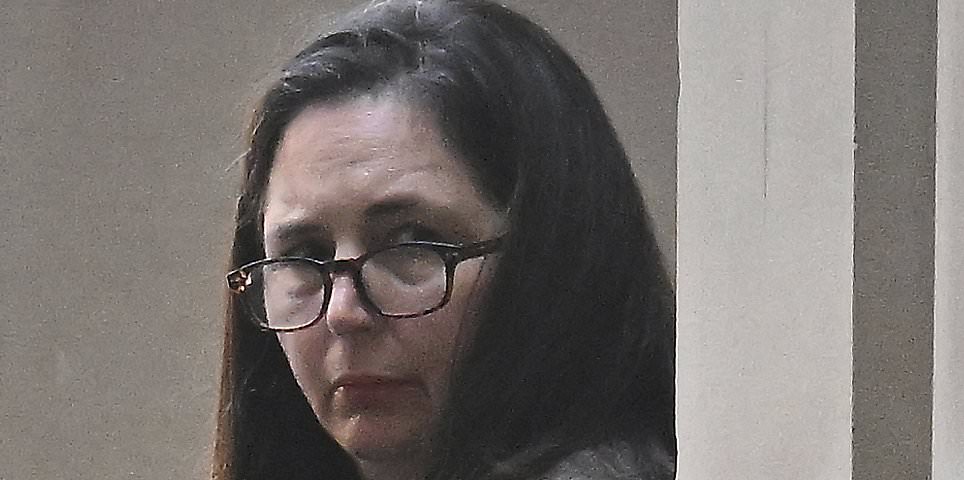
Patterson, who is wearing a brown cardigan and a green top, sat quietly as the statement from the then 15-year-old boy was read to the jury.
The teenager said he had been friends with Patterson’s son since Year 6, but couldn’t remember the name of his friend’s dad.
‘(We) are very close friends,’ he said.
The teenager said he would visit Patterson’s son at their Leongatha home every Tuesday and Friday after youth club.
He said he stayed the night before the lunch and the next day attended the movies with his friend and sister.
The boy said his friend’s dad dropped him and Patterson’s son at the Leongatha home as the lunch gathering was wrapping up.
He said they all greeted each other and spoke about the son’s flying lessons.
The boy said he and his friend ate some dessert, which he thought may have been a cake or muffin.
The teenager claimed he thought he saw his friend’s grandma cleaning a plate, and believes he saw some white plates in the kitchen sink.
Later that evening, he said Patterson drove him home.
The boy said he spoke with his mate about school and can’t remember if he spoke to Patterson.
‘Erin just seemed like her normal self to me,’ the boy said.
The court heard the boy went home because his friend had a flying lesson the following day.
Flight instructor Ulysses Villalobos made a statement that Patterson seemed ‘easy-going’ and a ‘typical mum’.
He recalled Patterson dropping him off one time and they discussed the son’s flying performance.
‘I told her he was good, and she seemed pretty proud,’ he said in his statement.
He recalled on the Sunday after the lunch that he called Patterson to say he was running late for that afternoon’s lesson.
The lesson was pushed from 2pm to 4pm, but he later called Patterson to cancel due to poor weather.
‘She got grumpy at me,’ he said.
She complained about the hour-long drive and why she hadn’t been contacted earlier.
Patterson trial set to resume for week three
Accused mushroom killer Erin Patterson, 50, will return to court this morning after she pleaded not guilty to three counts of murder and a charge of attempted murder.
The charges relate to a meal Patterson prepared for her in-laws at her Leongatha home on July 29, 2023.
Patterson cooked individual beef Wellingtons which contained death cap mushrooms.
Lunch guests including her parents-in-law Don and Gail Patterson and Gail’s sister Heather Wilkinson all died after consuming the lunch and spending several days in hospital.
Heather’s husband Pastor Ian Wilkinson survived after spending several weeks in intensive care.
This is the third week of the trial.
So far, the jury has evidence from several medical witnesses who treated the lunch guests.
Other medical staff who encountered Patterson also told what they knew to the jury.
Paramedic Eleyne Spencer (pictured below right) told the jury how she travelled in a ambulance with Patterson and administered the suspected killer powerful opioid fentanyl to treat a headache.
Family members including Patterson’s estranged husband Simon told the jury how he was invited to the lunch but declined the invitation.
Lone lunch survivor Ian Wilkinson told the jury how he noticed Patterson ate her lunch from a smaller and different coloured plate to those of her guests.
In an emotionally charged end to week two, Patterson choked back tears after video recorded evidence of her children was played to the court.
The trial will resume shortly.

Share or comment on this article:
Erin Patterson mushroom murder trial LIVE updates: Fungi expert tells court disturbingly easy way death cap mushrooms can be found