


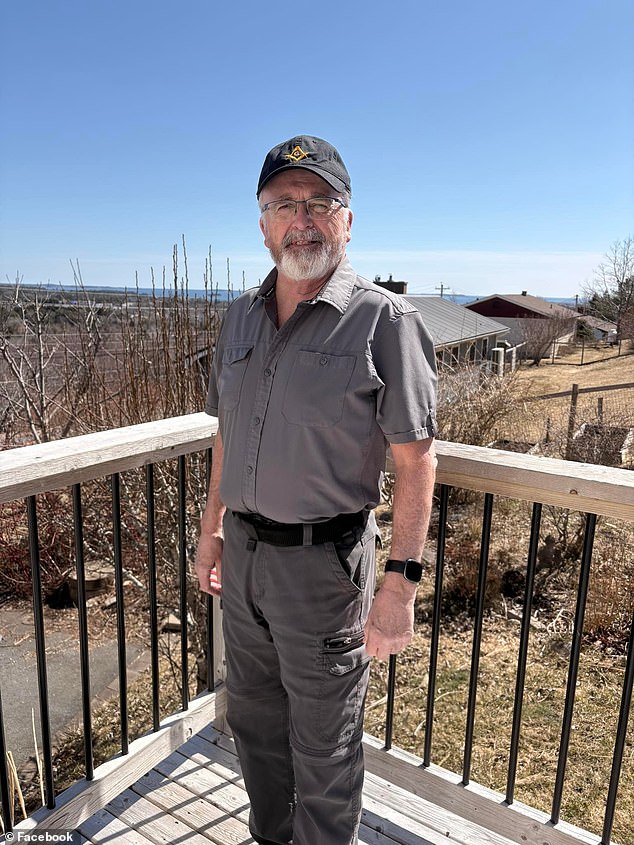
Charles Barkhouse was simply doing his job as a tour guide on a small island when a member of his tour group approached him with an unusual request.
Barkhouse said a woman approached him at the end of his usual Saturday tour and while he thought she was going to ask him a question about history, she instead identified herself as a doctor and asked if she could look at his neck.
After feeling the left side of his neck, the historian who works on Oak Island, Nova Scotia, said the physician told him to ‘call your doctor immediately.’
He wrote on his Facebook of the chance encounter in September 2025: ‘She felt the left side of my neck and advised me to contact my doctor immediately. I regret not getting her contact information to thank her, considering the chain of events that followed.’
That following Monday, he called his doctor who ordered tests and referred him to a specialist. After seeing an ENT – an ear, nose and throat doctor – at the Department of the Victoria General Hospital in Halifax, Barkhouse was diagnosed with thyroid cancer.
He said: ‘The tests showed that I had thyroid cancer. Anytime you hear that word, it’s scary. However, thyroid cancer has one of the best treatment and recovery rates of all the various types of cancer.’
Thyroid cancer is predicted to affect 45,240 Americans in 2026, accounting for about two percent of all new cancers. Approximately 2,320 people are expected to die.
On December 31, 2025, Barkhouse underwent surgery. He told CTV News that doctors removed the cancer, along with 40 lymph nodes, including 23 that were cancerous.
Charles Barkhouse was diagnosed with medullary thyroid cancer in late 2025 after a member of his tour group asked to examine his neck
Further testing revealed Barkhouse specifically had medullary thyroid cancer, a rare and aggressive type of thyroid cancer that can eventually spread to the lungs and liver and be fatal if left untreated for too long.
Overall, thyroid cancer has a 98 percent five-year survival rate.
Medullary thyroid cancer (MTC) accounts for about four to ten percent of all thyroid cancers, Cleveland Clinic reports.
His doctors believe they removed all the cancer from his body, Barkhouse added.
He wrote: ‘I feel great, and I’m looking forward to the rest of my life. I will require regular check-ups and testing.’
Barkhouse never exchanged information with the doctor on his tour but said he considers her his ‘guardian angel’ and wishes he had taken her contact so he could thank her.
He wrote on Facebook: ‘I truly believe that that doctor was on the tour that day for a reason, whether it was fate, destiny, or serendipity. I’ve always believed that things happen for a reason; people enter your life, even for a short time.
‘Often, you can’t figure out why those events occur, but this time it’s obvious to me. That doctor is my Guardian Angel.’
Barkhouse added to CTV News: ‘Everything lined up. It was like a perfect storm that day. She was in the right place at the right time and I wish she was here right now. I would thank her because I am telling you, she probably saved my life.’

On December 31, 2025, Barkhouse underwent surgery and doctors removed the cancer, along with 40 lymph nodes, including 23 that were cancerous
Posting about his story on social media, Barkhouse said he did so to raise awareness about early cancer detection.
Like Barkhouse, about 75 to 95 percent of thyroid cancer patients experience a lump on the thyroid gland and 70 percent have swollen lymph nodes in the neck.
The cancer can also cause hoarseness, breathing issues and difficulty swallowing. In people with MTC, the cancer often goes undiagnosed for some time because the tumor remains very small.
MTC has an unknown cause in about 75 percent of cases – meaning they occur in people with no family history of the cancer. In about half of these cases, patients have an acquired genetic mutation.
And in about 25 percent of MTC patients, they have an inherited condition that raises their risk of the disease.
Thyroid cancer is treated with the total removal of the thyroid gland, which is responsible for regulating the body’s metabolism, energy use, heart rate, body temperature and growth.
Surgery is then sometimes followed by radiation and chemotherapy and people are put on medications to maintain the hormone functions the thyroid normally carries out.