


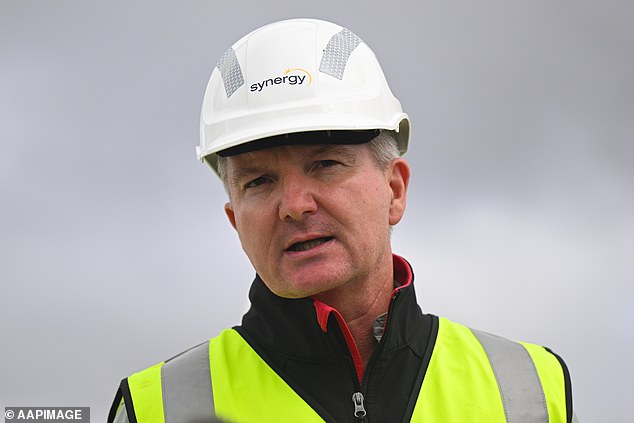
Chris Bowen has refused to rule out a ‘carbon tariff’ on cement or steel as he acknowledged that Australia must ‘do more’ to achieve its climate targets.
The Energy and Climate Change Minister was quizzed by the ABC’s David Speers about whether he would bring in a carbon tariff.
This would see levies placed on carbon-intensive products such as steel, cement and lime imported from abroad and could make the building process more expensive.
It is a way of preventing Australian companies from outsourcing carbon-emitting activities to other countries with less ambitious carbon-reduction targets.
‘We have been clear that we want to ensure Australian industry is best placed to compete in a decarbonising world,’ Bowen told the program.
‘What could be the case is … we look at particular sectors first around cement and lime, [which] are places that we looked at in particular, but I’m not going to get in front of the process…
‘We’ll have more to say during the course of this term.’
The Australian Government appointed Professor Frank Jotzo to lead a review into carbon leakage and what policy options were available to address it.
Energy and Climate Change Minister Chris Bowen (pictured) was quizzed by the ABC’s David Speers about whether he would bring in a carbon tariff – and twice refused to rule it out

This would see levies placed on carbon-intensive products such as steel, cement and lime imported from abroad and could make the building process more expensive
His preliminary report identified cement, clinker and lime as industries in which there was a high leakage risk, while steel, glass and ammonia posed a moderate risk.
The European Union has brought in a Carbon Border Adjustment Mechanism, which will imposes a carbon tax on imports from countries with less strict climate policies.
Bowen’s refusal to rule it out was criticised by the Coalition’s new energy spokesperson Dan Tehan.
‘Now before the election, Chris Bowen, this arrogant minister, said nothing about carbon tariffs,’ he said.
‘Yet here he is immediately after the election talking about putting them in place.’
Tehan accused Bowen of putting Australia’s ‘energy security at risk’ and putting gas and electricity prices up.
‘Now he wants to follow Donald Trump’s lead and put in tariffs. What a mess,’ he added.
Bowen said Australia was ‘by and large on track’ to meet its target of reducing carbon dioxide emissions by 43 per cent by 2030.
This is despite figures last week showing little progress was made in 2024.
‘We’ve never suggested it’s a linear line … But with the right approach from government, yes, we can continue to be on track (despite) facing headwinds and challenges from time to time,’ he said.
Labor was criticised by environmental groups for approving a 40-year extended licence to WA’s North West Shelf, the largest oil and gas project in the country.
The government has a deadline this year to set its 2035 emissions reduction target.
As the Australian government looks to increase the environmental taxes, New Zealand last week lifted a ban on oil and gas drilling as it abanoned net zero targets and prioritised cheap energy.
‘We are feeling the pain of constrained supply,’ NZ Energy Minister Shane Jones said.
‘The government is not prepared to sit on the sidelines and watch our industrial and manufacturing dwindle because of energy security concerns.’