



A yet-unseen population of ancient black holes may be lurking throughout the universe.
If they exist, these bottomless cosmic pits would have a lot in common with known types of black holes. But unlike known black holes, the mysterious kind would have formed right after the Big Bang — before stars and galaxies even existed.
Such early-blooming black holes would be primordial black holes.
Scientists have wondered for decades if such exotic objects exist. But there’s been a recent surge of interest in finding them — and there may be a lot of signs to look for. Primordial black holes across the universe could be leaking energy. Their gravity could be bending starlight. Some might even be gobbling up stars from the inside out.
Cosmologist Bernard Carr predicts we’ll know if primordial black holes exist within the next decade. “I would bet you, say … 60 or 70 percent that they exist,” says Carr, at Queen Mary University of London in England. “That’s partly wishful thinking, because I prefer them to exist.”
If primordial black holes are out there, they could help solve several puzzles. One is unexpected patterns seen in the ripples in spacetime, or gravitational waves, from black hole mergers. Another is how the supermassive black holes at the centers of galaxies got so big so fast in cosmic history. Then there’s one of the biggest mysteries in cosmology: What is dark matter?
This elusive substance is six times as abundant as all the ordinary stuff we know — from people to planets to pizza. Dark matter’s gravity is thought to help hold galaxies together. But since it doesn’t seem to absorb, reflect or emit any light, it can’t be seen. And despite decades of research, no one yet knows what it is.
Primordial black holes could account for some or all of the dark matter out there. They too have powerful gravity but cannot be seen. But first, scientists have to find out if such ancient black holes exist.
Why all the hype?
The new era of excitement about primordial black holes traces back to 2016. That year, scientists shared the first detection of gravitational waves. Those waves had been churned up by a pair of black holes smashing into each other.
Until that point, only two types of black holes were known to exist in abundance. One type was “stellar” black holes. This kind forms when a very massive star runs out of fuel and its core collapses in on itself. Stellar black holes generally have masses between five and 10 times the mass of the sun.
The second common type of black hole was “supermassive” black holes. These sit at the centers of galaxies and can weigh billions of times as much as the sun. Such cosmic monsters may have formed from the collapse of huge clouds of gas. Or they might have formed through the mergers of many stellar black holes.
But the first detected gravitational waves were kicked up by black holes that each weighed about 30 suns. In other words, they were bigger than typical stellar black holes. But they were nowhere near big enough to be supermassive.
Simeon Bird recalls puzzling over the masses. This cosmologist works at the University of California, Riverside. He wondered: Why would the first known gravitational waves come from black holes with such seemingly rare size? Surely it would have been more likely for the first detection to come from black holes of more common sizes.
“Maybe it’s a primordial black hole,” Bird recalls saying with a laugh. “What a silly idea.”
But Bird and others soon realized it might not be so silly after all.
Since then, other strange features have turned up. The first waves were picked up by a U.S.-based detector called LIGO. (That’s short for Advanced Laser Interferometer Gravitational-Wave Observatory.) Italy’s Virgo detector and Japan’s KAGRA detector have joined the hunt. So far, these machines have found more than 80 black hole mergers — which have raised many new questions.
Some scientists are puzzled by the slow spins of the black holes. Others are perplexed by the number of mergers between black holes of dramatically different masses. Still others are intrigued by how often black holes seem to be merging across cosmic time.
“There are many properties that are bizarre,” says Sébastien Clesse. This cosmologist works at the Université Libre de Bruxelles in Belgium. Primordial black holes could help explain the unexpected findings, he says.
How to make a primordial black hole
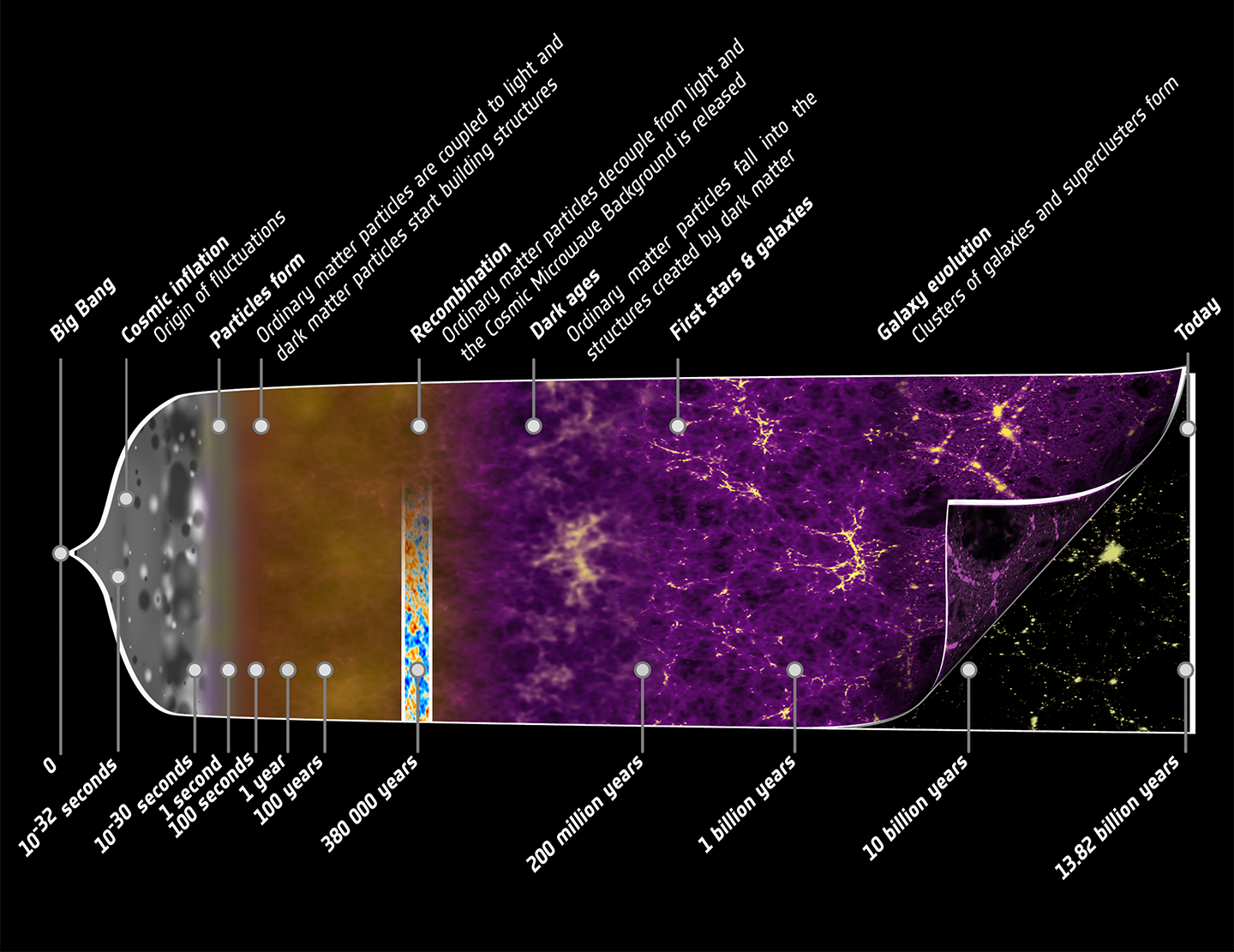
In the tiniest of the tiniest of fractions of a second after the Big Bang, the universe was nothing but a hot, compact ball of energy. Then, it expanded — faster and faster. It grew by a factor of at least 1025 in less than a trillionth of a trillionth of a trillionth of a second. That superfast ballooning is known as inflation.
During this time, tiny variations in the energy density of the universe could have also grown by a lot. In fact, some pockets of the universe may have become so dense that they could have collapsed into black holes.
This is just one way primordial black holes could have formed, some 13.8 billion years ago. Other ideas involve even stranger physics. But all you really need to make a primordial black hole is a large energy density, says Florian Kühnel. He’s a theoretical physicist at the Max Planck Institute for Physics. That’s in Munich, Germany.
If they did form, primordial black holes would have had a much wider range of masses than those seen today. There would have been black holes about the mass of a wildebeest. Others would have had the mass of Mount Everest. Still others would have had roughly the masses of asteroids, planets and stars — or a million stars.
Some of those primordial black holes might be behind the unexpected gravitational wave findings. But the existing evidence is nowhere near clear-cut. There could be other explanations based on known physics.
Hunting with gravitational waves
There are two signs that most scientists agree would point to a primordial black hole.
The first would be a black hole from before the first stars and galaxies formed. Perhaps within the first hundred million years after the Big Bang. In astronomy, looking far away is the same as looking back in time. Here’s why.
Gravitational waves coming from very far away have taken a very long time to reach us. So scientists know that any waves picked up from very far away must have been kicked up a very long time ago. Such waves can tell researchers what was happening in the extremely early universe.
Existing gravitational wave detectors can’t look far enough away — and therefore far enough back in time — to see the cosmos before the first stars. But future detectors might.
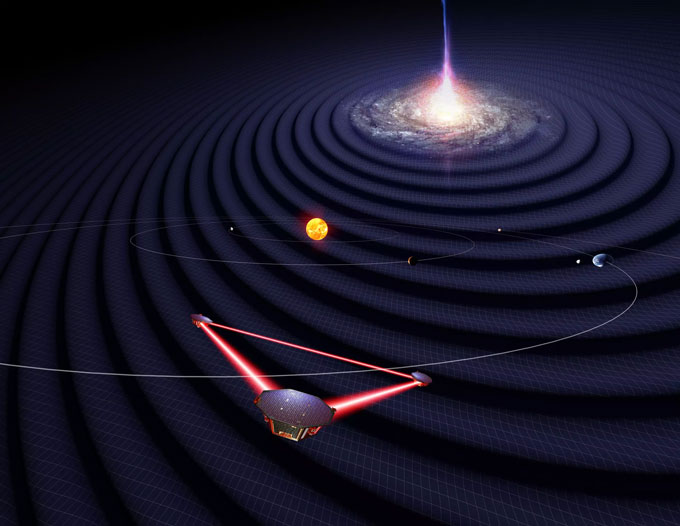
One such detector is the space-based LISA gravitational wave observatory. It’s planned for launch in the 2030s. Two others are the Einstein Telescope and the Cosmic Explorer. Such tools could search the ultra-ancient universe for primordial black holes from before the first stars and galaxies.
The second clear sign of a primordial black hole would be one that weighs about as much as the sun or less. That’s because stellar black holes are believed to form through the collapse of stars several times the mass of the sun.
“If LIGO found a one-solar-mass black hole, then everyone would be convinced primordial black holes are real,” says Earl Bellinger. This stellar astrophysicist works at Yale University in New Haven, Conn. There’s no other agreed-upon way to form a black hole that size, he says. “And if it is less than one solar mass, even better.”
Existing gravitational wave detectors might be able to spot such sun-sized black holes. The Einstein Telescope and the Cosmic Explorer would boost the search.

Black holes inside stars
Gravitational waves might not be the only way to find primordial black holes. Some physicists have wondered what would happen if a small primordial black hole lurked inside a star. That black hole might have an observable effect on the star.
Exactly what that effect might be, though, remains something of a mystery. Scientists don’t know how fast a black hole with a moon- or asteroid-sized mass would feed and grow within a star. It’s unclear if the star’s light could escape the black hole’s gravity.
“The black hole has this all-you-can-eat buffet, which is the stellar plasma. And you might think the star just falls into it, which might happen,” Bellinger says. “But if it falls in almost at an angle, you expect everything around that to get heated up. If it gets heated up, it exerts some pressure and some [light] flows out.”
Bellinger and his colleagues recently looked into several scenarios for stars with black holes inside. Such dark-hearted stars are called Hawking stars.
“The most fun scenario is if the energy does get out,” Bellinger says. In that case, you’d see a type of red giant star known as a red straggler. There are other, non-black hole explanations for the stars’ appearance. But studies of the light signals from these stars over time could distinguish a Hawking star from other red stragglers.
Black holes gone but not forgotten
There might even be a way to find some primordial black holes that no longer exist.
One team recently looked into the formation of primordial black holes slightly after inflation, but still very early in cosmic history. Say, only around 10−20 seconds after the Big Bang. At that time, particles known as quarks and gluons floated freely through the universe. They had not yet bound together to form the protons and neutrons that now make up atoms.
As primordial black holes formed, they would have swallowed up nearby quarks and gluons. In the process, they would have also picked up a quantum property of those particles called color charge.
Big primordial black holes would pick up so much color charge that those charges would likely cancel out. That would leave the big black holes with no overall charge. But that wouldn’t be true for the tiniest black holes. They could be left with some color charge.
Any primordial black holes small enough to have color charge would be long gone by now. As black holes leak energy into space, they lose mass. So they eventually evaporate. But puny, color-charge black holes could have left behind some imprints. For example, they could have affected the ratios of light elements that formed in the early universe.
If signs of past color-charge black holes are found, that would hint that some larger primordial black holes without color charge are still around today. And it is today’s primordial black holes that could solve the dark matter mystery.
Explaining dark matter
Primordial black holes have long been overshadowed by another possible explanation for dark matter. Namely, that some yet unseen particles make up the stuff. But after decades of searching for such particles, scientists are still coming up empty.
Cosmologist Anne Green compares the search for these particles to looking for a needle in a haystack. We’re now most of the way through the haystack with no needle found, says Green, of the University of Nottingham in England. It doesn’t mean the particles aren’t there. But confidence that they’ll be found is starting to dwindle.
That may mean it’s time for primordial black holes to shine.
In one sense, primordial black holes are a less far-fetched explanation for dark matter than mystery particles. At least we know that black holes generally exist. But explaining the formation of black holes so early in the universe requires new physics. Scientists’ typical models of inflation don’t create extreme enough variations in energy density to make black holes.
“If I just write down a model for inflation, it doesn’t produce any black holes at all,” says Will Kinney. “I have to really do some violence to that in order to get it to make black holes.” Kinney is a cosmologist at the University of Buffalo in New York.
Do you have a science question? We can help!
Submit your question here, and we might answer it an upcoming issue of Science News Explores
Accounting for all the dark matter in the universe would also require the right amount of black holes at the right masses. The smallest ones have already evaporated. And there can’t be that many jumbo-sized ones out there. Otherwise, their gravitational tugs on other matter, or the light thrown off in their feeding frenzies, would’ve already given them away.
Most scientists believe that only black holes with asteroid-like masses could explain most of the dark matter. But some scientists argue black holes with masses similar to the sun could do the trick.
“The idea that primordial black holes might contribute to dark matter in some way is not too much of a stretch,” Kinney says. “The fact that the black holes might be all of the dark matter, that’s a tougher sell for me.”
It’s always possible that dark matter isn’t just one thing. It might be a mix of types of things — like ordinary matter is. Some physicists also argue that changes to our understanding of gravity might explain away dark matter.
Even if primordial black holes turn out not to exist, working on them won’t have been for nothing, Clesse says. All the scientists studying primordial black holes are gaining a ton of insights into the early universe.
“It is not useless,” Clesse says. “It is science.”