



Anyone doing math today will use a lot of symbols in addition to numbers. Did you ever wonder why? Or who invented those symbols, such as the signs for plus (+), minus (-), multiply (x) and divide (÷)? Before these came along, how did we even do simple arithmetic?
Although people have been doing math for more than 2,000 years, today’s widely used symbols have been around for less than a couple of centuries. Math-phobes may see those symbols as a trigger for stress. But math experts argue that we should instead see them as helpful friends. And like any friend, every math symbol has its own odd, fun or colorful stories.
The goal of math is to represent absolute truths. Yet the field’s symbols evolved from the personal preferences of a few influential people or teams. “Every math symbol and notation carries with it a unique and often complex history,” says Kate Kitagawa. Now at La Trobe University in Melbourne, Australia, she has studied the history of math.
What’s more, she notes, “Their stories are rarely straightforward. Symbols have been adapted, altered, hidden or even deliberately erased over time.”
That’s something Raúl Rojas knows well. He’s been collecting those origin stories for nearly 30 years. His day job is to teach math and statistics at the University of Nevada, Reno. Learning where math symbols have come from could help students better appreciate them — and math itself, he believes. Yet those backstories have seldom been a part of classroom studies.
Rojas is now on a campaign to change that. He routinely tells his students stories about the symbols they’re using. And for those who aren’t in his classes, he’s set down much of what he’s learned in The Language of Mathematics: The stories behind the symbols.
“The history of language and mathematical notation is filled with chance and serendipity,” Rojas writes. It’s full of people across the globe — and across centuries — trying to solve practical problems. And these thinkers, who transformed math into the efficient language we know today, often had surprising and relatable stories.
Awash in words — about numbers
It might be hard to imagine a time before the plus and minus signs we’re taught in grade school. Yet these symbols are fairly recent additions to mathematicians’ toolbox. The + and – signs first appeared in a German math text back in 1489.
People initially used plus and minus symbols to denote surplus (meaning extra) and shortfall (too few) goods. In other words, they were not intended to add or subtract numbers. But the late 1400s saw a rise of sea trade. And this, perhaps surprisingly, prompted a need for math symbols.
Why? Until then, even expressing simple and numerical calculations was very hard work. People recorded everything longhand, using words even for the numerals.
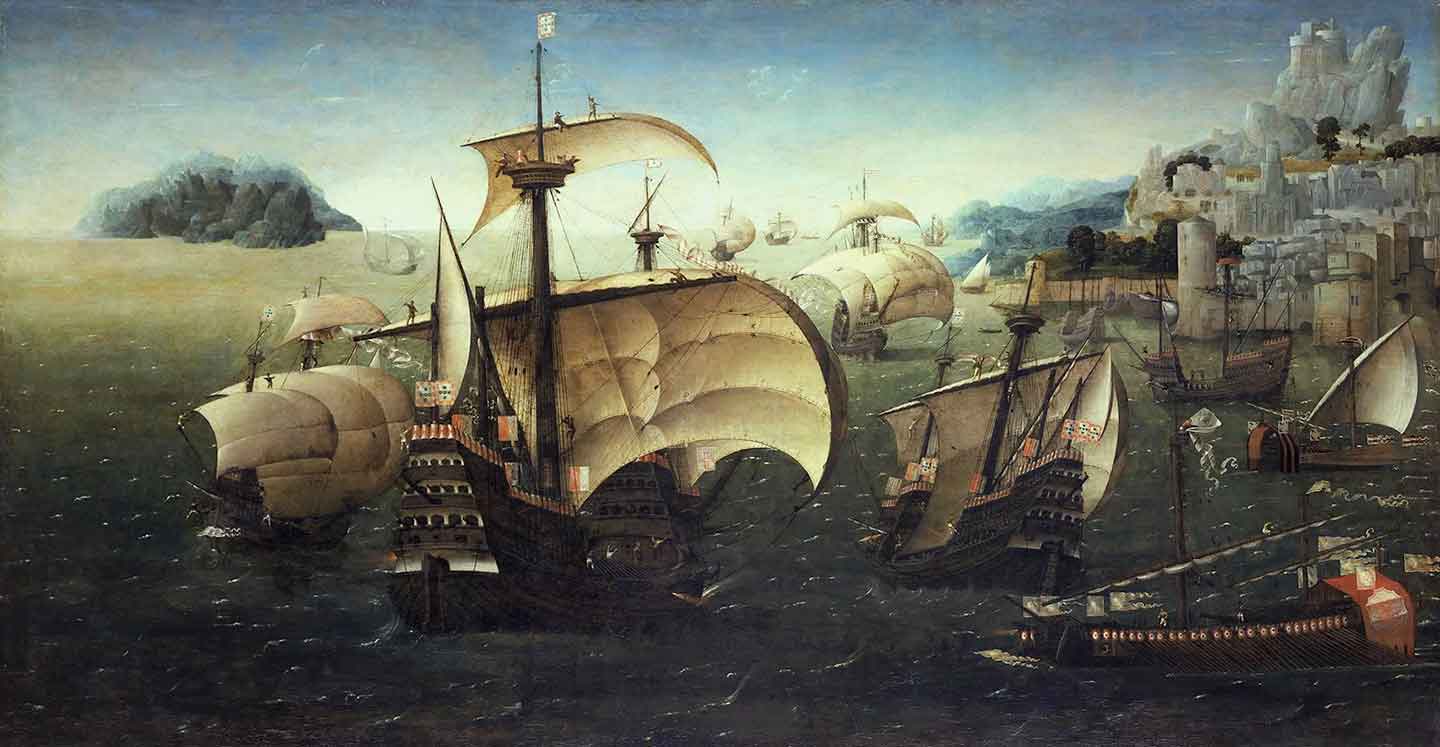
A simple example: Ship one brought in three crates of apples, with each crate equal to forty apples. It also carried two hundred fish: Fifty were flounder, seventy-five were bream, twenty-seven were sharks and forty-eight were anchovies. That equals a shipment of three hundred and twenty items.
With math symbols, this could be shortened to:
Ship 1 (320 items) = (50 flounder) + (75 bream) + (27 sharks) + (48 anchovies) + (3 crates of 40 apples).
The wordy version used 234 characters. The one swapping in some symbols had 83, or 65 percent fewer. In time, that might be shortened further to X = 50f + 75b + 27s + 48a + 3c(40 ap) — a mere 26 characters.
Of course, most ships carried more than apples and four types of fish. And harbor masters had to track what was being carried onto or off of many, many ships. All that required writing lots and lots and lots of words.
It quickly became a burden to record everything using text alone. To save time (and avoid hand cramps), merchants, port masters and tax collectors would soon start using symbols for their bookkeeping, calculating and other accounting steps.
Cross-cultural math
It took even longer for our modern symbols for multiplication and division to emerge.
Rojas tracked the origin of the “x” mark for multiplication back to William Oughtred. This 17th-century English math expert was the first person known to have used it. Later, Oughtred used a colon “:” to stand in for “divided by.” His symbols took off because of a widely popular textbook he wrote in 1631.
Long before Oughtred, though, Arab societies introduced a line to divide two quantities (creating fractions). The 12th-century math expert al-Hassar lived in what is now Morocco. He’s credited with coming up with the horizontal bar for division.
Modern math now uses “÷” to denote division. It’s a mashup of Oughtred’s colon and al-Hassar’s line, notes mathematician Sarah Hart. She works in England at Birkbeck, University of London. Swiss mathematician Johann Rahn first used “÷” in a 1659 book. But it’s not clear whether he came up with the idea or got it from someone else.
“The story of mathematical words and symbols,” Hart says, “is also the story of how mathematical ideas have spread around the world.” As the division symbol illustrates, some of these wordless substitutes for math ideas have evolved over centuries.
Practical algebra
For millennia, math has proven useful in ways both big and small, notes Amir Alexander. A math historian, he works at the University of California, Los Angeles. The ancient Egyptians and Babylonians used math to calculate everything from taxes to the amount of grain in storage. They also used it to figure out how to construct buildings that wouldn’t fall down.
Math learning today, however, often doesn’t feel so practical. “The way people are taught to think about math is that it is separate from our world,” Alexander says. “Most people feel that, beyond pretty elementary math, it’s sort of irrelevant for them.” But it’s really not, he adds.
Take algebra, where symbols represent mathematical relationships that let us work with unknown quantities. In class, you might be handed the equation 7 + a = 10 and asked to solve for a. This might not seem useful for day-to-day life. But algebra — and its symbols — arose as a means to solve important legal and business problems.
Al-Khwarizmi, an Arabic polymath (someone interested in many different things), wrote a book on this back in the ninth century. Ironically, his was not a math book. It was a guide for judges, written using only words. It described such things as how to fairly divide up inheritances into certain proportions.
Think of it as a recipe book. A cookbook might hold instructions to make chicken soup. But once cooks get familiar with this recipe, they might tweak it to prepare beef or goat soup. Likewise, al-Khwarizmi’s book presented a guide to solving everyday problems using algebra. An example might be: “Find a number that, when reduced by three units, becomes two.” His book showed how to get the result. This “recipe” — or algorithm — could then be adjusted to tackle related problems.
Such tools were useful not only for people in law but also those who were selling things. Three centuries later, al-Khwarizmi’s book was translated into Latin — bringing algebra from the Middle East to Europe and beyond. The +, -, x, ÷ and other symbols that we now rely on to perform those algebraic calculations came later.
The epic of pi
As a student, Rojas found it frustrating that he did not know where math’s many apparently odd or random symbols came from.
Consider the constant pi, represented by the symbol π. It is the ratio between a circle’s diameter and circumference, and it equals about 3.14159. In modern times, π is used in complex calculations for astronomy, engineering and physics. But the history of this little symbol reveals it to be far more than just a value to memorize and plug into equations. It was a groundbreaking discovery that was millennia in the making.
It all goes back around 3,600 years ago to the ancient Babylonians and Egyptians and their practical math. The people at that time needed to survey land. To do that, they had to find the area of a circular field. In doing so, they realized that the ratio between a circle’s diameter and circumference is always the same: roughly 256/81. (The decimal system wasn’t invented yet. But the decimal version of that fraction would be 3.16 — impressively close to the true value of pi.)
The math describing this shows up as “problem 48” in the ancient Rhind papyrus. This 5.2-meter (17-foot) long manuscript from ancient Egypt is now housed in the British Museum in London.

More than 1,000 years later, a Greek mathematician and scientist named Archimedes used geometry to calculate the true value of pi. In his honor, pi was nicknamed the “Archimedes constant.”
Later math experts challenged themselves to further refine the value of pi. Notably, the Indian math genius Srinivasa Ramanujan (who died in 1920) proposed a formula to calculate the exact first nine digits of pi. Ramanujan credited a Hindu goddess for appearing to him in a dream and revealing to him the exact value of pi, says Rojas.
While mathematicians raced to compute pi, Welsh mathematician William Jones is thought to have first used the symbol π for the Archimedes constant in the early 1700s. It is commonly believed he may have chosen this symbol since it is the first letter of the Greek word periphery — or perimeter (as in circumference).
“These tangential stories are a great way to bring [math] alive,” says Alex Bellos, a math and science writer based in the United Kingdom.
Math stories are human stories
Rojas stumbled across many stories with surprising twists and turns while studying the lives of famous math symbol inventors.
Consider the meandering career of Karl Weierstrass, who lived in the 1800s. His domineering father sent him to study law and finance at two universities. However, the young man preferred partying. He also showed an interest in science.
Much to his father’s displeasure, Weierstrass dropped out of law school. Later, he entered yet another university — this time to study math. This degree did not yield him good job prospects, though, so the young man became a high-school math teacher.
“He had no money,” says Rojas, “but he had a lot of good ideas.” In short order, Weierstrass started doing proofs. (These are the solutions to challenging math problems.) He even developed a new mathematical theory.
Do you have a science question? We can help!
Submit your question here, and we might answer it an upcoming issue of Science News Explores
When a leading math journal published his work, other well-known mathematicians took notice. It led to the 41-year-old Weierstrass getting a job as math professor at the University of Berlin in Germany. Despite a late start to the career he wanted, Weierstrass would still spend decades advancing his field.
In fact, he’s credited with developing the absolute value symbol. It’s a pair of vertical lines enclosing a number. In math class, calculating the absolute value gives you the distance of one number from another on the number line. For instance, the distance from negative four to zero on the number line would be four. With symbols, this is written as |-4| = 4.
But lurking behind that simple symbol is a fable, showing that even math giants can start out as partying late-bloomers. Knowing people’s stories can make math less intimidating. “We should treat math as part of human heritage, not just science,” says Bellos.
Math is alive
Once math symbols became widely used, Rojas has found, they triggered a surprising turn of events. Mathematicians increasingly lost interest in using words.
Born in 1858, the Italian Giuseppe Peano became known as a father of symbolic logic. He became “one of the first who tried to write math without words,” notes Rojas. The reason: Peano wanted to make math more accessible — to break down any language barrier.
After seeing Peano’s efforts, math experts in the United Kingdom decided to try the same. But there was an irony to this budding trend. Even math experts found it hard to follow work that was heavily riddled with symbols. Like a foreign language, those symbols could obscure meaning.
Peano still went on to a successful and impactful career in math. But Rojas notes that the early 1910s was the last time people tried writing all math “with only symbols.” Nowadays, they blend symbol-filled equations with words describing their thoughts.
But there’s no doubt that the symbols mathematicians have devised over millennia are valuable tools. Rojas hopes that if people understand where they came from, math won’t seem so abstract.
“I find it deeply fascinating to witness how what once began as culturally specific practices have transformed into a universal language we now call mathematics,” says Kitagawa. “Yet the journey is far from complete. There remain endless possibilities for how we might represent the mathematical principles that shape our world.”
Math symbols will surely continue to evolve as mathematicians share ideas around the world and tackle great mysteries — that may take centuries yet to solve.