


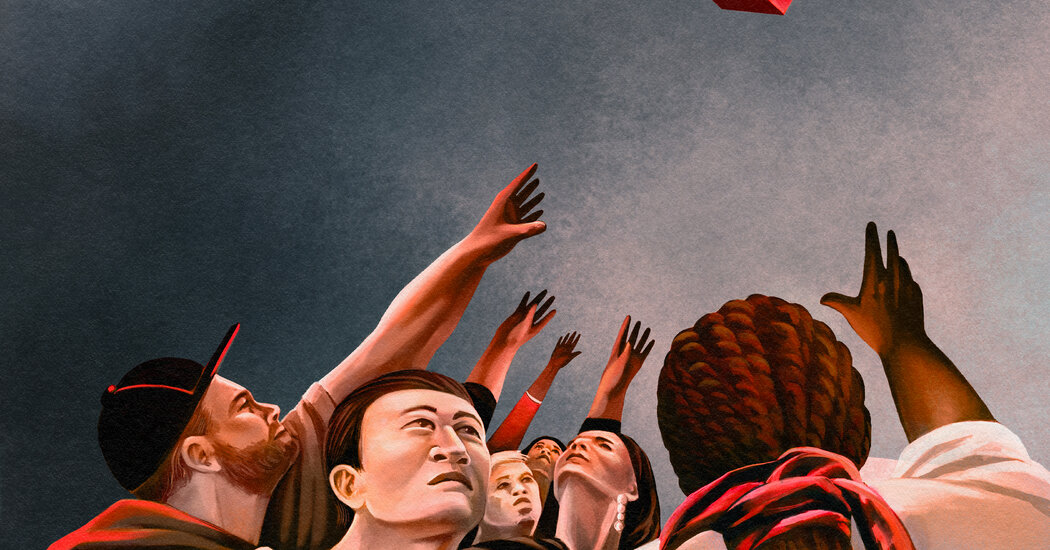
I have covered economics for 11 years now, and in that time, I have come to the realization that I am a statistic. Every time I make a major life choice, I promptly watch it become the thing that everyone is doing that year.
I started college in 2009, in the era of all-time-high matriculation rates. When I moved to a big coastal city after graduation, so did a huge crowd of people: It was the age of millennial urbanization. When I lived in a walk-in closet so that I could pay off my student loans (“The yellow paint makes it cheerful!”, Craigslist promised), student debt had recently overtaken auto loans and credit cards as the biggest source of borrowing outside of housing in America.
My partner and I bought a house in 2021, along with (seemingly and actually) a huge chunk of the rest of the country. We married in 2022, the year of many, many weddings. The list goes on.
I am no simple crowd follower. What I am is 32, about to be 33 in a few weeks.
And there are so many of us.
If demographics are destiny, the demographic born in 1990 and 1991 was destined to compete for housing, jobs and other resources. Those two birth years, the people set to turn 33 and 34 in 2024, make up the peak of America’s population.
As the biggest part of the biggest generation, this hyper-specific age group — call us what you will, but I like “peak millennials” — has moved through the economy like a person squeezing into a too-small sweater. At every life stage, it has stretched a system that was often too small to accommodate it, leaving it somewhat flabby and misshapen in its wake. My cohort has an outsized amount of economic power, but that has sometimes made life harder for us.
When millennials gripe that they get blamed for everything, in other words, the accusers might be onto something.
Meet the Peak Millennial
The 1990 and 1991 babies’ influence in the consumer economy has often been overt.
While it is difficult to pinpoint the spending habits of just two birth years, this group makes up a sizable chunk — about 13 percent — of the generation that marketers have been trying to woo for more than a decade. Millennial vacationing and dining-out habits caused research firms to endlessly tout the rise of the “experience economy.” We’ve been accused of killing McMansions and formal dress codes, but we helped to fuel the rise of tiny homes and athleisure.
“There are a lot of them — their parents may have said they’re very special, but there were a lot of these very special babies,” said Neil Howe, who coined the term “millennial.” “They create a lot of pressure. Whatever they are buying, a lot of people are buying it.”
That economic influence extends well beyond day-to-day consumption. When peak millennials went to college in 2009, the enrollment spike was so significant that community colleges that had once prided themselves on welcoming all students started to turn away applicants.
When that group began to graduate and moved for jobs, the population of metro areas like New York City, San Antonio and San Francisco jumped to new highs, leading to a fierce contest for a limited supply of apartments in some places — the Bay Area in particular.
That re-urbanization boom came “when those millennials were coming of age, getting their first jobs, looking for housing, looking for roommates,” said Igor Popov, chief economist at Apartment List.
Now, the people who will turn 33 and 34 this year are at another crucial juncture in their financial lives: They are leaving cities, starting families, and buying houses. And while some of those changes have been sped up by the pandemic, the demographics alone help to explain why today’s economy is performing in often surprising ways.
Housing Shift
In 2017, a real-estate mogul birthed a meme when he suggested that millennials were failing to buy homes because they were squandering their money on avocado toast and fancy coffee. Outrage ensued. The New York Times published a fact check.
But like many a flip statement that strikes a deep societal nerve, the toast comment took off for a reason. People really were wondering why millennials weren’t buying houses in greater numbers.
Much of the answer was unquestionably that the generation had just experienced a grueling entry into the labor market in the aftermath of the worst recession since the Great Depression. But at least a small part was likely simpler. While we often talk about millennials as one monolithic group, the biggest part of the generation — peak millennial — was still in its mid-20s in 2016 and 2017. That’s on the young side for homeownership.
Today’s population of 30- to 34-year-olds is about 700,000 people larger than the group between ages 35 and 39.
Now, those people are increasingly ready to buy.
Millennials snapped up houses in 2020 and in 2021 as the Federal Reserve cut interest rates to near-zero. That was partly about the pandemic: People wanted space amid lockdowns. But it also reflected that a big group of people were finally far enough along in their economic lives to buy property.
“Just the demographic story is a big one to explain why homeownership went down in the 2010s, bottomed out in 2016, and now we’re seeing this boom in suburban demand that the housing market is grappling with,” said Mr. Popov of Apartment List.
And the wave of millennials now trying to buy could contribute to a topsy-turvy housing market for years to come.
The median age for first-time home buying is typically in the mid-30s, according to the National Association of Realtors. Peak millennials are only now approaching that age range.
Given the sheer generational numbers, “the demand for entry-level single-family homes should remain high for the rest of the decade,” economists at Fannie Mae noted in a recent analysis.
But hot demographic demand is colliding with very limited housing supply, following years of under-building after the 2009 recession. That has helped to push prices to record levels — where they are hovering even as the Fed tries to slow the economy with higher borrowing costs. And steep prices are combining with elevated mortgage rates to make the market painfully unaffordable, including for the starter homes many peak millennials would love to buy.
College Echoes
Today’s crazy housing market is not the first time 32- and 33-year-olds have found themselves forced to compete with one another for resources — nor will it be the first time they helped to reshape a market with lasting consequences.
The sub-generation faced its first real economic scramble in 2008 and 2009, when they graduated from high school and, in many cases, tried to go to college.
The group made up a huge entering class in its own right, but thanks to the Great Recession, older people with few job opportunities were also flooding into college classrooms to weather the downturn.
Enrollment rates spiked. The population of people in college peaked in 2010, the year after my class matriculated.
“The big strain that the students felt was to get classes and to get resources,” said Robert Kelchen, a professor who studies higher education at the University of Tennessee.
Tuition rates climbed sharply at public schools as state support waned during the downturn, though they also nudged steadily higher at private colleges. The ratio between student debt burdens and starting salaries got worse.
But demand for college seats has begun to reverse as demographic trends pair with a cultural shift away from higher education. Less selective colleges, which couldn’t add seats fast enough in the late 2000s, are now closing and merging.
It’s not just colleges. Another age-old institution could struggle as peak millennials age: wedding venues. The millennial generation’s sheer numbers have managed to prop up demand in the wedding industry even at a time when marriage rates overall have been steadily falling, said Shane McMurray at the Wedding Report.
But a post-lockdown wedding boom from 2022 is already fading, and will likely recede further as my agemates move past top marriage years. Mr. McMurray thinks business will stay steady for some time, but eventually, “it’s going to impact the industry pretty significantly.”
Baby Boom Precedent
Thirty-three-year-olds could also whipsaw the job market.
Throughout much of the 2010s, employers had more entry-level applicants than they knew what to do with. When peak millennials graduated from high school in and around 2009, they were a flood of potential workers pouring into a labor market rocked by recession. The unemployment rate hovered at a near-record 16 percent for 18- and 19-year-olds that year.
The labor market remained weak even when those who went to college began to graduate, and employers had their pick of hires for years on end. Remember the rise of baristas with bachelor’s degrees?
Now, that tide is turning.
The economic backdrop has changed, for one thing. Companies have been clamoring for hires ever since letting workers go at the start of the pandemic. Demographics could be part of that story. A lot of people were born in 2001, albeit not quite as many as the millennial peak, which had helped to keep entry-level employees available. But that early 20s group is mostly in the labor market these days, and noticeably fewer people are now aging into adulthood with each passing year.
The question is whether the drop-off is significant enough for employers and workers to feel it.
If it is, there would be precedent. Economic research has suggested that the Baby Boom generation (which included a peak birth cohort born in the early 1960s) faced a tough entry into the labor market as its members competed for a limited supply of jobs. Generation X, or the so-called “Baby Bust,” was smaller — and experienced better outcomes.
“There seemed to be a real advantage in the labor market to the baby busters,” said Ronald Lee, a demographer at the University of California Berkeley, noting that they saw good wage growth and rapid advancement.
“That might be true for Gen Z-ers as well,” he said.
In fact, late baby boomers offer a template for the way a big sub-generation moves through the economy. They were the largest population group in history until millennials came along, and they were much bigger than the Silent Generation, the group that came before them.
That gap meant that the economy had to stretch out even more rapidly to accommodate boomers when they were hitting their adult years in the early 1980s. And they too entered a challenging economy: Inflation had spiked, so the Fed had raised interest rates to double-digit levels, forcing the economy into a punishing recession right as late baby boomers were looking for jobs.
“The market was flooded,” said Richard Easterlin, an economist at the University of Southern California who is behind a lot of the research into how generation size affects labor outcomes.
Because they were forced to compete in crowded job and housing markets, some peak-birth-year baby boomers have been left with permanent economic scars compared to the rest of their generation: Research suggests that they remain at a heightened risk for homelessness.
So are peak millennials destined for a similar fate?
Silver Lining
Mr. Easterlin thinks that my peers are likely to be better off.
“It is the change in generation size that is important for outcomes, not just the generation size,” Mr. Easterlin told me.
While there are roughly 1.5 boomers for every one person who had been in the generation before, that ratio is more like 1.1 for millennials. It’s as if baby boomers were a giant trying to fit into an extra small sweater, and millennials are a giant squeezing themselves into a large.
It is not that millennials have had a painless ride. Dennis Culhane, a University of Pennsylvania social researcher who has tracked homelessness among baby boomers, noted that millennial homelessness in New York City was high after the 2008 recession, for instance. But since competition isn’t as fierce as it was for younger boomers, the bumpy start should fade with time.
In recent years, millennials do seem to be finding their economic and financial footing.
After high initial unemployment, today’s early-30 adults now work at very high levels, with about 8.1 in 10 holding jobs. Wealth holdings for people under the age of 35 have recently begun to pick up notably, helped along by rising home values and higher stock prices.
And What About Kids?
Still, evidence of a struggle lingers under the surface. Men in the early 30-something group are employed at much lower rates than 30-something men were in previous generations, part of a long-running trend. Debt delinquencies for auto loans and credit cards are picking up sharply for people aged 30 to 39 as student loan repayments restart after a pandemic hiatus and put the generation under financial pressure. And today’s 30-somethings are having historically fewer kids.
While that last one can be chalked up to a wide array of societal factors, people cite financial concerns as one of the top reasons they are not procreating.
That decline in childbearing itself could create big economic changes and challenges ahead — specifically, around 2055, when people my age will be nearing retirement.
If today’s 32-year-olds become a huge wave of retirees when they hit their mid-60s, they will be drawing money out of a retirement system that is poised to have far fewer active taxpayers to support it, assuming today’s demographic trends do not change.
Peak millennials will also be filling up nursing homes with fewer young nurses to staff them, eating at restaurants with fewer servers and cooks to choose from, and in general taxing an economy with far fewer young people to support them.
And that will be a problem not just for the early ’90s kids, but for everyone who follows.
The question is whether fertility trends for the generation turn out to be a permanent state — or just another sign that millennials are doing things later, and that the peak of the generation is still aging into the years when those crucial decisions get made.
On that, I can only tell you what I tell my mother when she wonders (gently, hintingly) if and when she’ll ever be a grandmother.
Thirty-three isn’t all that old in the grand scheme of things. We’ll have to wait and see.