


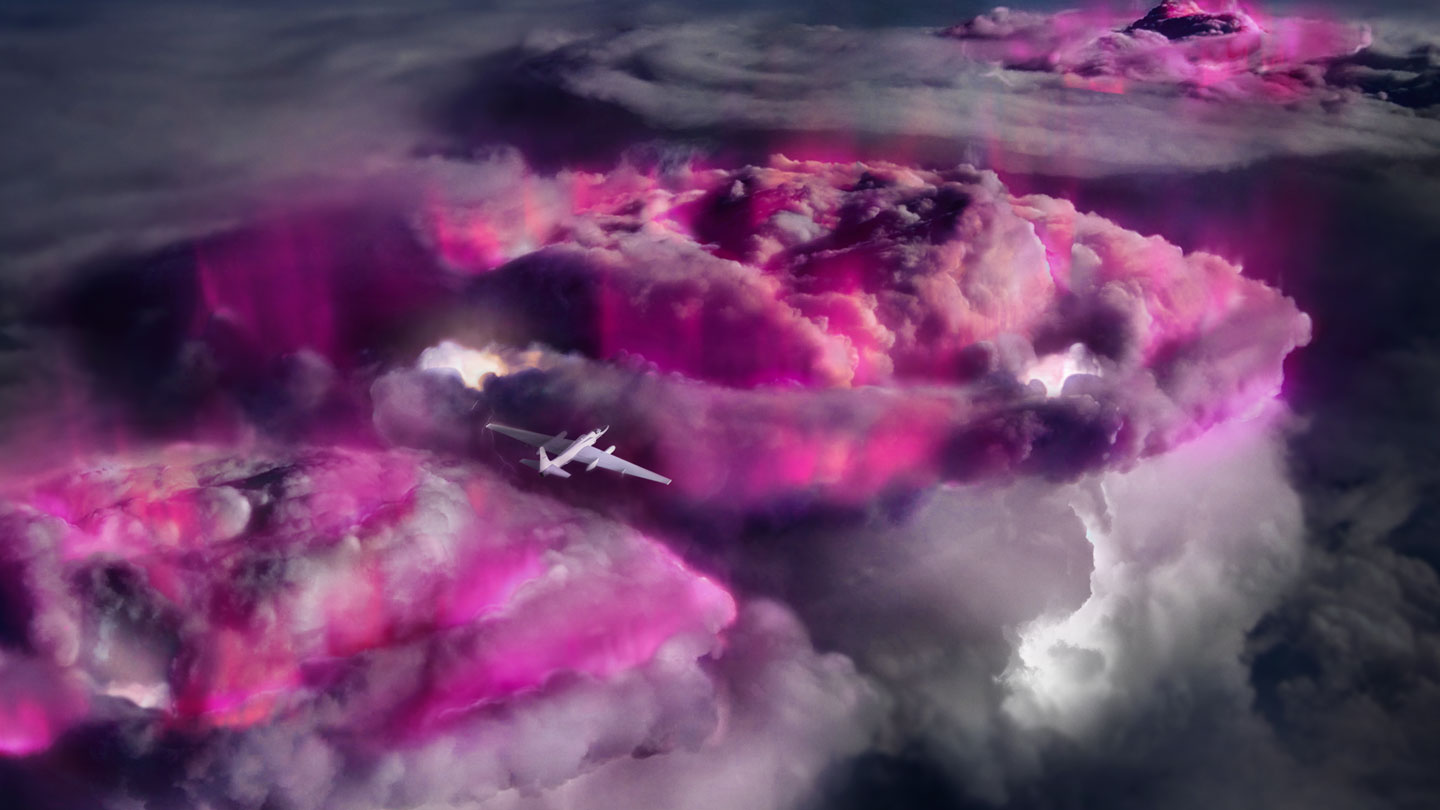
Caribbean: The name of a sea that runs from the Atlantic Ocean in the East to Mexico and Central American nations in the West, and from the southern coasts of Cuba, the Dominican Republic and Puerto Rico down to the northern coasts of Venezuela and Brazil. The term is also used to refer to the culture of nations that border on or are islands in the sea.
cloud: A plume of molecules or particles, such as water droplets, that move under the action of an outside force, such as wind, radiation or water currents. (in atmospheric science) A mass of airborne water droplets and ice crystals that travel as a plume, usually high in Earth’s atmosphere. Its movement is driven by winds.
colleague: Someone who works with another; a co-worker or team member.
data: Facts and/or statistics collected together for analysis but not necessarily organized in a way that gives them meaning. For digital information (the type stored by computers), those data typically are numbers stored in a binary code, portrayed as strings of zeros and ones.
electric field: A region around a charged particle or object within which a force would be exerted on other charged particles or objects.
electrical engineer: An engineer who designs, builds or analyzes electrical equipment.
electron: A negatively charged particle, usually found orbiting the outer regions of an atom; also, the carrier of electricity within solids.
engineer: A person who uses science and math to solve problems. As a verb, to engineer means to design a device, material or process that will solve some problem or unmet need.
field: (in physics) A region in space where certain physical effects operate, such as magnetism (created by a magnetic field), gravity (by a gravitational field), mass (by a Higgs field) or electricity (by an electrical field).
gamma rays: High-energy radiation often generated by processes in and around exploding stars. Gamma rays are the most energetic form of light.
millisecond: A thousandth of a second.
molecule: An electrically neutral group of atoms that represents the smallest possible amount of a chemical compound. Molecules can be made of single types of atoms or of different types. For example, the oxygen in the air is made of two oxygen atoms (O2), but water is made of two hydrogen atoms and one oxygen atom (H2O).
physicist: A scientist who studies the nature and properties of matter and energy.
real time: A term that connotes immediacy; something is being studied, recorded and/or reported at the very time it is happening.
satellite: A moon orbiting a planet or a vehicle or other manufactured object that orbits some celestial body in space.
sensor: A device that picks up information on physical or chemical conditions — such as temperature, barometric pressure, salinity, humidity, pH, light intensity or radiation — and stores or broadcasts that information. Scientists and engineers often rely on sensors to inform them of conditions that may change over time or that exist far from where a researcher can measure them directly.
square: (in geometry) A rectangle with four sides of equal length. (In mathematics) A number multiplied by itself, or the verb meaning to multiply a number by itself. The square of 2 is 4; the square of 10 is 100.
terrestrial: Having to do with planet Earth, especially its land. Terra is Latin for Earth.
terrestrial gamma-ray flash: A brief burst of gamma rays, a high-energy type of radiation, that can be produced in Earth’s atmosphere (usually due to thunderstorms). When equipped with the right cameras or radiation detectors, satellites in low-Earth orbit can record the fleeting bursts of these gamma rays.