


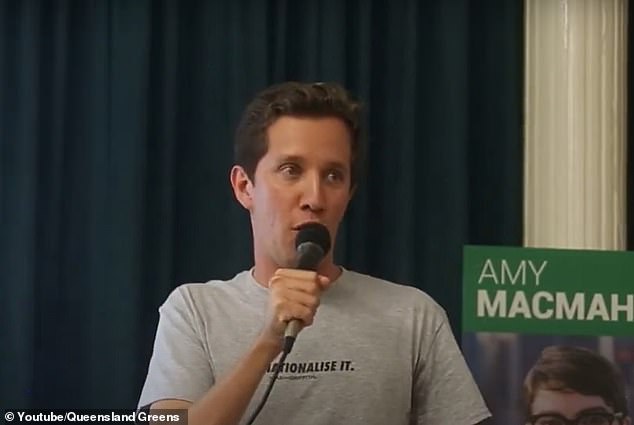
Video has emerged of young Greens federal MP Max Chandler-Mather explaining how the party plans to seize power in Australia by 2040.
The 32-year-old, who has developed a reputation for getting under Prime Minister Anthony Albanese‘s skin, is touted by Canberra insiders as a rising star who could well be head of that future Greens government.
‘He’s a genuine threat,’ one political insider said. ‘Brilliant at what he does.’
A clip has emerged showing Mr Chandler-Mather briefing party members on how they could seize government in the next 15 years – and already his plan is running ahead of schedule.
In video filmed in 2021, before he had even won the seat of Griffith, which he snatched from Labor’s Terri Butler in the 2022 election, acknowledged his plan was ‘a bit crazy’.

Video has emerged of Greens wunderkind Max Chandler-Mather explaining his template for how the party could seize power in Australia by 2040
Mr Chandler-Mather said his electoral plan emerged from what he learnt on the hustings – you get one vote for every three meaningful, genuine conversations you have with constituents.
By that reckoning, if the Greens could have 1,866,216 meaningful conversations with Australian voters, they would get enough votes to seize power.
According to his long-term strategy, the Greens should have won just one extra seat in the 2022 election. Instead they won three, including his own, putting them well ahead of target.
In the 2025 election, with an additional 1,633 volunteers, the goal will be to engage with 130,635 more voters with an anticipated yield of three additional lower house seats giving them six in total.
Over the next five elections, that would then build up to 6,998 volunteers in the 2040 election reaching 559,865 households.

Mr Chandler-Mather has put his money where his mouth is on this plan. He runs a free meal program in his Brisbane community, costing him on up to $24,000 each year
Under the Chandler-Mather plan, the Greens would have nine seats by 2028, building to 15, 23 and 32 at subsequent elections, and then the 45 seats needed to form a minority government in 2040.
By his reckoning, 45 seats would allow the Greens to be the senior party in a coalition with Labor which would have 44.
That revealed the Greens strategy of targeting Labor-voting inner-city electorates with a large proportion of renters who could be enticed to vote for policies such as rent freezes and the provision of more free public housing.
It’s understood seats like Sydney and Grayndler, now held by Environment Minister Tanya Plibersek and Prime Minister Albanese, are already earmarked as future Greens seats once the current big-name Labor incumbents retire.
By 2040, presuming he’s able to hold his Brisbane seat of Griffith, he will be a well-established politician in the prime of his life, just 45 years of age.
He could well be positioned to be party leader by that points, as the Greens current leader Adam Bandt will then be 65.
Daily Mail Australia approached Mr Chandler-Mather about whether his time in office has altered or reinforced his vision for a Greens government by 2040.
‘Labor and the Coalition’s utter failure to represent ordinary people over big corporations makes it entirely possible that the Greens could form government by 2040,’ he said.
In fact, Mr Chandler-Mather said he expects Labor and the Coalition to ‘form an alliance’ in the next 16 years ‘in an attempt to prevent the Greens forming a government’.
‘During my time in parliament it has become clear that when that political establishment feels threatened, they will unite to defend their interests,’ he said.
‘Ultimately that won’t stop the Greens.
‘As long as Labor continues to ignore the Greens calls to cap rents, bring dental into Medicare, tax big corporations, take on the power of the banks and property developers and actually start building affordable housing, and stop serving the interests of coal and gas corporations, then the Greens will continue to grow and eventually form government.’

Mr Chandler-Mather boiled much of the strategy down to a political equation based on his own experience on the hustings
Four-day work week
Among the Green policies which he believes would win votes is the regulation of a four-day working week.
Mr Chandler-Mather’s plan involves getting the radical trade unions to back the plan and push for it at a grassroots level over several years, rather than simply trying to impose it via parliament.
‘Every time it’s been won, it’s been won by powerful unions,’ he says. ‘All across the world.’
‘Something parties have done in the past [around the world] is build large scale community support networks where workers can go and get free food, where they can learn.
‘Are we running free breakfasts and lunches in areas where workers are fighting for a four-day work week, to prove we’ve got their backs?’
Mr Chandler-Mather has taken that initiative, organising a free meal program in his Brisbane community, costing him up to $24,000 each year.
This includes a weekly dinner for homeless people, and breakfasts at local schools. He works alongside charity Foodbank, which is also able to provide some of the basics.

This includes a weekly dinner for homeless people, and breakfasts at local schools. He works alongside charity Foodbank, which is also able to provide some of the basics
More public housing
Just as Mr Chandler-Mather advocated a slow build-up of support for a four-day work week, he believes the same needs to be done in the provision of more government-funded housing.
‘We can think about one pretty major barrier to that,’ he says, identifying the ‘enormous amounts of money’ to be made from private development.
‘The Greens sometimes don’t have fantastic relationships with construction unions, and you can see what would happen if we went about and said ‘okay we’ve won we’re going to build 100,000 public houses’.
‘After two protracted, bitter years of fighting with communities and construction unions and banks and property developers, we ended up losing the next election and it doesn’t really matter anyway,’ he said.
Mr Chandler-Mather said the first practical step to making more public housing is to win consent from the public.
It would be a very popular policy among renters and younger voters yet to get on the property ladder, but less so with those who have paid huge amounts for their homes and do not want to see that value diminished by a flood of free housing.
He proposes bringing the public along by deploying thousands of volunteers in the very areas they plan to build those houses.

The 32-year-old has developed a reputation for getting under Prime Minister Anthony Albanese’s skin and is touted by political insiders as a rising star
‘Talk to those communities, engage in democratic consultation. We know state and federal governments are really trash at consultation, so we take it into our own hands to do it.’
The second step is to ensure residents of newly built public housing aren’t isolated from their communities. He circles back to his tried-and-tested method of public cook-ups and community events.
Welcome day events, ‘come and meet your neighbours’ gathers, community soccer matches and potluck dinners are all solutions he offers to bridge that gap.
Finally, he acknowledges that the banks and developers could still pose a hurdle. To combat this, he says the Greens must develop relationships with workers on the ground.
‘Get to a point where construction workers say, ”well, no, we want to build public housing because at least we can afford to live in it, not the luxury apartments you’re making us build at the moment”,’ he says.
‘That’s winning public housing.’
How it can happen
In addition to his formula, Mr Chandler-Mather says the demographic in Australia is shifting further in the minor party’s favour.
‘What’s occurring in the political system is more people are being cut free from the conservative or Labor party,’ he said.
‘For those who have gone door knocking you experience that in a very material sense when you ask people what they think about politics and they say ”aw mate it’s s**t, I don’t pay attention”. It manifests as disengagement, distrust or anti-politics.’
Australians are increasingly feeling disenfranchised with the major parties, he said, prompting a ‘long form crisis without any resolution’.
Mr Chandler-Mather told the crowd of Greens supporters: ‘There hasn’t been an emergence of a political force that takes all of that disorganised energy in society and organises it into a big political movement.
‘Hopefully, that’s where we come in.’

Mr Chandler-Mather says the demographic in Australia is shifting further in the minor party’s favour
Who he expects to vote for them
Mr Chandler-Mather has a very clear understanding of his base. Young people, and renters.
‘That’s about it,’ he says.
The 32-year-old has mapped the rise of the Greens vote alongside the rate of increase in tenants in Australia. The two are ‘remarkably aligned’.
In the same period, there has been a marked decrease in the amount of Australians who own their own home and are mortgage-free.
‘To the point where if you follow those trends, there’s a crossover in a couple of years,’ he says.
‘This has never happened before in Australian history, that there would be more renters than home owners.’
While home-owners have more incentive to maintain a system which is skewed in their favour, Mr Chandler-Mather notes that renters and young people who feel the system is ‘really badly broken’ are more inclined to seek radical alternatives.
‘We’ve happened upon something that happens so rarely in politics – a strategy that wins, and we need to start winning as quickly as possible.’