


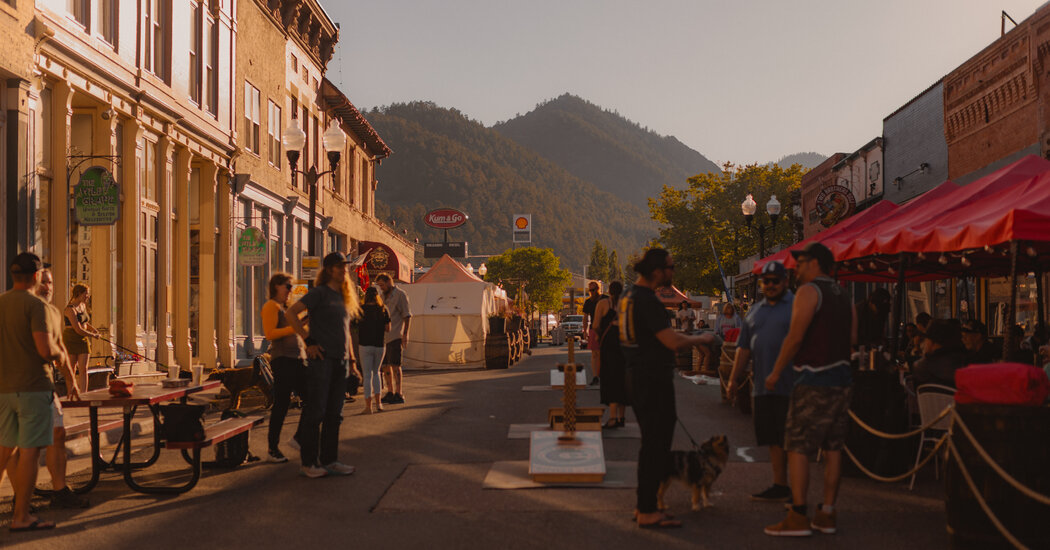
In the recreation-fueled, amenity-rich economy of Colorado’s Rocky Mountain region, there are two peak seasons: summer, with its rafting, hiking, fishing and biking, and the cold months filled with skiing and other winter activities.
And then there is “mud season” — a liminal moment in spring when the alpine environment, slowly then suddenly, begins to thaw and only a trickle of tourists linger.
It’s a period that workers in other places might bemoan. But for much of the financially stretched work force serving the assemblage of idyllic mountain towns across the state, a brief drop-off in business this spring was a respite.
During a slow shift on a 51-degree day at the Blue Stag Saloon — a nook on Main Street in the vacation hub of Breckenridge — Michelle Badger, a veteran server, half-joked with her co-workers that “this winter was hell.”
Crowds were larger than ever. And workers in the old Gold Rush town still enjoy the highs of the easy camaraderie and solid tips that come with service jobs in the area. But it was all sobered by the related headaches of soaring rents and acute understaffing, which left employees, managers and demanding customers feeling strained.
Working in mountain towns like Breckenridge and others in Summit County — including Silverthorne, Dillon and Frisco — would feel like a fairer bargain, Ms. Badger and her colleagues said, if they could better afford living close by.
Long commutes are common throughout America. But rental prices in hamlets among the wilderness on the outskirts of town are becoming burdensome too.
Job growth has severely outpaced the stock of shelter throughout Colorado. Median rent in Frisco — which a decade ago was considered a modest “bedroom community” for commuting employees — is about $4,000 a month, according to Zillow, and 90 percent above the national median. Home buyers buttressed by family money abound.
The wage floor for most jobs in and around the county — from line cook to ski lift operator — is at least $18 an hour, or roughly $37,000 a year. Yet for those not lucky enough to land a rare slot in subsidized local employee housing, it’s not uncommon to live an hour or more away to attain a livable budget.
As that happens, the contingent displaced by the rich ripples outward down rural highway corridors and, in turn, displaces the farther-flung working poor.
Inequality has always been rampant within the orbit of popular destinations. But the financial knock-on effects of those ritzy spheres have expanded as the pandemic-induced surge in remote work has supercharged divides.
Wanderlust-filled white-collar workers abruptly discovered that multiweek visits or even permanent relocations were possible for them and their families. Those seeking investment properties saw the opportunities of this hybrid-driven land rush as well, and pounced.
Longtime residents have had a front-row seat.
Matt Scheer — a 48-year-old musician who grew up on a ranch eastward in El Paso County, where “as soon as we could carry the milk bucket we were milking the cow” — is the sort of extroverted jack-of-all-trades who typifies the spirit (and the wistful brand) of Summit County.
Having moved near Breckenridge in the early 2000s to ski, hike, fly fish and work around town, he’s relieved that he managed to pick up his place in 2012 for $240,000 with a fixed-rate mortgage. Prices in his tucked-away French Creek neighborhood — a hilly, unincorporated patch with modest double-wide manufactured homes — have more than tripled.
Though he’s a loyal resident with little interest in ever moving, Mr. Scheer said he “can’t really leave.”
For a payout of tens of thousands of dollars from the local government, he recently signed onto a hefty “deed restriction” for his property, banning its use for Airbnb stays, limiting any potential renter or buyer to the work force of Summit, and limiting any potential resale price. And he did it with pride.
It’s part of a growing program led by Breckenridge and other local governments to limit gentrification without licensing a large buildup of new developments. (Deed restrictions in destination areas got off to a quieter start in the 2010s but have ticked up.)
Incumbent property owners willing to sacrifice lucrative short-term vacation rental income see it as a fair trade-off, key to keeping long-term residents and the dashing contours of their towns’ terrain. Policy critics, and frustrated local renters fighting over limited spots, say it is an inadequate tool for the scale and source of the problem: a lack of units.
Those critics include the governor of Colorado, Jared Polis, who is skeptical that lump-sum payments to owners in exchange for deed restrictions will be a sufficient incentive to broadly move the needle on affordability.
“There is no silver bullet,” he said in an interview. “But one of the areas that we have focused on is removing the barriers to additional home construction.” He added that “housing is not a problem that you can solve by throwing more money at the existing housing stock.”
His sweeping legislation to ensure “a home for every Colorado budget” by pre-empting local land-use laws and directly loosening zoning rules statewide died in the State Senate in May, after some initial momentum. All but one of the mayors in the state’s Metro Mayors Caucus issued a letter opposing the plan.
‘It’s Either Five Mil or Five Jobs’
As politicians jockey, many resourceful Coloradans find ways to make do.
Mr. Scheer, for instance, has picked up over 30 music gigs through the end of summer, paying about $100 an hour — though he acknowledges it’s his locked-in, lower housing costs that make his lifestyle workable.
During a practice jam session and impromptu afternoon party of 20- to 40-somethings at Mr. Scheer’s place in the spring, his pal and fellow guitarist, Bud Hallock (the other half of their occasional duo band, Know Good People), explained the grind people face by echoing the playfully hard-nosed aphorism uttered around town: “It’s either five mil or five jobs.”
“If you’re willing to put in the work, you’ll be able to,” argues Mr. Hallock, who moved out West shortly after graduating from St. Lawrence University in 2015. Mr. Hallock has three jobs, he said, adding, “I don’t think it’s the God-given right of anyone to come to a ski town and have it easy.”
For many longtime residents and transplants alike, it has become harder to finesse: Even as Summit County adds waves of remote workers, it has experienced net negative migration since 2020. It’s a trend mirrored in the larger urban areas of Denver and Boulder, where the share of people working remotely is among the highest in the country, as homelessness rises.
Tamara Pogue, a member of Summit County’s governing board, said the mountain towns and valley cities of the Front Range near Fort Collins and Colorado Springs as well as those out by the Western Slope struggled with an “affordability issue” similar to the nation’s big cities for the same reason: “We’re supply-constrained.”
“The problem is the average cost of a single-family home in Summit County so far this year is $2.14 million,” Ms. Pogue said. “Not one job makes that affordable.”
The stock available is limited: 70 percent of homes in the county are second homes that sit vacant most of the year or serve as short-term rentals, she said, typically Airbnbs.
As a single mother of three, Ms. Pogue bought a 1,400-square-foot duplex for $525,000 in 2018 — a rarity, if not an impossibility, now. She said a determination to prevent “mountain communities” from becoming “towns without townspeople” had driven her to become a staunch YIMBY, or a “yes in my backyard” supporter of home-building efforts, against the wishes of perceived NIMBYs, or the “not in my backyard” voices.
Ms. Pogue and her allies argue that the relatively slow pace of building in the Rockies, despite the area’s popularity and rising prices, is a subtle form of denial.
“Everyone wants to be here, whether they work here or not,” she added, “and so we have this spiral.”
If, When, Where and How to Build More
A few affordable-housing projects visibly chug along in Summit near the airport service road, not far from Kingdom Park Court, one of a handful of mobile home parks in the county with pricey lot rents. But getting middle-income developments greenlit can be a slog. Many proponents of limiting development note that about 80 percent of the county is restricted federal public land, putting a ceiling on what can be done. (There’s a nascent pilot program with the U.S. Forest Service to approve some apartments on leased land.) In the meantime, the well-off are gobbling up much of what’s left.
Just north of downtown Silverthorne sits Summit Sky Ranch — a sprawling development with homes starting around $1 million, with a pledge of “bringing modern mountain living to over 400 acres of pristine natural beauty” in the valley. It quickly sold out and many have moved in, lured by a private observatory and private access to a river bend.
Laurie Best, the longtime planning manager for housing in the community development department for the Town of Breckenridge, said she had emphasized deed-restriction policies and more generally trying to preserve existing units to reduce the need for new ones.
Ms. Best and her backers have acceded to some construction at a slow and steady pace, but they staunchly oppose taller, dense multifamily buildings, which are not, as she put it, “consistent with the character of the town.”
Eric Budd, a leader of a movement in Colorado called Bedrooms Are for People — which favors expanding land use and more widely permitting apartments, duplexes and triplexes — scoffs at the uptick in easements. He contends that what he tartly calls a “xenophobic attitude of ‘there’s only so much to go around’” is self-defeating.
Trying to restrict access to a hot commodity — in this case, half of a state — won’t end well for anyone, he said, and a California-level, cost-of-living crisis is only five or 10 years away.
Down in the foothills of the Rockies in Boulder, where Mr. Budd lives, school enrollment and the overall population have declined along with affordability, as remote-worker migration has picked up.
In some sense, the arguments against restrictionism amount to a water-balloon analogy: squeezing leads to odd bulges in random places.
Before the pandemic, Leadville, an old mining town 15 minutes from the trailhead of the highest peak in the Rockies, was an affordable harbor for working-class Hispanic employees of the nearby vacation economies: just out of reach of the affluence around Aspen to the west and resorts near Vail to the north.
Since 2020, though, Leadville has become engulfed as those realms of wealth expand and overlap, causing rents and home prices to spike beyond what many can feasibly afford over time, with few other places to go.
Second-home owners constituted half of all home sales in 2020 and 2021.
The Downside of Good Intentions
Half of Colorado renters are officially defined as cost-burdened — spending more than 30 percent of their income on housing costs. And local economists suggest that the rate has ticked even higher in mountain locales.
For Kimberly Kreissig, a real estate agent in Steamboat Springs, a year-round recreation hub with natural hot springs near Wyoming, the affordability crisis in “the high country” has no simple villain. For years, her practice in Steamboat — where the average home price is above $1 million, compared with $580,000 in early 2019 — included both upper-middle-class, first-time home buyers and luxury-market sellers.
In 2018, she and her husband, a developer, broke ground on a dense, 50-unit multifamily project in Steamboat designed for people “in that $75,000 range,” she said — “for instance, my office manager here.”
“We had grandiose plans that we were going to be able to sell these things for $300,000,” Ms. Kreissig said, but they were foiled by several factors.
Even before Covid-19 struck, “the demand was just so through the roof that people were offering us more than list price right out of the chutes,” she said, with precontract bids coming in “twice as high as we anticipated.”
Then, once lockdowns in early 2020 ended, the remote-working cohort swooped in — just as labor and material costs shot up for the contractors still finishing some units. Before long, many families she sold units to in 2019 for around $400,000 realized that because of the housing boom they had “over $300,000 in equity” in their homes — and with interest rates so low, they could parlay a different (or additional) purchase. Many apartment owners began independently flipping their units to investors and buyers of second homes who were willing to pay well above the list prices.
“One flip near the end for one of the units was for $800,000,” Ms. Kreissig said. “We tried to be the good guys.”
One way to respond to house flippers is through greater deed restriction, which Steamboat has enforced in a few neighborhoods, along with some short-term rental restrictions, not unlike other hot spots. The area has also benefited from the state’s Middle Income Housing Authority pilot program, which has put up a few buildings in town. But Steamboat still has a shortage of 1,400 units, according to a report from local authorities.
A big break came when an anonymous donor recently purchased a 534-acre farm property, Brown Ranch, and turned it over to the Yampa Valley Housing Authority, with instructions that it be used for long-term affordable housing for local workers.
It came as welcome news to the area’s middle class. And yet the sheer surprise, and luck, of the donation is indicative of broader, underlying tensions that typically drive community-level and state debates: Is more supply a threat to both cultural vibes and property price appreciation, or a win-win opportunity to flourish?
Ms. Kreissig thinks it all comes back to “the kind of ‘not in my backyard’ mentality” that a silent majority holds.
“For the people that are already ‘in,’ there’s a fair share of folks that are saying, ‘You know, ‘I’m in, we don’t we don’t need any more growth,’” she said. “But you can’t stop growth.”
Adrift Between Uphill and Down
In March 2020, Nancy Leatham, 34, was making just above the minimum wage, living with her husband and their baby daughter in Idaho Springs — a little city above 7,000 feet wedged between a steep crag and an I-70 exit, far downhill from chic resort land.
They struggled to get by “right during the height of the pandemic, when everything was shut down,” wiping out their income, she said. It felt like a repeat of her teenage years during the mortgage-induced financial crisis when her family’s business as excavation contractors — preparing sites for home construction — went belly-up, and their house was foreclosed upon.
In spring 2020, “I had to start going to food banks and stuff to get food,” she said. “And we had to sell a car, and just stuff like that to, like, to make ends meet.”
By 2021, her husband, Austin, had found a job at Walmart making $19 an hour, while she was promoted at Starbucks, becoming a manager at $18 an hour, plus bonus — and “we had our child tax credit,” she added.
“I started looking for a house because we had really great income,” roughly $80,000 before taxes, she said. “I grew up in poverty, since 2008 especially, and we’d been living with food insecurity and stuff, so I was like ‘Look at us, we made it!’”
But almost as soon as she started house hunting, she realized that, within months, the booming housing market had far outpaced the good labor market. They had been priced out of their sleepy, snowy town, after merely a few bidding wars. The average home price — $340,000 at the start of 2019 — is up 66 percent. Higher mortgage rates hurt, too.
Many of the Starbucks employees Ms. Leatham managed owned their homes rather than rented, she said, and “half left because they were able to sell their house off for considerably more than they were when they bought.”
Hoping to buy or rent something bigger than what she called a “closet” apartment, Ms. Leatham, who now has a second child, is preparing for the cold reality of “having to move downhill” — though where exactly is unclear: 15 miles down the corridor, renters and buyers run into coveted areas near Golden and Denver.
Recently, a woman visited the Starbucks Ms. Leatham works at, she said, and was dressed very much like an out-of-towner. They chit-chatted at the register, and the woman mentioned she was in town to check on a recent property purchase.
Getting her hopes up for a nicer place, Ms. Leatham pried a bit:
“I was like, ‘Oh, nice, what are you going to do with it?’ And she’s like, ‘Oh, it’s for rental.’”
“And I’m like, ‘Oh, cool.’ And then she goes, ‘Short-term rental.’”
“And then, I went ‘Dang it!’ But really loud, and I made her feel awful — I didn’t mean to make her feel that way.”
Irresistible Allure, Harsh Reality
Back up the I-70 corridor in Frisco, a sprawling Walmart parking lot often occupied by unhoused people living out of their cars and campers is tucked in front of a commercial complex with a high-end furniture store, a Whole Foods and a craft microbrewery.
It’s one of the few places for the growing homeless population to go, since overnight parking is widely banned in Summit County, even in sparse hamlets like Blue River, perched just beyond Breckenridge above 10,000 feet.
The effects of the global and national wealth parked in the Rockies often cascade downstream like the snow melt that carves the rivers. But it’s a force that can be identified in any direction.
For many, if not most, homeowners in high-country counties like Summit, the hard truth is that only so much can be done if the very idea of mountain living — experiencing nature, removed from the bustling downhill hassles of the outside world — is to be maintained.
“It’s funny, on our little block, there’s probably, you know, 10 homes — and on a beautiful day, which we have a lot of, you’ll see all of us standing out in our driveway, taking pictures,” said Ms. Best of Breckenridge’s community development department. “I must have the same picture 100 times because it’s so stunning when you go out there, and you’re still in awe of where we live. So I totally get the folks that want to be here.”