


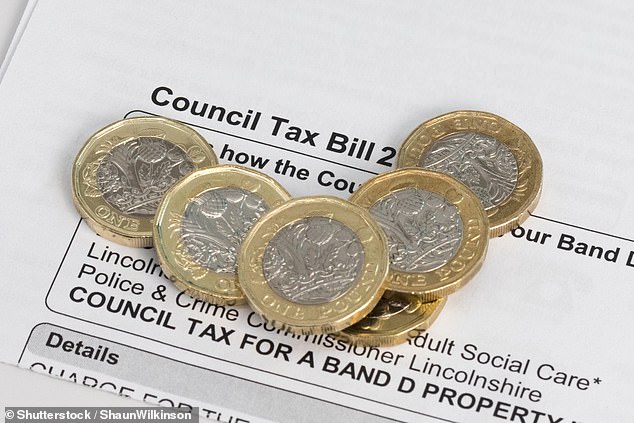
Millions of households will pay more council tax from April after the Government gave the green light to some councils to increase rates by as much as 9 per cent.
Last week, six councils were allowed to increase council tax above the usual 5 per cent threshold, putting more of a burden onto households.
This includes Bradford with a 9.9 per cent rise and 8.9 per cent in both Newham and Windsor & Maidenhead. Birmingham is set for a 7.5 per cent rise.
In response, some taxpayers have taken to social media to say that they plan to withhold council tax payments.
While some households may be exempt from paying council tax, those without a good reason are taking a significant risk.
We explain what happens if you stop paying your council tax and how you can slash your bill to keep your costs down.
Price hikes: Millions of households will pay more in their council tax from April
Why is council tax increasing?
The Government re-committed to keeping the 5 per cent cap on council tax rises, but in some areas where local budgets are stretched they can be permitted to increase it even more.
For example, Birmingham City Council approved a 21 per cent increase in council tax over the next two years, after the local authority effectively declared itself bankrupt.
In total, six areas will increase their council tax bills by more than 5 per cent while others can hike prices by up to that threshold, meaning millions will have to pay more from April.
Local authorities can start to claw back some of their lost revenue but it means some households will, in some cases, see their bills increase by hundreds of pounds.
What happens if you don’t pay council tax
Some taxpayers have expressed their anger with the planned tax increases and the Government’s plans to postpone local elections in some parts of England.
In protest, they claim to have cancelled direct debits to their councils, while others say they are planning a ‘council tax strike’.
However, taxpayers who choose to withhold council tax risk serious consequences, including in some cases a prison sentence.
Various reports suggest around 100 people a year go to prison for failure to pay council tax.
Councils say that you are legally obliged to pay the tax even if you’re unhappy with some or all of the services.
Council tax is a tax on the occupation or ownership of property and only partly funds council services, so you cannot withhold payment or claim a refund over frustration with council services.
Councils can take action to recover payments and as a result, those who do not pay may have to pay additional costs.
In extreme cases, this could lead to a prison sentence or forced sale of your home.
The Local Government Finance Act 1992 imposes a legal duty to local authorities to collect council tax.
Taxpayers who ask for evidence of a contract between them and the local authority should note that there is no requirement for this in the Act, according to guidelines by Oldham Council.
Similarly, any complaints about a local authority holding data under GDPR should also note that councils do not require the consent to process data that is necessary for the performance of a task carried out in the public interest.
What if you can’t afford council tax increases?
If you are worried about higher bills in April, there are some ways to cut your bill or even receive a refund, especially if your circumstances have changed.
Low-income households can apply for a reduction to their bill by visiting the gov.uk website.
You could see a reduction of up to 100 per cent if you are on a low income or claim benefits, but this will depend on where you live.
Attendance Allowance, Disability Living Allowance, Carer’s Allowance and Personal Independence Payments could all increase the size of the reduction.
All local authorities also have a Section 13A scheme through which anyone can make a request for their council tax to be reduced or written off.
While anyone can apply, you will have to prove you are in financial hardship and all other avenues to reduce the bill have been explored.
You might also qualify for the disabled band reduction scheme, which is for people who live in larger properties than they would do if they or another occupant were not disabled.
The bill will be reduced to the next lowest council tax band, and if you are in the lowest band (Band A) you will receive a 17 per cent discount on your council tax bill instead.
If you live alone, you are eligible for the 25 per cent single person discount and you might qualify even if there are other adults living in your home who are ‘disregarded’ for council tax purposes.
Finally, you could choose to challenge your council tax band but there is a risk that it could revalue your property to be even more expensive which would mean higher bills.
Who’s exempt from council tax?
You do not have to pay council tax for those under 18 or those over 18 in certain apprentice schemes or a full-time student.
Student nurses and foreign language assistants registered with the British Council are also ‘disregarded’ when it comes to working out how many people live in a property, as are diplomats.
Someone who is severely mentally impaired, or a carer for someone who isn’t your partner, spouse or child under 18, will also not have to pay council tax.
SAVE MONEY, MAKE MONEY
£100 Isa cashback
£100 Isa cashback
Open a new stocks & shares Isa with £10k
Fix energy bills
Fix energy bills
Find out if you can save with our partner uSwitch
5.03% cash Isa
5.03% cash Isa
Get 5.03% with our code TIM

4.82% cash Isa
4.82% cash Isa
Cash Isa and money management

Sipp cashback
Sipp cashback
Up to £3,000 when you open a Sipp by 28 Feb
Affiliate links: If you take out a product This is Money may earn a commission. These deals are chosen by our editorial team, as we think they are worth highlighting. This does not affect our editorial independence. Terms and conditions apply on all offers.
Some links in this article may be affiliate links. If you click on them we may earn a small commission. That helps us fund This Is Money, and keep it free to use. We do not write articles to promote products. We do not allow any commercial relationship to affect our editorial independence.